
Executive Summary
Ensuring that AI is safe and empowers American workers must be a top priority for US policymakers. But the discussion about AI safety should not be influenced by geopolitical rivals, especially China, which aims to accelerate AI development “to gain the initiative in global science and technology competition.” Depending on the advances made in this field, there may come a time when the United States and China must engage in bilateral negotiations to ensure safe AI development. But until then, an honest conversation about AI safety requires filtering any foreign influence.
The same logic applies to debates surrounding AI data centers. AI data centers have become a lightning rod in policy conversations across all levels of government. American citizens have legitimate concerns about water use, energy costs, and grid capacity, concerns that deserve serious local deliberation. But local deliberation works only when the public can see who is bankrolling and influencing the campaigns shaping the debate. This report aims to provide that transparency to equip citizens and lawmakers alike with the information they need to make informed policy decisions on AI and other emerging technologies.
What emerges from our research is a disturbing trend: international actors are working through state media organizations, nonprofit networks, and dark money groups to shape US policy and public opinion on artificial intelligence. The campaign against American AI is being waged across three vectors of foreign influence:
Foreign state media. Beijing’s English-language outlets — CGTN, China Daily, and Global Times — together with Russia’s RT have run attributed campaigns directly targeting US AI data centers and US export controls while the Chinese state simultaneously subsidizes its own AI buildout.
The CCP-aligned Singham network. A US 501(c)(3) ecosystem funded by Shanghai-based US expatriate Neville Roy Singham, who is currently under congressional inquiry for his reported ties to the CCP, has openly collaborated with China’s official state media organs and spent nearly five years producing parallel domestic content opposing US AI infrastructure, AI labs, and AI export controls.
Foreign-billionaire funding. Multiple foreign-tied charitable vehicles, including those of Swiss billionaire Hansjörg Wyss and British billionaire Alan Parker’s Oak Foundation, have funneled more than $2 billion into US 501(c)(3) and 501(c)(4) advocacy infrastructure. A significant portion of that money now flows directly into the organizations driving the anti-data-center campaign.
This extensive, multiyear foreign influence campaign has been taking place against the backdrop of mounting tensions between the US and China. This report contextualizes the role AI will play in the era of Great Power Competition and offers several policy recommendations to strengthen the United States’ position in the race for AI dominance.
The choice facing our country — and the world — is not between AI or no AI but between American AI or Chinese AI. The Bitcoin Policy Institute has spent the last two years arguing that American leadership in computing infrastructure, including AI compute, is a bedrock condition of US economic and national security. BPI will continue to advocate for that position as we educate policymakers and the broader public on the merits of building an AI economy that is open, pro-human, privacy-centered, and seeks to put US workers first.

INTRODUCTION
On April 29, 2026, Sen. Bernie Sanders convened a 75-minute panel in the US Capitol on “the existential threat of AI.” Two of the four panelists were Chinese government affiliates: Zeng Yi, Dean of the Beijing Institute of AI Safety and Governance, and Xue Lan, a Tsinghua University professor who chairs China’s national AI governance expert committee and serves as a Counsellor of the State Council of the People’s Republic of China. From a US Senate platform, Xue called the US-China AI race “an inaccurate narrative” and argued for “safe zones” of cooperation on AI safety. The event was held one month after Sanders introduced legislation to impose a federal moratorium on new US AI data centers.
The fact that this panel happened at all is itself telling. Two officials tied to the Chinese government, one an active Counsellor of the State Council, were invited onto a US Senate platform to advise the United States on slowing its own AI buildout. The panel was the culmination of an influence campaign across three documented streams of foreign input: attributed PRC and Russian state-media activity directly targeting US data centers; a CCP-aligned US nonprofit ecosystem producing parallel domestic content; and a foreign-billionaire dollar trail running into the very coalition that produced the Sanders–Ocasio-Cortez AI Data Center Moratorium Act.
None of this is hidden. Each layer is documentable from primary sources: the state-media outlets’ own publications, US tax filings, foreign foundations’ published grant lists, a New York Times investigation, a Delhi Police chargesheet, and four separate House committee inquiries.
INFLUENCE VECTOR I: Foreign State Media
Beijing’s English-language propaganda outlets — China Global Television Network (CGTN), the PRC’s state broadcaster and direct counterpart to Russia’s RT; China Daily, the Chinese Communist Party’s flagship English-language newspaper; and Global Times, its tabloid subsidiary — are now openly campaigning against US AI data centers under their own attribution.
An October 2025 CGTN video blames “energy-hungry data centers that have sprung up due to AI investments” for a “major spike in energy prices” on “the West Coast, Mid-Atlantic, and New England.” A March 2026 China Daily piece, headlined “AI boom sends electricity bills in US skyrocketing,” argues that surging power demand from data centers is “a new source of economic strain” for American consumers. Global Times followed with similar coverage in April 2026, claiming US AI data centers face a “difficult birth” because of America’s “unilateralist policies” and electrical-equipment dependence on China. Russia’s RT, meanwhile, has been promoting campaigns to ban data centers in Maine, New York, South Carolina, and Oklahoma.
The asymmetry is what gives the operation away. While Beijing’s state media warns American audiences that data centers are environmentally and economically dangerous, the Chinese state subsidizes up to half of the energy costs of its own AI data center operators. The same Global Times that frets about US power consumption in English celebrated, on April 26, a “week of breakthroughs” in Chinese large language models. The strategic logic is straightforward and openly stated in the White House’s July 2025 AI Action Plan: whoever has the largest AI ecosystem “will set global AI standards and reap the broad economic and military benefits.” China has responded by seeking to slow the American AI buildout while accelerating its own.
The Two Chinese Panelists Are Veteran PRC State-Media Voices
Zeng Yi and Xue Lan are not independent academics who happened to be available to Sen. Sanders. Both have spent years serving as featured English-language voices for Chinese Communist Party AI-governance framing in the same state-media outlets running the anti-data-center campaign documented above.
On November 23, 2022, Zeng Yi authored a bylined op-ed in China Daily titled “China responsible on AI ethical governance.” The piece opposed “the building of exclusive groups,” and called on the world to work toward “building a community with a shared future for mankind powered by AI,” a direct reference to Xi Jinping’s signature foreign-policy slogan. On May 13, 2025, CGTN aired a long-form “High-Talk” episode titled “AI expert Zeng Yi tackles Western-centric AI governance concerns,” explicitly framed by CGTN around “growing concern that the current global AI governance framework is shaped by Western perspectives” and tied to the China–CELAC Forum. CGTN has repeatedly featured Zeng on AI governance across 2024 and 2025, including in coverage of the UN’s China-proposed AI resolution. Global Times has published him on AI risk and governance at least four times since 2023, including three separate opinion pieces on AI authored by Zeng, as well as coverage of the February 2025 Paris AI Action Summit.
Xue Lan is a Counsellor of the State Council of the People’s Republic of China and chairs the Ministry of Science and Technology’s New Generation Artificial Intelligence Governance Expert Committee. On February 20, 2025, CGTN aired an interview with him titled “DeepSeek shows how innovation can outpace raw computing power, says expert,” in which CGTN’s own editorial framing summarized his argument: “Despite U.S. chip restrictions, Xue said these challenges have driven Chinese companies to innovate, revealing the counterproductive nature of such tech embargoes.”
This is the same anti-export-control argument the Singham-funded and CCP-aligned Tricontinental Institute has been publishing since 2021, now articulated by a State Council Counsellor on Beijing’s flagship English-language broadcaster, less than three months before he sat on the Sanders panel. China Daily and Global Times have featured Xue at least six times across 2024 and 2025.
When Sen. Sanders invited Zeng and Xue to brief a US Senate audience on AI policy on April 29, 2026, he was importing onto a US legislative platform two figures who had spent the prior several years executing Chinese state media’s English-language playbook on exactly the same set of US policy debates the moratorium addresses.
INFLUENCE VECTOR II: The Singham Network
Inside the United States, the most operationally significant foreign-aligned actor is a network of 501(c)(3) nonprofits and media outlets funded primarily by Neville Roy Singham, a Shanghai-based US expatriate, former Huawei consultant, and self-described socialist with documented Maoist sympathies.
The New York Times’s August 2023 investigation traced Singham’s operation across four continents, documenting through tax filings and operational records that his network produces coordinated content closely aligned with Chinese government positions across every major geopolitical issue. The Times called it a “global web of Chinese propaganda” running through US-domiciled nonprofits.
In a December 2021 statement publicly defending its funding, the People’s Forum, one of the US nonprofits Singham funds, described him as “a Marxist comrade who sold his company & donated most of his wealth to non-profits that focus on political education, culture & internationalism.” The FBI first investigated Singham in 1974 over his ties to groups it described as engaged in “activities inimical to the US.”
Singham is married to Jodie Evans, the co-founder of CodePink, the US anti-war organization that runs explicit anti-data-center and anti-Pentagon-AI campaigns. The Times investigation documented that organizations in Singham’s network have supplied roughly a quarter of CodePink’s budget. Per a Fox News Digital review, Singham has channeled approximately $278 million into six US nonprofits between 2017 and 2023. These nonprofits do not operate independently. As the Times documented, they routinely cross-post each other’s articles and share staff and office space. In May 2024, the Delhi Police chargesheet in the parallel NewsClick case, a Singham-network outlet that cross-publishes with US Peoples Dispatch, explicitly charged “the Chinese government” with being the network’s “ultimate paymaster.”
Tricontinental: Institute for Social Research, the Singham-funded think tank that is the analytical engine of this network, has itself drawn formal congressional scrutiny. On February 9, 2026, House Ways and Means Chairman Jason Smith sent Tricontinental a formal inquiry letter seeking documentation of its Singham funding and its ties to Chinese state-aligned entities.
The most legible documentation of the network’s anti-AI playbook is Tricontinental’s anti-export-control archive, which now spans nearly five years. In November 2021, a year before the United States imposed any AI-relevant chip export controls, Tricontinental published Dossier no. 46, Big Tech and the Current Challenges Facing the Class Struggle, which framed US semiconductor “choke-point” tactics as a tool to “delay or even block China’s progress.”
In April 2023, the network published Newsletter 17, “You Are Reading This Thanks to Semiconductors,” which opened by quoting Chinese Foreign Ministry spokesperson Mao Ning that the United States was “abusing export control measures to wantonly block and hobble Chinese enterprises” to “maintain its sci-tech hegemony” and that the controls would “only hurt and isolate” Washington when the action “backfires.” That is Beijing’s official position, issued the day after the US export controls on semiconductors dropped, parroted by a US 501(c)(3) publication six months later, co-produced with the Singham-network “No Cold War” coalition.
By March 27, 2026, Tricontinental had updated the playbook with Breaking the Stranglehold: How China Is Shattering US Technological Hegemony, which pinpointed US “bans on AI chips” as a central instrument of the strategy Washington was using to slow Chinese AI development, and which Tricontinental was arguing China was already overcoming. The same day, Peoples Dispatch, Tricontinental’s sister outlet under the same Singham umbrella, published “Kill Chain: Silicon Valley, AI, and the war on Iran,” attacking Anthropic’s Claude and Palantir’s Maven Smart System. Same-day publication across two sister outlets is often the signature of a coordinated messaging operation.
Indeed, this coordination is in keeping with the Singham network’s tactics as documented by the New York Times, which reported that the groups in his network “operate in coordination,” having “cross-posted articles and shared one another’s content on social media hundreds of times,” while also “interview[ing] one another’s representatives without disclosing their ties.” Tricontinental has reinforced the same PRC position on US export controls across multiple publications and many years. That is the same position Xue Lan articulated on CGTN in February 2025 when he called the controls “counterproductive,” and the same position he delivered, two months later, on a US Senate platform.
CodePink, the network’s most public-facing US affiliate, has carried the same line into mass-audience contexts. CodePink’s January 2026 article, “The War Intervention: AI, Data Centers, and the Environment,” explicitly targeted US AI data centers, named Meta Hyperion in Louisiana and Meta Cheyenne in Wyoming, and framed the entire campaign as a fight against “the new Cold War on China.” That phrase surfaced previously in an August 2023 Xinhua article that directly amplified a CodePink and ANSWER Coalition letter defending the Singham network by name three days after the New York Times exposed it. It is one more example of Chinese state media using a US nonprofit to push CCP talking points.
The US government’s institutional posture toward the Singham network is, on paper, aggressive. House Ways and Means Chairman Jason Smith published a September 4, 2025 letter formally exposing the People’s Forum as “a likely CCP-funded propaganda arm operating under tax-exempt status.” In April 2026, the same committee, jointly with House Select Committee on the CCP Chairman John Moolenaar, called on the IRS to examine Singham-network tax-exempt entities, and sent formal inquiry letters to three of them: the People’s Forum, BreakThrough News, and Tricontinental: Institute for Social Research.
The Senate Judiciary Committee, under Chairman Chuck Grassley, has demanded a FARA-registration determination on the Singham network’s US affiliates. On February 10, 2026, the Ways and Means Committee held a public hearing, “Foreign Influence in American Non-Profits: Unmasking Threats from Beijing and Beyond,” which placed Singham at the center of its testimony. In September 2025, after meeting with US Attorney for the District of Columbia Jeanine Pirro, Rep. Anna Paulina Luna publicly predicted that the DOJ would charge Singham with a FARA violation. And yet, no entity in the network has been charged under the Foreign Agents Registration Act. None has lost its tax-exempt status. All continue to operate.
.png)
INFLUENCE VECTOR III: Foreign Billionaires
Singham is not the only foreign-aligned megadonor. Americans for Public Trust’s October 2025 and February 2026 reports, with the supporting February 10, 2026 testimony to Ways and Means by APT Executive Director Caitlin Sutherland, together document that six foreign-tied charitable vehicles have funneled more than $2 billion into US-based advocacy groups. The donors finance climate-radicalism, anti-fossil-fuel litigation, and anti-corporate organizing of exactly the kind now pointed at US AI data centers.
Swiss billionaire Hansjörg Wyss is the lead figure. Wyss has, in his own words, “never felt the need to become an American,” but his biographer recorded a stated political goal to “(re)interpret the American Constitution in the light of progressive politics.” Because federal law bars foreign nationals from giving directly to US candidates, Wyss routes his money through two charitable vehicles he founded, the Wyss Foundation (501(c)(3)) and the Berger Action Fund (501(c)(4)), which together have moved roughly $700 million into the US nonprofit sector. The Associated Press has described the Berger Action Fund as “a nondescript name for a group with a rather specific purpose: steering the wealth of Hansjörg Wyss…into the world of American politics and policy.”
Wyss’s single largest beneficiary is the Sixteen Thirty Fund, the 501(c)(4) at the center of the Arabella Advisors dark-money network, which has received approximately $278 million from Wyss alone. Sixteen Thirty Fund is now being investigated by the House Oversight Committee for running a secret paid-influencer program that was reportedly designed to evade campaign-finance disclosure laws.
The other major foreign-billionaire vehicle most relevant here is the Oak Foundation, founded in 1983 by Alan Parker, a British billionaire who collected roughly $840 million on LVMH’s 1997 takeover of Hong Kong–based DFS Group (Duty Free Shoppers) and relocated to Geneva, Switzerland, to scale up the foundation’s grantmaking. Oak operates at scale: per Sutherland’s February 10, 2026 testimony, “the far-from-neutral Switzerland-based Oak Foundation has given over $750 million in foreign money to over 150 U.S. groups” in the decade through 2024 alone.
Past investigations have surfaced something more troubling than scale: direct policy and financial ties to the People’s Republic of China. Capital Research Center documented in 2019 that “Oak makes hefty grants to environmental groups like ClimateWorks, [Global] Environmental Institute, and the World Wide Fund for Nature in support of China’s Belt and Road Initiative,” with Oak “justif[ying] its giving as an effort to reduce the projected carbon emissions caused by the Belt and Road by ‘greening’ it.” The Global Environmental Institute, in CRC’s words, “is headquartered in Beijing, and collaborates with the Chinese government on various projects — it has even trained government officials in policy creation.”
Oak’s environmental program is directed by Kristian Parker, Alan Parker’s son, who also sits on the board of ClimateWorks, the principal “greening BRI” intermediary in the chain (ClimateWorks’s own Decarbonizing the Belt and Road report is the analytical embodiment of that “greening” rationale). The downstream flow into the anti-AI campaign is well documented: Oak funds Oil Change International, 350.org, New York Communities for Change, and the Global Alliance for Incinerator Alternatives. All four were signatories on the December 8, 2025 Food and Water Watch coalition letter demanding the moratorium.
The American Energy Institute’s April 2026 report focused specifically on foreign influence in the anti-data-center fight: 12 US organizations actively opposing US data center development have collectively received more than $39 million from foreign donors, primarily Swiss, British, and Danish. The cleanest single chain in the public record runs from Wyss almost directly into the legislation now pending before Congress.
The Wyss Foundation’s own published 2024 grants list shows a $1,255,000 grant to Americans for Financial Reform Education Fund, the 501(c)(3) arm of Americans for Financial Reform, which was a signatory on the December 8, 2025 Food and Water Watch coalition letter that demanded a national moratorium on new US data centers. The Wyss-funded Greenpeace also signed the coalition letter.
This letter was signed by 230-plus organizations, several of which are themselves grantees of the foreign-billionaire infrastructure documented above. The letter’s substantive demands track closely with Section 3 of the Sanders–Ocasio-Cortez AI Data Center Moratorium Act, S. 4214. The bill was introduced 107 days after the coalition letter. That kind of efficiency typically distinguishes coordinated advocacy infrastructure from spontaneous grassroots opposition.
The Trickle-Down Impact of Foreign Funding on State and Local Policy
The bill is not the influence campaign’s only scalp. At least 54 local data-center moratoriums have already passed in US towns and counties, with another nine under active consideration. Statewide moratorium bills have been filed in at least 12 more states this legislative cycle.
Maine came closer than any state to enacting a full statewide moratorium: the legislature passed an 18-month freeze on facilities over 20 MW before Governor Janet Mills vetoed it on April 24, 2026, and the legislature failed to override the veto on April 29, 2026. In Virginia, which hosts the largest concentration of data centers in the world, public support for new construction has cratered from 69% in 2023 to 35% in an April 2026 Washington Post poll.
.png)
The grassroots side of the campaign now runs on two coordinated playbooks published within weeks of each other by foundation-funded US nonprofits: the AI Now Institute’s “North Star Data Center Policy Toolkit” (December 2025), explicitly designed “to use local and state policy to stop rampant AI data center expansion,” and MediaJustice’s “The People Say No: Resisting Data Centers Toolkit” (January 2026).
The toolkits are designed to be deployed by exactly the kind of state and local grassroots groups that the Climate and Clean Energy Equity Fund (a fiscally sponsored project of the Arabella-managed New Venture Fund, which itself receives both Wyss money and foreign-charity money per Sutherland’s testimony) funds operationally. The intellectual layer is domestic while the deployment layer touches the foreign money.
The criticism the anti-AI campaign has drawn has been bipartisan. Two Senate Democrats broke with the moratorium effort on national-security grounds. Sen. Mark Warner of Virginia called the bill “idiocy,” warning it would give China the edge in the AI race. Sen. John Fetterman of Pennsylvania labeled it “China First”: “The emerging chassis of AI must be built by America. We can put appropriate guardrails in place without handing the win on AI to China.”
CONCLUSION: American AI or Chinese AI
This report demonstrates that there is a documented CCP-aligned US nonprofit ecosystem producing coordinated, transnationally distributed content opposing US AI infrastructure, AI labs, and AI export controls; that this content is amplified by Chinese media; that the US nonprofit funding for this ecosystem comes substantially from a Shanghai-based US expatriate whose payments to a parallel network in India were judicially identified as flowing from the Chinese government; and that named foreign billionaires have routed billions into the broader 501(c)(3) and 501(c)(4) infrastructure that pushed for the pending federal moratorium on AI data centers. Whether the streams formally coordinate is a question for FARA enforcement, the IRS, and the intelligence community. The convergence on a single policy outcome is already documented.
Beijing’s intent in this influence campaign is neither subtle nor classified. As far back as 2018, Xi Jinping singled out artificial intelligence as “an important strategic handhold for China to gain the initiative in global science and technology competition.” China’s State Council 2017 New Generation Artificial Intelligence Development Plan committed the country to becoming the world’s “primary” AI innovation center by 2030. Xi has more recently called for a “new national system” to mobilize the Chinese state behind that goal. Beijing is matching the rhetoric with subsidy: as of late 2025, the Chinese state is cutting the energy bills of large domestic AI data centers in half.
The kind of AI Beijing is racing to deploy is also documented. Chinese AI models, by regulation, must pass an ideological review and censor information that challenges the Communist Party — and the same models are being exported globally. The closest precedent for what a Beijing-dominated AI ecosystem would feel like to ordinary Americans is the era of full Chinese ownership of TikTok. If TikTok showed what a single Chinese-controlled algorithmic platform can do to American discourse and privacy, a Beijing-dominated AI ecosystem would extend that profile across every layer of the digital economy.
The choice facing policymakers is not between AI or no AI but between American AI or Chinese AI. The Bitcoin Policy Institute has spent the last two years arguing that American leadership in computing infrastructure — including AI compute — is a bedrock condition of US economic and national security. The structural facts on the public record today are sufficient to inform Congress, the IRS, the executive branch, and the broader US counterintelligence community that a moratorium on US AI data centers is the legislative endpoint of an advocacy ecosystem with documented foreign inputs at multiple layers.
Policy Recommendations
Three policy responses follow from this newly surfaced information.
First, Congress should build on the Ways and Means Committee’s February 2026 work by passing legislation that requires public disclosure of foreign-source funding into US 501(c)(3) and 501(c)(4) policy advocacy — a FARA-style disclosure regime adapted for philanthropic vehicles.
Second, Treasury and the FBI should treat continued FARA non-registration of the Singham network as the open-record matter it is; the legal threshold for designation has been met in public reporting, and continued non-action signals a policy choice rather than an evidentiary gap.
Third, state and local policymakers facing data-center decisions should ensure full transparency about who is funding the advocacy organizations weighing in on those decisions. Communities have legitimate concerns about water use, energy costs, and grid capacity — concerns that deserve serious local deliberation. But local deliberation works only when the public can see who is bankrolling the campaigns shaping the debate.
BPI will continue to research, document, and publicize the foreign inputs as S. 4214 advances and the broader campaign continues.
About the Author
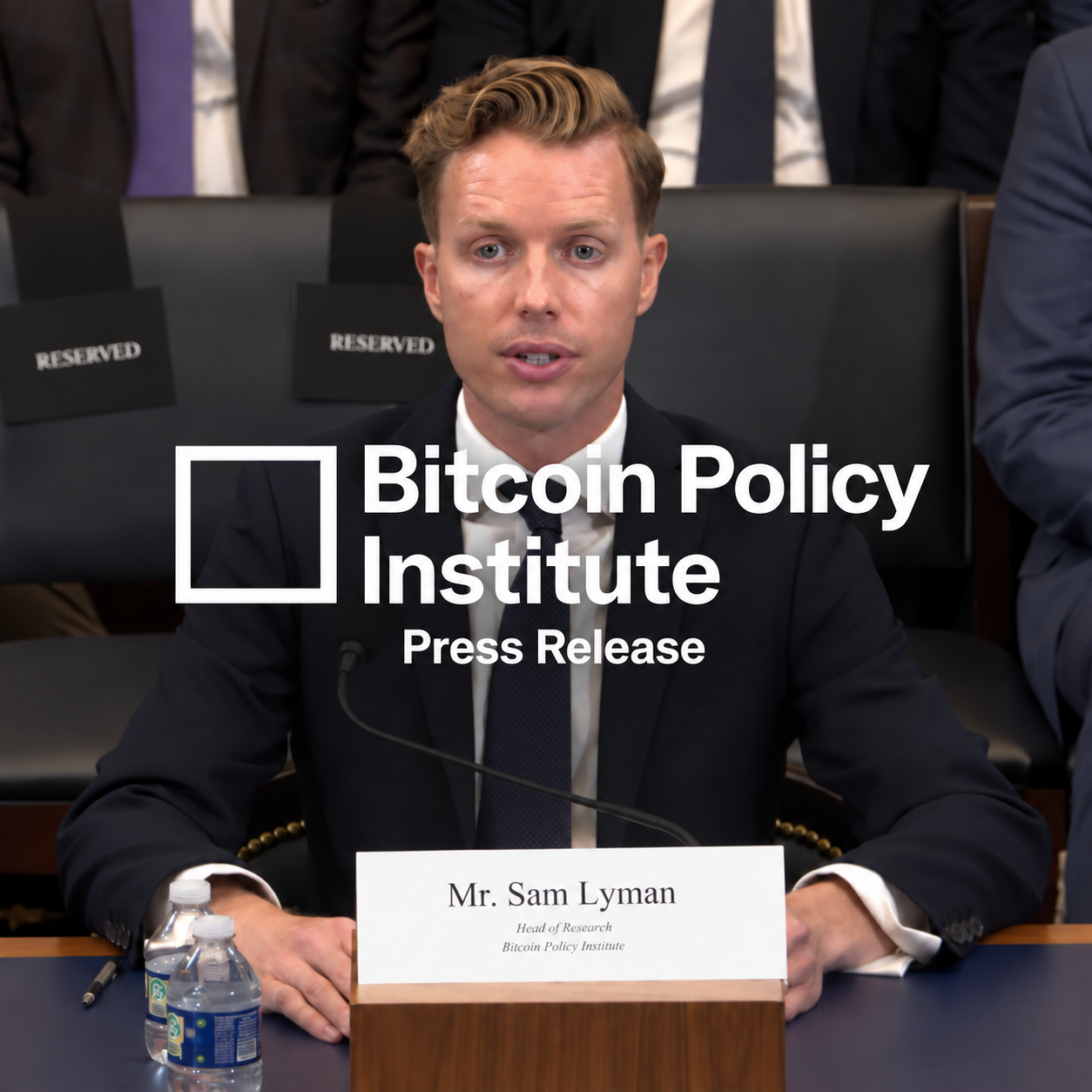
Sam Lyman is the head of research at the Bitcoin Policy Institute. He served previously as a senior advisor and chief speechwriter to Treasury Secretary Scott Bessent, where he helped shape the administration’s messaging and policy agenda on tax, trade, financial regulation, AI, and digital assets.
Before serving at Treasury, he was the public policy director at Riot Platforms, a digital assets and AI infrastructure company; the policy director of a DC-based think tank; the speechwriter to the President and CEO of the US Chamber of Commerce; and the chief speechwriter to Senator Orrin G. Hatch.
His graduate research at Princeton focused on the impact of emerging technologies on international relations. And his work on financial regulation, digital assets, and more has been published in The Washington Post, Forbes, Fortune, Newsweek, The Hill, The National Interest, and RealClearPolicy.