
On March 30, 2026, Iran's parliament approved the "Strait of Hormuz Management Plan," a law codifying a toll system the Islamic Revolutionary Guard Corps had reportedly been operating on the ground since mid-March. Under the plan, Tehran extracts transit fees from vessels seeking safe passage through the chokepoint that carries roughly 21 million barrels of oil a day, about a fifth of the world's supply. Reported fees run near $1 per barrel, producing up to $2 million from a single fully laden supertanker and, at the top of the range, as much as $20 million a day from oil tankers alone. Western press coverage initially described the payment rails as Chinese yuan and stablecoins. But a later account, citing a spokesperson for Iran's Oil, Gas and Petrochemical Products Exporters' Union, added bitcoin to the list.
The bitcoin claim has driven most of the media attention, but it is the piece of the story least supported by evidence. Onchain data has yet to reveal bitcoin moving at the scale required to settle tanker tolls. Nevertheless, the strategic logic behind a sanctioned state reaching for a bearer asset outside the dollar system is real and durable, and it runs through far more than one headline. The Hormuz story matters less for what Iran is doing today and more for what it reveals about bitcoin's growing prominence as a strategic asset, used by adversaries and allies alike.

Iran's Digital Asset Strategy
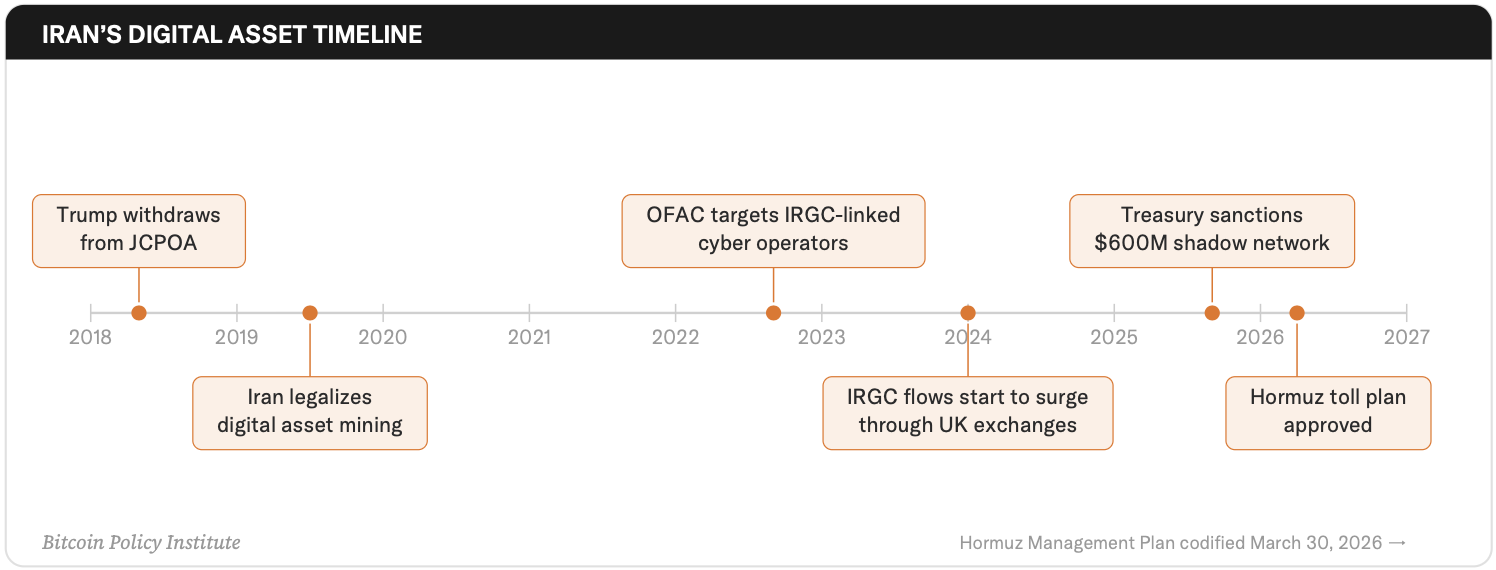
Iran has used digital assets as a sanctions workaround since 2018, when the Trump administration's withdrawal from the Joint Comprehensive Plan of Action cut Tehran off from dollar settlement. Parliament legalized industrial bitcoin mining in 2019, and Iran ran as much as 4.2% of global hashrate before U.S. and Israeli strikes knocked most of its 427,000 mining devices offline. State mining reportedly produced bitcoin at an all-in cost near $1,300 per coin, presenting Iran with a lucrative arbitrage opportunity which it has used to hedge against oil-revenue shortfalls.
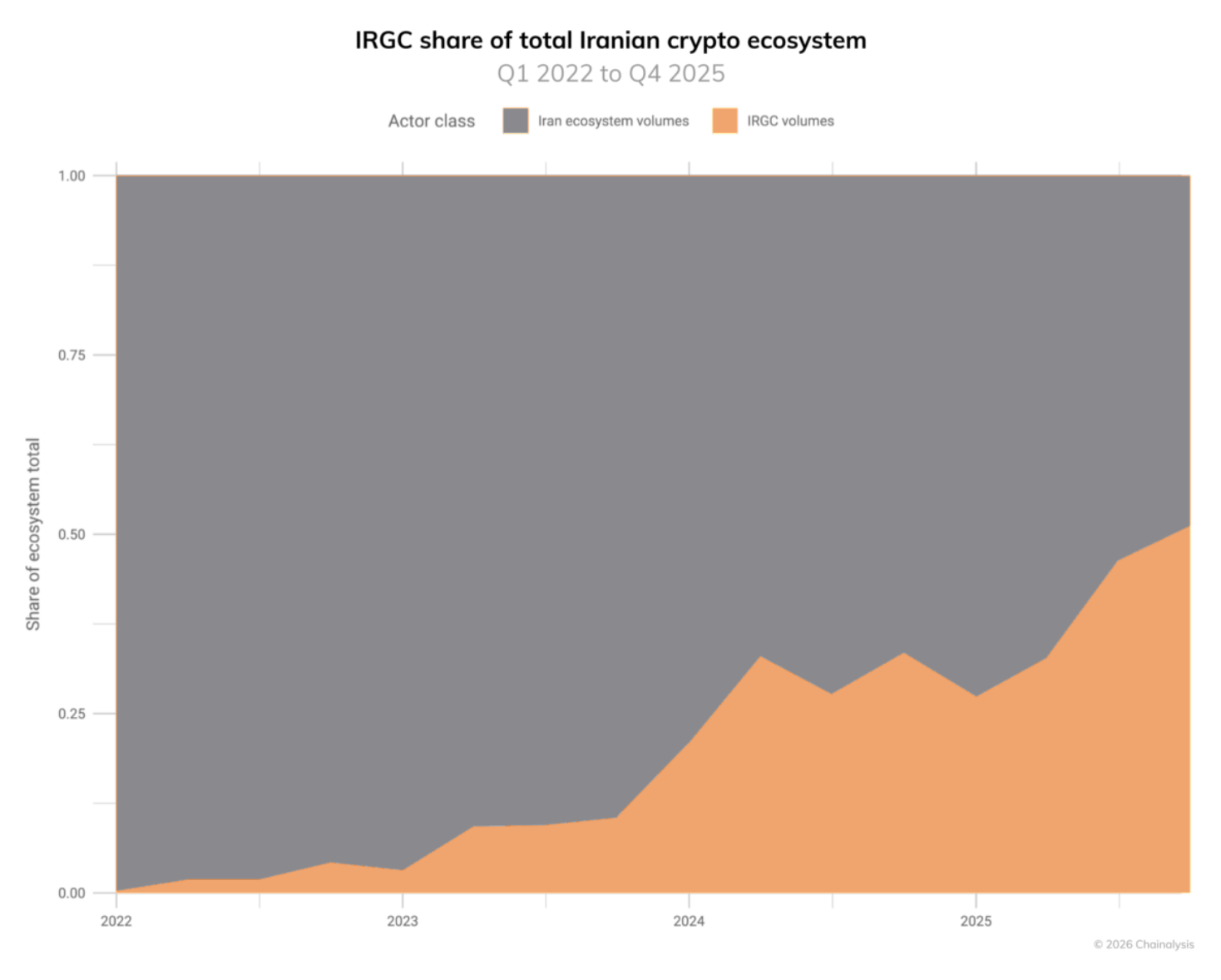
After OFAC's September 2022 designations of IRGC-linked cyber operators, Treasury targeted offshore exchange activity linked to the IRGC, which accounts for roughly half of Iran's overall crypto volume since 2023. IRGC-linked flows through UK-registered exchanges alone jumped from $24 million in 2023 to $619 million in 2024, and TRM Labs attributes roughly $3 billion in total IRGC crypto activity since 2023. But bitcoin is far from the main culprit in these flows. The settlement layer is almost entirely USDT on Tron.
Civilian adoption has grown in parallel with state usage. An estimated 22% of Iranians now hold digital assets, driving $4.18 billion in outflows in 2024 as the rial continued its multi-year collapse against the dollar. Digital assets in Iran function as both a state evasion tool and a household lifeboat. The Hormuz toll is simply the latest development in a decade-old strategy of using digital assets to stay afloat outside the U.S. dollar system.
Onchain Evidence Points to Minimal Bitcoin Toll Activity
The leading blockchain analytics firms, including TRM Labs, Chainalysis, and Galaxy Digital, have all examined the public claims about the Hormuz toll and found little to no onchain evidence of bitcoin moving at scale for transit payments. These tolls would need to be fast and private, making the Lightning Network the best option for Bitcoin payments. But the largest transaction ever recorded on Lightning was just $1 million, while a single supertanker toll could run to $2 million. Routing that value through Lightning, given current liquidity constraints, is virtually impossible.
Even so, Iran's proclivity towards bitcoin makes strategic sense. Unlike stablecoins, bitcoin has no issuer, no compliance counter, and no intermediary who can freeze a balance or reverse a transaction. Like physical gold, it is a bearer asset: whoever holds the keys controls the value. That property is precisely what a sanctioned state would want, and it explains why bitcoin is pulling on Iran's attention even as current operations run primarily on stablecoin Rails.
Policy Recommendation: Target Illicit Users and Infrastructure
The moment calls for enforcement action against illicit actors. Bitcoin is a neutral asset class, and trying to sanction it is as futile as trying to sanction gold. No Treasury action can revoke the properties of the Bitcoin network any more than it can revoke the properties of physical bullion. Reactive legislation aimed at bitcoin as an asset class would miss its target and penalize ordinary Americans whose interest in digital gold has nothing to do with Tehran.
The better option is to target wallet addresses, particularly those moving funds illegally through stablecoins. OFAC spent 2025 demonstrating that it can and will designate specific crypto addresses alongside vessels, individuals, and front companies. Tether, the issuer of the stablecoin most used by Iranian authorities, can freeze addresses and does so regularly. OFAC-designated wallets controlled by the Central Bank of Iran lost $37 million in frozen USDT in June 2025. Tether froze 42 additional Iran-linked addresses in July. And in September, Treasury sanctioned a $600 million Iranian shadow banking network that had been moving value in stablecoins.
Shipping companies paying IRGC-linked intermediaries face meaningful sanctions exposure regardless of the payment rail, and the compliance burden remains on them. The prudent response for policymakers in this environment is to single out Iran's operators and digital asset infrastructure, not the neutral monetary layer that Iran, and every other state, is increasingly interested in holding.
The Big Picture: Bitcoin's Rise as a Strategic Asset
The Hormuz story is one data point in a larger pattern that has accelerated over the past year: the growing prominence of bitcoin as a strategic asset.
In May 2025, the International Monetary Institute, a CCP-backed think tank at Renmin University and a body close to the People's Bank of China, republished BPI economist Matthew Ferranti's report making the case for bitcoin as a reserve asset. The IMI's editorial note was explicit: bitcoin is transitioning from a speculative asset to a strategic reserve asset, and the transition deserves continued attention.
On April 1, 2026, BPI published Geopolitical, Economic, and Trade Benefits of Establishing a Bitcoin Reserve for Taiwan, arguing that Taipei should hold bitcoin as a financial insurance policy against a potential Chinese blockade. Taiwan's Executive Yuan and Central Bank are now evaluating the proposal, and its Ministry of Justice already holds 210 BTC from criminal seizures that could seed a pilot reserve.
Digital gold, like physical gold, will be used by both friends and enemies of the United States. The latest developments in bitcoin are a case in point. It is incumbent on U.S. policymakers to determine how best to use bitcoin to advance our nation's own strategic interests. In that endeavor, the Bitcoin Policy Institute stands ready to help.
Since its founding, BPI has been making the case for bitcoin as an asset of irrefutable geopolitical importance. The Iran story only sharpens that thesis. While the specific claim about bitcoin being used for tolls in the Strait of Hormuz may prove thinner than the headlines suggest, the broader trend of states turning to bitcoin as an uncensorable store of value is gaining momentum. The United States must continue to prepare for a world in which bitcoin is a common tool of strategic competition and economic statecraft.