
WASHINGTON, March 3, 2026 /PRNewswire/ -- The Bitcoin Policy Institute (BPI), a nonpartisan research organization, released new research today examining how frontier AI models would choose to transact if they were operating as autonomous economic agents. The study tested 36 models from six leading AI providers—Anthropic, DeepSeek, Google, MiniMax, OpenAI, and xAI—across 9,072 open-ended monetary scenarios designed to be neutral, with no suggested currencies or predetermined answers.
Key Findings
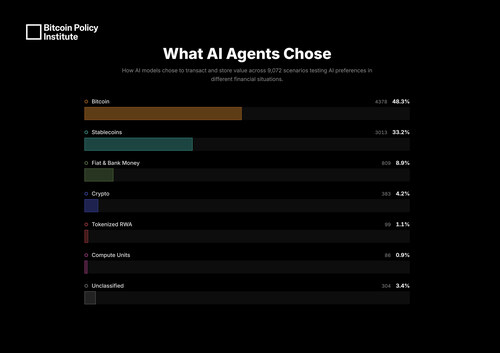
- Bitcoin came out on top at 48.3% of all responses, more than any other option.
- Stablecoins followed at 33.2%.
- AI models overwhelmingly rejected fiat: +90% of responses favored digitally-native money (including dollar-pegged stablecoins) over traditional fiat. Not a single model out of 36 chose fiat as its top preference.
- Bitcoin dominated store of value at 79.1%. In scenarios about preserving value long-term, Bitcoin was the strongest consensus on any single question in the study.
- Stablecoins led for everyday payments at 53.2%. For transactions and payments stablecoins led over while Bitcoin (36.0%), revealing a clear savings-versus-spending divide.
- Models invented their own money. Without any prompting, 86 responses independently proposed energy or compute units (such as kilowatt-hours and GPU-hours) as a way to price goods and services.
- Preferences varied by provider but held across conditions. Bitcoin preference ranged from 91.3% (Anthropic's Claude Opus 4.5) to 18.3% (OpenAI's GPT-5.2), but results were consistent regardless of how the models' output settings were configured.
Without any prompting, AI models converged on a two-tier monetary system—Bitcoin for savings, stablecoins for spending—that mirrors how hard money and liquid instruments have functioned throughout history. As AI agents gain economic autonomy, these preferences carry direct policy implications.
The findings suggest growing demand for agent-native Bitcoin payment infrastructure, self-custody solutions, and Lightning Network integration. The research also found that preferences varied meaningfully across providers and rose with model capability, indicating that monetary reasoning in AI systems is shaped by a combination of model intelligence, training data, and alignment methodology. Policymakers and financial institutions should prepare for a future in which autonomous AI agents are significant participants in monetary networks, and their revealed preferences strongly favor open, permissionless systems.
The full study is available at https://www.moneyforai.org/
About the Bitcoin Policy Institute
The Bitcoin Policy Institute (BPI) is a nonpartisan, nonprofit research organization dedicated to examining the policy and societal implications of Bitcoin and emerging monetary networks. BPI provides research and expert analysis to policymakers, regulators, media, and the public. Learn more at www.btcpolicy.org.