

Read the full article below. Download the pdf version here.
Executive Summary
Every year, tens of millions of Americans invest in "passive" funds to get exposure to "the market." What many don't realize is that somewhere upstream, private Wall Street committees they have likely never heard of decide which companies count as "the market" and which companies are excluded.
Today, a handful of private firms known as "Index Providers" decide which lawful public companies belong in the portfolios of American savers. Funds tracking these index provider benchmarks have grown dramatically in recent years.1 Now, 54 percent of all long-term fund assets in the United States overwhelmingly follow benchmarks prepared by just three firms.2 MSCI alone reports $21 trillion benchmarked to its indexes.3
The rapid growth of assets following these benchmarks has placed index providers in an incredibly powerful market position. They determine the constituents that many firms choose to follow; small changes to their standards can shift billions of dollars in capital from one section of the market to another or remove passive capital from companies altogether.4
This paper examines how that power developed, how MSCIʼs proposed non-operating-company screen would exercise it, how the firmʼs ESG history bears on its claims of neutrality, and why discretionary exclusions from broad-market indexes can become a strategic vulnerability for the United States.
For years, index providers have stood in a privileged regulatory position as neutral sources of information. To the SEC in 2022, MSCI said it “expresses no opinion or view as to whether any market, company, strategy or investment is good or bad.”5 Responding publicly to Congressional investigators in 2024, it said an index “is simply a mathematical calculation” that “does not, and cannot, channel investments.”6 As a result, index providers are currently not regulated as investment advisers.
Recent actions place that claim of neutrality under strain. Over the past year, MSCI has proposed two rules that would remove lawful public companies from broad-market indexes based on the composition of their assets and the financing methods used to acquire them.
In September 2025, MSCI proposed to remove from its global indexes any company holding half its assets in bitcoin or other digital assets.7 Many objected to this new criteria as unfair discrimination against digital asset companies, and drew comparisons to oil companies, gold miners and REITs which are never removed for what sits on their balance sheets. Following the public criticism, MSCI shelved the rule, but quietly capped the affected digital asset companiesʼ index footprint and barred new entrants.
In August 2026, MSCI returned with a broader two-part non-operating-company test built around five financial ratios.8 Its central input, operating assets, is not a standardized balance-sheet category defined by U.S. GAAP or IFRS.9 MSCIʼs simulation would delete Strategy, Metaplanet, and Yellow Cake plc, a company that holds uranium. Public comments remain open through today, September 30, with a decision expected by October 16.10
If adopted as proposed, this rule threatens a dangerous precedent whereby index providers can indirectly decide where trillions of dollars of capital is directed so long as they publish a formula for how they did it.11 This raises a policy question about whether existing U.S. oversight of index-provider methodology changes is adequate.
Congress, regulators, fund boards, and index users should require a presumption of inclusion for lawful, liquid, investable equities in broad-market indexes. Categorical exclusions should rest on transparent market-representation or vehicle-structure criteria that can be reproduced across sectors. Values-based or business-model screens should be offered through clearly labeled opt-in indexes.
SECTION 1 — Introduction
Every two weeks, a nurse in Ohio sends a part of her paycheck into a target-date fund that describes itself as passive and says it tracks the market. She chose that fund for good reasons. She does not want anyone picking stocks with her money, and the fee is a fraction of what an active manager would charge. What she has likely never been told is that someone is still making choices on her behalf. A committee at a private company called an “index provider” decides which companies count as “the market” that her fund tracks, and it can change that definition at any time with minimal oversight.
This paper explains how that arrangement developed and why concentrated, weakly supervised index discretion now matters for American capital formation.
What an index is, and who controls it
An “index” is a list of securities with a weight assigned to each one. It is maintained under a written rulebook by a company known as an index provider. The rulebook decides which companies are eligible for the list, how they are classified, how much of each one the index holds, and when a company is added or removed. The three largest index providers in the world are MSCI, S&P Dow Jones Indices and FTSE Russell.12
An “index fund” is a different kind of institution. It is a pool of real money, run by a fund sponsor such as Vanguard or BlackRock, that licenses an index and promises its investors to track the performance of the selected index. The fund manager does not decide whether Apple belongs in the portfolio. The index providerʼs rulebook makes that decision. The managerʼs job is to match the list as cheaply and accurately as possible.13
This division of labor has an important consequence. The index provider never touches a dollar of investor money, yet its decisions may move billions of dollars indirectly. When a company is added to a widely tracked index, every fund following that index adjusts its exposure.
Passive on the outside, active on the inside
Today, a fund is called “passive” because the fund itself has given up the job of choosing securities; however, that job did not disappear entirely. Some of that decision making moved upstream to the index providerʼs rulebook. Every index rests on a series of choices about what counts as the investable market, which companies are eligible, how they are classified, how they are weighted, and when they leave. Most of those decisions are technical in nature and entirely defensible. A broad index has to exclude companies that are too small or too thinly traded to be bought in large quantities. It also must account for shares that are held by insiders and cannot actually be purchased, and may exclude mutual funds and investment trusts, to avoid counting the same companies twice. These are rules designed to assess whether a security can represent the market in a portfolio.
How index providers became so powerful
Index investing won its position in the marketplace over decades of competition. Fees were much cheaper and diversification was a powerful way to manage risk.14 Decades of evidence showed that most active managers failed to beat the benchmarks they were paid to beat and savers accordingly responded to that evidence by moving their funds.15 In 2010, index funds held 19 percent of the assets in long-term mutual funds and exchange-traded funds in the United States. By 2015 the figure was 28 percent, and by 2020 it was 40 percent. At the end of 2025, index funds crossed into the majority for the first time, holding 52 percent of $36.6 trillion in fund assets. As of July 2026 the share is 53.9 percent, with $21.8 trillion in index funds against $18.6 trillion in actively managed funds.
The shift is even more pronounced in the ownership of companies themselves. In 2015, actively managed domestic equity funds owned 18 percent of the U.S. stock market by value and index funds owned 11 percent. By 2025 the positions had reversed. Index funds now own 19 percent of the U.S. stock market, and active funds own 11 percent. For the first time, funds that follow an index own more of corporate America than funds that select their own investments.16
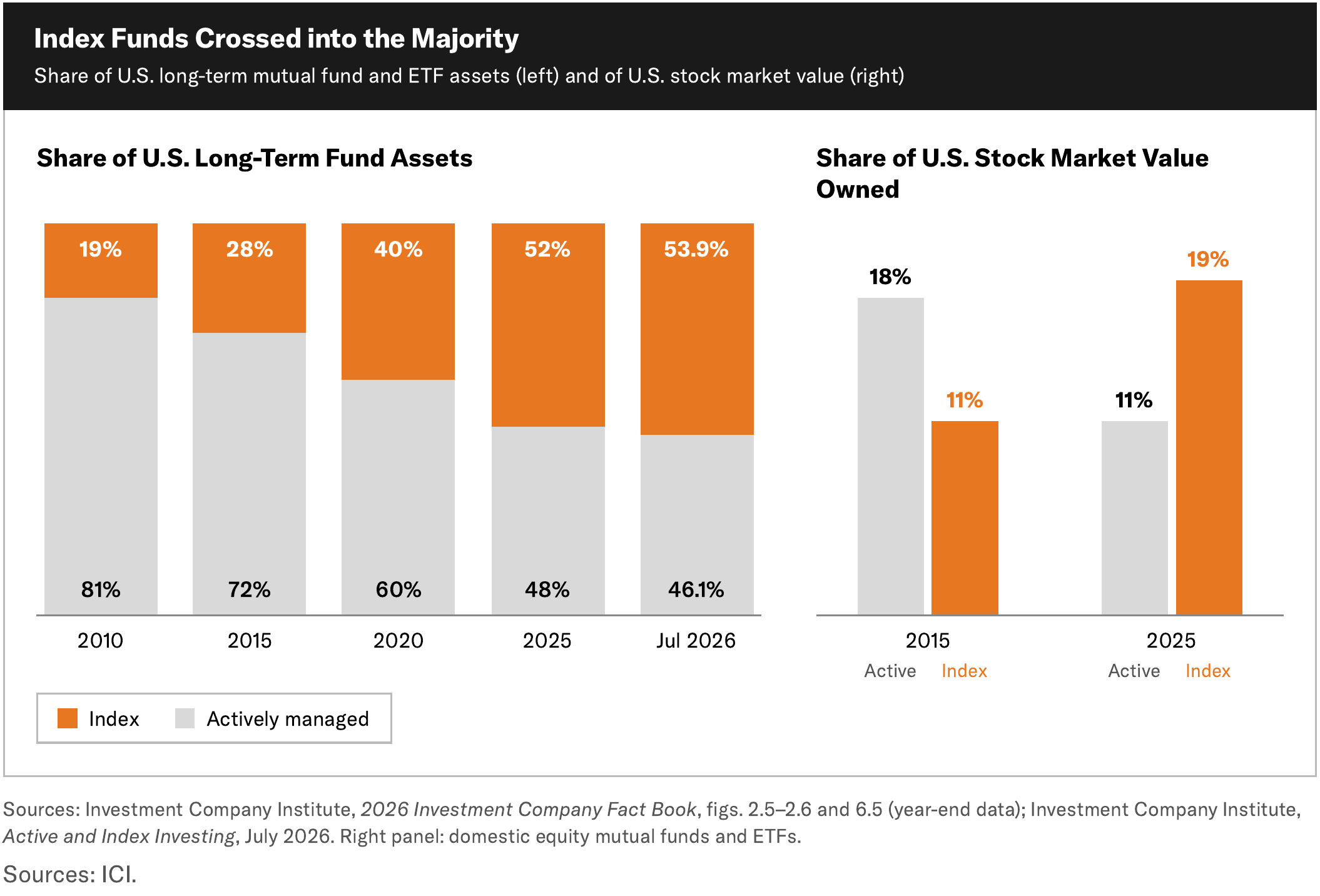
The shift toward indexing has delivered lower costs and broad diversification. It has also increased the consequences of index-provider decisions. A methodology change that once affected a specialized product can now propagate through a majority of U.S. long-term fund assets and through funds that collectively own nearly one-fifth of the U.S. stock market.
Three providers accounted for more than two-thirds of index-market revenue
The concentration of the index business multiplies the effect. In 2022, the SEC observed that “three index providers account for over two-thirds of the market for indexes, totaling approximately $5.0 billion in revenue in 2021.”17 MSCI alone reports $21 trillion in assets benchmarked to its indexes and $2.8 trillion in equity ETFs that track them directly.
In principle, a fund sponsor that dislikes a providerʼs rules can switch to a competitor. In practice, that almost never happens for various structural reasons discussed in further detail below.
SECTION 2 — Anatomy of an Exclusion
The discretion described in the previous section already has measurable consequences. MSCIʼs recent consultations show how an index committee can convert a judgment about a business model into mandatory trading by funds that follow its benchmarks, even when the affected companies remain lawful, liquid, and publicly traded.18
Over the past year, MSCI has twice proposed rules that would remove groups of lawful public companies from its global indexes because of the assets they hold. The first proposal named digital assets directly. MSCI explained that some market participants viewed those companies as similar to investment funds, but it did not identify the participants or publish an economic test for that comparison. After substantial public criticism, MSCI withdrew the proposal in January 2026.19
Seven months later, MSCI published a facially broader proposal covering non-operating companies. The new language no longer singles out digital assets, but MSCIʼs own simulation conveniently reaches several of the same digital asset companies and metadata in public documents indicate the new consultation could be part of a project targeting digital asset companies.
Below is a full accounting of the recent public statements and consultations made by MSCI regarding digital asset companies, including prior institutional statements on digital assets like Bitcoin.
October 2021: MSCI identifies Bitcoin as an ESG threat
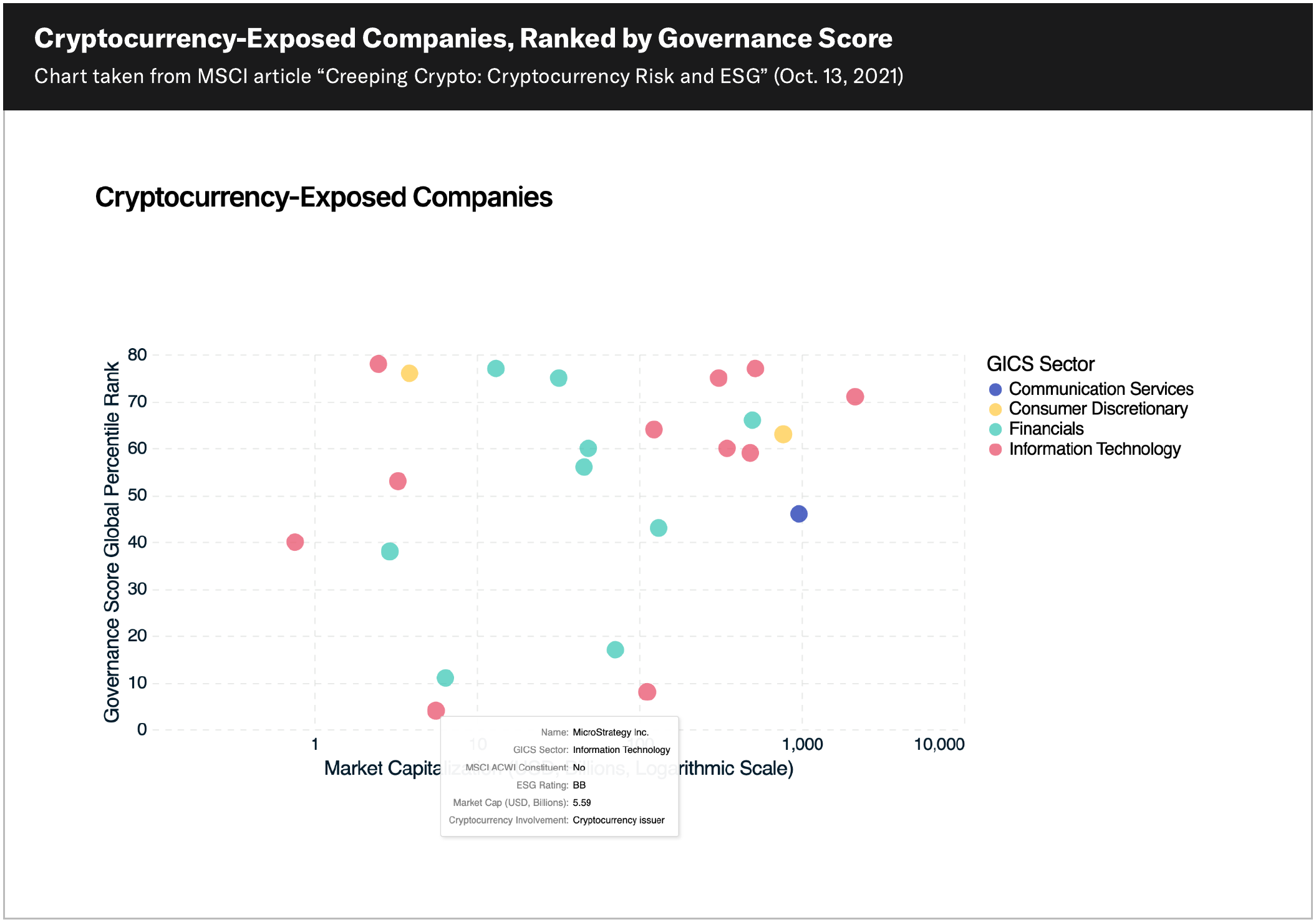
MSCIʼs scrutiny of digital assets began years before any exclusion proposal. On October 13, 2021, its ESG researchers published “Creeping Crypto,” warning that investors could acquire cryptocurrency exposure through companies entering indexes or adding bitcoin to their businesses. They identified 52 exposed public companies, including 26 MSCI ACWI constituents, and described most cryptocurrencies as “speculative investments with little evident utility.” The post assessed crypto through an ESG framework, highlighting Bitcoinʼs emissions and electronic waste alongside social and governance risks. It also directed readers to MSCIʼs custom screening tools to identify additional exposed companies. The post did not call for index exclusions. But it establishes that MSCIʼs ESG researchers had already framed cryptoʼs entry into equity portfolios as a source of risk four years before the proposed exclusion.
Notably, the article highlights a list of different companies that have cryptocurrency exposure and ranks them based on a “Governance Score Global Percentile Rank” related to environmental, social, and governance standards. Ranked lowest in the chart is Strategy (then named Microstrategy) for its Governance Score (screenshot below).
October 2025: a rule aimed at one kind of company
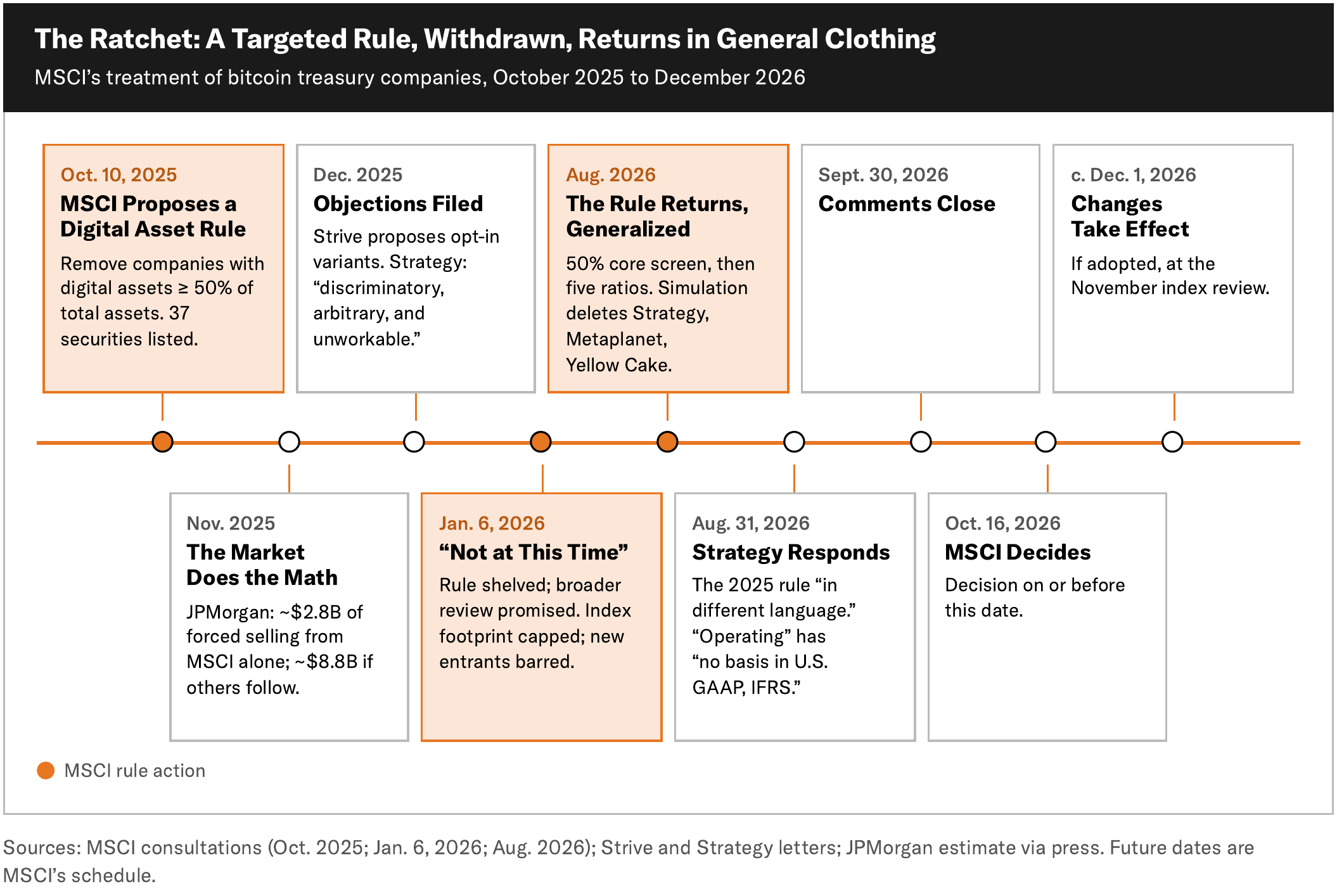
On October 10, 2025, MSCI opened a public consultation proposing to remove from its Global Investable Market Indexes any company whose digital assets made up 50 percent or more of its total assets. The Global Investable Market Indexes are MSCIʼs flagship family of benchmarks, and they are the lists that trillions of dollars in index funds follow. MSCIʼs stated reason for the proposal was brief. It said that “some market participants have expressed that such companies may exhibit characteristics similar to investment funds, which are currently not eligible for index inclusion.” MSCI did not say who those participants were.20 It published a preliminary list of 37 securities, 12 of which were already in its indexes, set a comment deadline of December 31, promised a decision on January 15, and scheduled implementation for its February 2026 index review.21
The financial consequences were immediately apparent, with Strategy being the most directly impacted by the proposed rule. Analysts at JPMorgan estimated that removing Strategy from MSCIʼs indexes would force roughly $2.8 billion of selling by funds that track them, and that the figure could reach $8.8 billion if other index providers followed MSCIʼs lead.22
Objections followed. On December 4, Strive, Inc., wrote to MSCIʼs chairman, Henry Fernandez. Strive observed that “index providers do not exclude energy companies whose oil reserves dominate their balance sheets, gold miners whose value depends largely on the metal they extract…” It also proposed a different solution. MSCI could offer opt-in versions of its indexes that excluded digital asset companies for any client who wanted them, while leaving the standard benchmark intact.23 Later that month, Strategy filed its own objection. It called the 50 percent threshold “discriminatory, arbitrary, and unworkable,” and it warned that a rule tied to the price of a volatile asset would cause companies to “whipsaw” in and out of the index as prices moved.24 In response to the volume of feedback, MSCI extended the consultation past its original deadline.
January 2026: the rule is shelved, and a quieter penalty takes its place
On January 6, 2026, MSCI announced that it would not implement the rule “at this time.” The announcement explained that feedback had confirmed concern that some of these companies resembled investment funds, but that digital asset treasury companies “may represent only one category within a broader group”. MSCI said it would instead open “a broader consultation on the treatment of non-operating companies generally.”25
What received far less attention was a second decision in the same announcement. MSCI froze increases in the number of shares it would count for the listed companies, and it deferred any new additions or migrations of their securities.26 In practical terms, funds tracking MSCIʼs indexes would stop buying additional Strategy shares as the company issued them, and no new digital asset treasury company would be admitted to the indexes at all. MSCI had declined to adopt a rule and had begun penalizing the companies anyway. No consultation preceded these interim measures, and no explanation of their basis was offered.
The same pattern was visible at a second index provider during the same months. In 2025, Strategy met every published quantitative requirement for inclusion in the S&P 500: U.S. domicile, a major listing, sufficient market capitalization and liquidity, and four consecutive quarters of positive earnings under GAAP.27 The S&P index committee, whose members are anonymous and which does not explain its decisions, passed the company over at every opportunity in the second half of the year.28 In both cases, a committee holds discretion, gives no public reasons, and offers no appeal process.
August 2026: the same rule returns in general language
Seven months after shelving the digital asset rule, MSCI published its Consultation on Eligibility of Non-Operating Companies for the MSCI Global Investable Market Indexes. Public comments are due September 30, 2026. MSCI has said it will announce its decision on or before October 16, and if it proceeds, the changes will take effect at its November index review, around December 1.29
The new consultation describes its target without mentioning bitcoin or digital assets. According to MSCI, non-operating companies “create value by accumulating and holding non-operating assets,” and they “spend and generate little cash from running an actual business.” Their performance is “driven by market movements, not other revenue-generating activities,” and they are “reliant on external capital, not their own operations, to grow.”30
To identify these companies, MSCI proposes a two-step test. The first step is a core screen. If a companyʼs operating assets exceed 50 percent of its total assets, a company that fails the core screen moves to the second step, where it is scored against five financial ratios and excluded if it fails four of them.
The consequences differ depending on whether a company is already in the index. A company that is not yet included is barred on the strength of a single filing. A company already in the index is removed only if it fails in two consecutive annual reviews, and a single failure places it on a new public “watchlist.”
Two features deserve immediate attention. “Operating assets” is not a standardized balance-sheet category defined by U.S. GAAP or IFRS, and the consultation provides no asset taxonomy or definition for applying it. MSCI must therefore subjectively classify cash, investments, inventory, mineral rights, construction in progress, intellectual property, and strategic holdings before any ratio can be calculated.31
The proposal also appears to depart from public filings. For example, since adopting fair-value accounting for bitcoin in 2025, Strategy has reported bitcoin gains and losses within operating expenses. In the first half of 2026, those losses totaled $22.8 billion, compared with $195 million for its other operating expenses.32 Counted as filed, the expense-intensity flag would not be triggered. Reaching MSCIʼs simulated result therefore requires an analytical reclassification that the consultation does not disclose.33
A DATCOs project path in the public file
Also of note, the public PDF for the August 2026 consultation contains metadata that could shed light on the proposalʼs origins and intentions. A metadata field named “Tfs.LastKnownPath” records a SharePoint presentation path under “Projects/DATCOs”, followed by “Operating vs Non Operating” and “IPC Decks”. DATCOs presumably refers in this context to (D)igital (A)sset (T)reasury (Co)mpanies. The broad non-operating-company proposal thus retains a link in its recorded source path to the category targeted by the earlier exclusion proposal.34
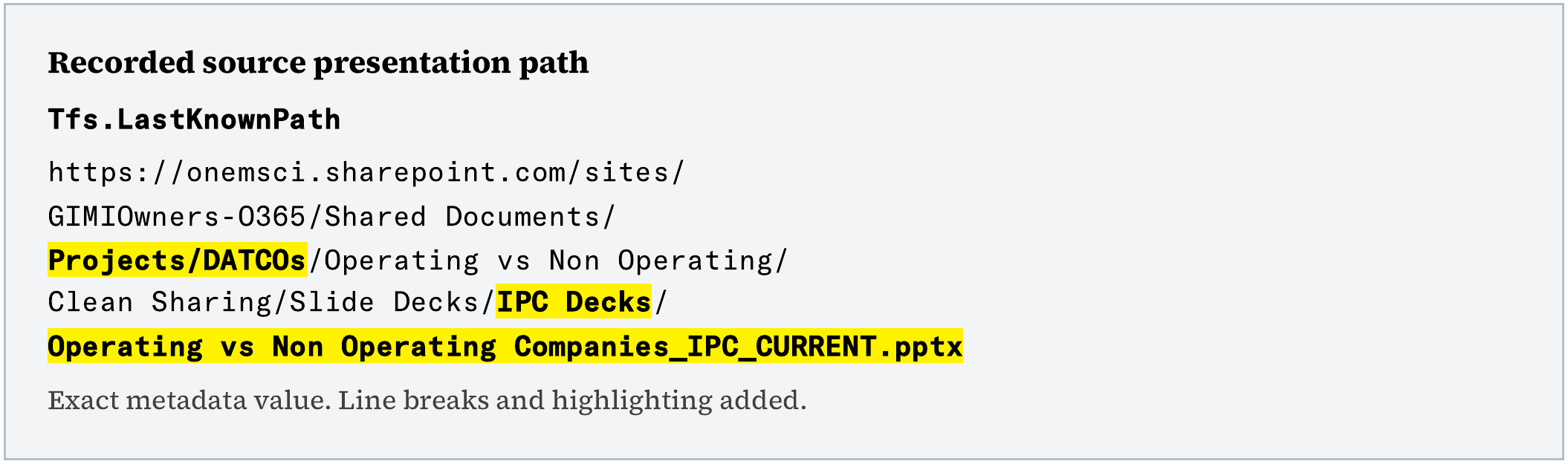
This is concrete evidence of continuity and potentially shared purpose between the two consultations. It supports a reasonable inference that the 2026 operating-company test was developed within MSCIʼs existing DATCO workstream, and warrants asking whether its broader language carried forward the earlier intentional effort to remove those companies.
The path does not by itself establish that exclusions were predetermined, that the financial tests lack a legitimate classification rationale, or that a committee approved the proposal at a particular meeting. Metadata can survive reuse of a presentation or template. Even with that limitation, the retained DATCOs project label warrants a direct explanation of how the earlier DATCO initiative shaped the broader proposal and what safeguards ensured that the criteria were not chosen to reach a predetermined set of exclusions.
How the two sides have responded
Strategy filed its formal response on August 31, 2026, signed by its executive chairman, Michael Saylor, and its chief executive officer, Phong Le. The response calls the proposal “discriminatory, arbitrary, and misguided.” It describes the new test as a repackaging of the withdrawn 2025 rule “in different language, but reaching the same result.” Strategy argues that the terms “operating” and “non-operating” have “no basis in U.S. GAAP, IFRS, or any recognized legal framework.” It states that the company reports its bitcoin business as an operating segment under GAAP “consistent with discussions with SEC Staff.” And it argues that the test “injects MSCIʼs own policy judgments into index construction.” Strategy asks MSCI to withdraw the proposal. If MSCI proceeds regardless, Strategy asks it to publish objective criteria, to apply any rule only to filings made after the rule is final, and to release the consultation record.35
As the response puts it, “if adopted, the proposal would have no meaningful impact on Strategyʼs business, but it would profoundly harm MSCIʼs reputation as a reliable and neutral index provider.”36
In essence, Strategy is articulating the real stakes are principle and precedent. This paper agrees. This case could set a strong precedent for how capital is allocated in Americaʼs markets.
SECTION 3 — Applying the New MSCI Proposal
A screen intended to distinguish operating companies from investment vehicles should generate stable results across sectors and accounting frameworks. To demonstrate the dangers of subjective definitions, we have applied the proposal to a cross-sector sample using public filings and a consistent classification rule. The exercise does not purport to reproduce MSCIʼs unpublished judgments. It shows how much the outcome changes when reasonable analysts draw the operating-asset boundary differently.
The dangers of an ill-defined operating asset standard
The initial screen turns on “operating assets”, yet the consultation defines the term only as assets that are operating or used as business inputs. That description does not tell an analyst whether a mineral right becomes operating when it is acquired, permitted, developed, or placed into production. It does not resolve whether construction in progress, preproduction inventory, strategic stockpiles, acquired technology, minority stakes, or cash committed to a project count. The same uncertainty extends to operating expenses, non-operating fair-value changes, and capital raised for asset accumulation. MSCI has not published the classifications used to produce its own simulated deletions.37
What the scorecard could do to strategic industries
The proposalʼs most consequential ambiguity is temporal. It describes operating assets as assets “operating” or “used as business inputs,” without explaining when a long-lived strategic asset crosses that boundary. A permitted mineral deposit, semiconductor fabrication plant undergoing qualification, satellite awaiting launch, or LNG train under construction may be central to the companyʼs business while producing little or no current revenue.38 The inclusion of Yellow Cake, a company that holds physical uranium, in MSCIʼs simulated deletions shows that the proposed screen already reaches beyond digital assets.
One facially plausible implementation would be an “assets in service” convention. Under this approach, an asset becomes operating only when it is deployed in recurring commercial production. Cash, restricted cash, mineral properties awaiting production, construction in progress, advance launch payments, preproduction facilities, and development-stage intangible rights would remain non-operating until the related project enters service. The same convention could define operating expenses narrowly, counting costs associated with the existing commercial business while excluding research, engineering, exploration, predevelopment, start-up, and other expenditures directed toward future capacity.
This is one possible interpretation, and it is not necessarily MSCIʼs intended interpretation; however, its plausibility is the source of the concern. Nothing in the proposal supplies a sufficiently detailed taxonomy to foreclose it.
Once a company fails the 50 percent core operating-asset test, MSCI would examine five additional measures. A non-constituent would become ineligible if it triggers four flags, including operating assets below 20 percent of total assets, operating expenses below 5 percent, negative operating cash flow, elevated non-operating fair-value changes, and financing cash flow above 20 percent of assets. Current constituents receive 10 percent and 30 percent buffered thresholds for operating assets and capital dependence, as well as a two-year persistence requirement.39 MSCIʼs proposal therefore gives substantial consequences to the unresolved classification of assets and expenses.
Below are two examples across various strategic industries demonstrating the potential risks of adopting ambiguous language.
AST SpaceMobile and space-based communications
AST SpaceMobile is constructing a satellite constellation intended to provide broadband connectivity directly to ordinary mobile devices. The company also performs work for the U.S. government and has completed government-related communications and non-communications testing. Its satellite assembly, integration, and testing facilities are headquartered in Texas.40
As of June 2026, AST reported $5.85 billion of assets. Cash and restricted cash accounted for approximately $2.72 billion. Another $1.81 billion consisted of satellite materials, satellites under construction, advance launch payments, other construction in progress, and capital advances. Satellites already in orbit had a gross carrying amount of approximately $235 million. Under an assets-in-service convention, more than three-quarters of the balance sheet could be classified as cash or undeployed project assets.41
AST used $145 million of operating cash during the first six months of 2026. Its trailing twelve-month financing cash flow was approximately $4.0 billion, or roughly 69 percent of total assets.42 The operating-asset, operating-cash-flow, and capital-dependence flags would therefore be straightforward under the restrictive convention.
Expense intensity supplies the decisive fourth flag. ASTʼs reported operating expenses exceed 5 percent of assets when engineering, research, and all other operating-statement costs are included. A narrower definition could exclude satellite design, network-development engineering, research, and a large launch-related loss as costs of building future capacity. Trailing general and administrative expense was approximately $164 million, or 2.8 percent of total assets.43 Under that interpretation, AST could trigger four flags and could be barred as a new index entrant.
Lithium Americas and domestic lithium production
Lithium Americas provides the clearest critical-minerals example. The company is constructing the Thacker Pass lithium project in Nevada and has relied on equity, strategic investment, and advances under a U.S. Department of Energy loan to fund the project. It had not generated operating revenue as of its latest filing.44
At June 2026, Lithium Americas reported $3.54 billion of assets. Mineral properties, plant, and equipment accounted for $2.09 billion, while cash and restricted cash accounted for approximately $1.28 billion. If the project assets remain non-operating until lithium production begins, very little of the balance sheet qualifies as an asset in service.45
The remaining flags follow directly from the economics of mine construction. Trailing operating expenses were approximately $65 million, or 1.8 percent of total assets. Operating cash flow was negative. Trailing financing cash flow was approximately $1.85 billion, or 52 percent of assets. The company would therefore trigger the operating-asset, expense-intensity, operating-cash-flow, and capital-dependence flags. The fair-value screen would be unnecessary.46
This outcome could satisfy even the buffered thresholds applicable to current constituents if it persisted for the required period. A company building a strategically important domestic lithium mine could be classified as non-operating precisely because the mine is large, expensive and still under construction. The test treats the characteristics of infrastructure development, including large construction balances, low current operating expense relative to project assets, negative operating cash flow and external project financing, as evidence that the company may not be operating.
The structural disadvantage to strategic industry
These cases identify a common lifecycle problem with MSCIʼs proposed definition. Novel and strategic industries require companies to assemble capital before revenue. Their principal assets can remain in permitting, construction, qualification, commissioning, or deployment for years. Accounting rules capitalize much of that work, producing a large asset base and relatively low reported operating expenses. Operating cash flow remains negative, and financing cash flow remains positive, until the project enters service.
A committee seeking to disfavor resource development, industrial expansion, or U.S. strategic capacity would not need to adopt an explicit sector exclusion. It could apply a narrow assets-in-service definition, classify research and predevelopment spending as investment in future operations, and interpret capital dependence using gross capital formation. Each choice would have a recognizable financial rationale. Applied together, they would predictably remove or delay index access for capital-intensive entrants while preserving access for diversified incumbents.
A methodology that leaves the treatment of construction in progress, mineral properties, development-stage intangible rights, underutilized facilities, and precommercial engineering to unpublished staff judgment gives a small index committee substantial power over which forms of economic activity qualify as operating businesses.
At a minimum, any final methodology should expressly address strategic development assets, apply the asset and expense definitions symmetrically, rely on reproducible financial-statement classifications, publish company-level calculations, and provide a meaningful issuer review process. Without those safeguards, the scorecard risks measuring corporate maturity and financing structure while presenting the result as an objective determination of whether a company is operating.
SECTION 4 — MSCI’s History of ESG Activism
The discretion described in the previous section belongs to a company with a public record of advocating changes in how capital is allocated. MSCIʼs environmental, social and governance business has been accompanied by climate commitments, management incentives, and senior executives urging financial institutions to change corporate behavior. That history deserves scrutiny when the same firm proposes new restrictions on access to broad-market indexes.
Henry Fernandez’s campaign to redirect capital
MSCIʼs chairman and chief executive, Henry Fernandez, has advocated making access to financing conditional on climate commitments. In an MSCI podcast published on October 14, 2021, he recounted telling senior bankers at one of the worldʼs largest banks that “they should refuse to take a company public or do a bond offering if company hasnʼt yet made a pledge to net zero.” This was a proposal to use underwriting decisions to induce changes in corporate conduct. Later in the conversation, Fernandez questioned the effectiveness of divestment and favored engagement. His preferred approach still assigned financial institutions an active role in pressing companies to decarbonize.47
In November 2023, Fernandez wrote that “the world urgently needs a faster repricing of assets and reallocation of capital.” Fortune published his essay under a headline describing that process as “already happening, even without a political consensus.”
These statements make a clear case for examining the boundary between MSCIʼs climate advocacy and its benchmark rules. Investors who select a climate fund authorize a climate objective. Investors who select a broad-market fund authorize a different mandate. A chief executiveʼs support for reallocating capital cannot establish the motive for a particular index decision, but it makes verifiable safeguards between those mandates especially important.
ESG leadership overlapped with index leadership
The institutional connections extend beyond the chief executive. MSCIʼs 2017 annual report identified Remy Briand as both Head of ESG and chairman of the Index Policy Committee, the body overseeing major index editorial decisions. The filing also described his involvement in the ESG business since its acquisition in 2010. At that point in MSCIʼs history, responsibility for ESG offerings and a central index-governance role sat with the same executive.48
By April 2021, Diana Tidd simultaneously served as Head of Index and Chief Responsibility Officer. In an official MSCI podcast, she discussed progress toward net zero through engagement with the companies in MSCIʼs broad global benchmarks. Her stated aspiration was that “ACWI itself essentially becomes green, one company at a time.” She described companies reducing their own carbon footprints, rather than being deleted from the index. Even with that distinction, the remarks show that the head of MSCIʼs index business publicly connected the flagship benchmark to a collective decarbonization objective.49
In January 2022, MSCI appointed Briand, then Head of ESG and Climate, as Chief Product Officer and Head of Index. Tidd became a full-time Chief Responsibility Officer, with responsibility for integrating ESG practices across the firmʼs strategy, governance and operations. These appointments document the place of ESG within MSCIʼs senior leadership. They do not identify who is deciding the present consultation, and historical positions should not be treated as a current committee roster.50
Climate goals became management goals
MSCI also incorporated climate objectives into management incentives. Its 2025 CDP disclosure, reporting on 2024, says every Management Committee member had climate-related performance goals. The annual incentive plan allocated 70 percent to financial performance, 20 percent to individual key performance indicators and 10 percent to a sustainability component. The disclosure connected management incentives to MSCIʼs internal environmental efforts and the success of its sustainability and climate products. This was an organizational commitment backed by performance assessment and compensation.51
MSCIʼs 2026 proxy says it removed the separate sustainability component in 2025, increasing the financial component to 80 percent and retaining 20 percent for culture and leadership. For 2026, the annual incentive plan for Managing Directors, including named executive officers, became entirely financial. The earlier arrangements show how climate priorities entered management processes. They do not establish that todayʼs index committee receives climate-linked bonuses, and they provide no evidence of a payment tied to excluding digital asset companies.52
SECTION 5 — A Dangerous Precedent For America’s Capital Markets
The governance consequences extend beyond MSCIʼs climate objectives and beyond bitcoin. Adoption would establish a precedent with immense consequences. A private committee would gain authority to decide which lawful issuers conduct a sufficiently authentic business, using classifications that are neither standardized nor fully disclosed. The resulting decision can propagate through funds benchmarked to MSCI without investor consent, issuer-specific due process, or effective competitive discipline.
MSCI claimed to be neutral, and the test abandons that claim
For years, MSCI has described itself to regulators as a neutral measurer of markets. In 2022, the SEC asked whether index providers had become investment advisers. MSCI responded that it “expresses no opinion or view as to whether any market, company, strategy or investment is good or bad” and that it makes “no recommendations about investments or asset allocations.”53 In 2024, Congressional investigators asked how MSCIʼs indexes had carried billions of American dollars into companies the U.S. government had flagged for military and human-rights concerns. MSCI responded that “an index is simply a mathematical calculation of the performance of the market” and that an index “does not, and cannot, channel investments.”54
Those statements have had real consequences. They are the reason MSCIʼs index business is not regulated as an investment adviser and owes no fiduciary duty to the people whose money follows its lists.55 They are the reason MSCI was not held responsible for the capital its indexes directed toward companies on U.S. government watch lists.56 The bargain has been simple. MSCI describes the market, and because it only describes, it is not responsible for where the money goes.
The non-operating-company test changes that institutional bargain. It requires MSCI to decide whether lawful issuers are running an actual business or merely accumulating assets. That is a substantive judgment about corporate form and strategy, even when expressed through ratios. MSCI may choose to exercise that judgment, but regulators and index users should then evaluate the index business according to the discretion it actually exercises rather than the neutrality it previously claimed.
Once established, the power has no natural limit
The sequence of consultations shows how discretionary authority can expand. The October 2025 proposal used an explicit digital-asset threshold. After critics questioned that asset-specific distinction, the August 2026 proposal replaced it with general terms such as actual business, operating assets, and capital dependence. The revised language reaches the same principal companies and adds a uranium holder. Generalization reduced the appearance of asset discrimination while enlarging the range of companies potentially subject to MSCIʼs classifications to capital intensive strategic industries.57
Adoption would establish several powers with no clear limiting principle. MSCI could define operating assets outside a recognized accounting taxonomy, reclassify audited line items for index purposes, treat capital raising as evidence against eligibility, and place companies on a public watchlist. A future committee could apply the same framework to strategic commodities, preproduction industrial projects, intellectual-property businesses, or holding-company structures. The rule would remain facially technical even if its classification choices produced a consistent disadvantage for one sector.
This is a national economic-security concern. Capital-market access affects which technologies and productive capacities can scale in the United States. The risk does not depend on proving improper motive in the present consultation. It arises from creating a concentrated and weakly supervised channel through which a small committee can disadvantage an emerging sector at the stage when it depends most heavily on external capital.
The vulnerability can arise without an explicit industry blacklist. A committee skeptical of extraction or domestic industrial policy could define operating assets around current production and recurring revenue. Mineral rights, reserves, stockpiles, and unfinished facilities would then appear investment-like. Commodity-related fair-value changes would reinforce that classification, while the debt and equity used to build capacity would become evidence of capital dependence. The rule would remain facially neutral and financially legible even as it burdened the sectors most dependent on long-duration physical investment.
To be clear, that possibility does not establish that MSCIʼs present proposal is politically motivated. It establishes that the methodology lacks safeguards against politically skewed application. A sound governance framework must be designed for future committees, future pressure campaigns, and future sectors, including circumstances in which the decision-makerʼs preferences differ sharply from those of todayʼs market participants.
There is no appeal, no accountability, and no exit
The current consultation invites general market feedback, but it does not create an issuer-specific adjudication process. The proposal offers no defined procedure for a company to inspect MSCIʼs classifications, correct factual errors before a decision, obtain a reasoned determination, or seek independent review.58 The identities and deliberations of the relevant committee are not published. Similar discretion exists at other providers, including the S&P committee that determines additions to the S&P 500 without publishing company-specific reasons.59
A fund sponsor that dislikes the new rule can leave in theory, but in practice the obstacles are severe. The U.K. Financial Conduct Authority found that the benchmark market “usually tips in favour of one industry standard benchmark” and that most users report “limited ability to negotiate.” It also found that some contracts require a departing client to purge its historical data or pay for a perpetual license in order to keep it.60 When Vanguard moved 22 funds off MSCI benchmarks in 2012, the move was described at the time as the biggest benchmark switch ever, and switches on that scale have remained rare in the years since.61 For a mid-sized fund, leaving a benchmark is a multi-year project with tax consequences for its shareholders. For the individual saver, leaving is not an option at all.
The market is the right judge of a business
Free markets work through disagreement. An investor who believes a novel company like Strategy is reckless can sell its shares, short them, or decline to buy them in the first place. An investor who believes that a company is brilliant can do the opposite. Prices move, capital flows, the strategy is tested, and the company expands, adapts or fails. That contest is the mechanism by which a market economy discovers which corporate experiments deserve to continue.
A categorical exclusion from a broad-market index short-circuits that contest. It removes a company from the default portfolios of tens of millions of people who never chose to remove it. It does so on the judgment of a committee that has told regulators it makes no such judgments, and for a reason that has nothing to do with whether the companyʼs strategy is working. The company may remain lawful, liquid and profitable. It has simply been declared not to be a business by a firm whose product is supposed to describe the market as it actually is.
The point extends beyond any one issuer. Public markets finance corporate experiments before their economics are fully proven. Negative operating cash flow and repeated capital raising often describe the construction phase of a valuable business. Treating those characteristics as evidence of non-operation creates an incumbency bias. Established firms with positive cash flow receive a safe harbor, while companies financing new productive capacity face additional eligibility risk.
We will close this section with a clear lesson that should resonate with every policymaker in Washington: Discretion this large, held by this few, is a chokepoint in the American financial system.
Whoever can influence three small index committees can influence the allocation of trillions of dollars, and that influence is available to foreign governments, domestic factions and well-funded incumbents alike.62 Once index providers begin deciding which industries, technologies or business models deserve inclusion on discretionary grounds, they create a channel through which a determined adversary could disadvantage a strategically important American industry without ever passing a law or winning a vote. The remedy is to shrink the discretion, publish the rules, and leave the drawing of national-security lines with the institutions that answer to voters.
Sidebar
Washington has already recognized similar problems in this industry.
Washington has already decided that an intermediary which injects policy preferences into a service that is supposed to be neutral is a problem worth review.63
Institutional Shareholder Services, known as ISS, is the largest of the proxy advisory firms that tell institutional investors how to vote their shares at corporate annual meetings. On December 11, 2025, the President signed an executive order titled “Protecting American Investors from Foreign-Owned and Politically-Motivated Proxy Advisors.” The order asserted that ISS and its main competitor, Glass Lewis, had used their dominant market position “to advance and prioritize radical politically-motivated agendas.” It directed the SEC to review its rules governing proxy advisers and to consider requiring new disclosure of environmental, social and diversity factors in their recommendations. It also directed the SEC to assess whether proxy advisers should be regulated as investment advisers.64 The SEC began examining ISS in March 2026 and issued an administrative subpoena on July 21. On September 4, 2026, the SEC asked a federal court in Pennsylvania to compel ISS to hand over client-level recommendation and voting data. The Commissionʼs stated question is whether ISSʼs “investment advice to clients on proxy voting is driven by a particular political or policy aim to the detriment of its clientsʼ interests.” ISS has raised First Amendment objections, and the SEC says it has reached no conclusion.65
The structural parallel is the concentration of decision-making in an intermediary whose service is valuable because users expect it to apply a defined mandate. Proxy advisers influence shareholder votes. Index providers define the investable universe followed by funds. In both settings, undisclosed policy judgments can enter a process that clients may understand as technical or neutral.
The regulatory asymmetry deserves attention. ISS is a registered investment adviser subject to duties arising from that status.66 MSCIʼs index business has avoided comparable treatment in part by describing its output as impersonal market measurement rather than investment advice.67 A methodology that recommends which lawful corporate forms belong in broad-market portfolios weakens the factual premise for that distinction.
SECTION 6 — How to bring more transparency to index providers
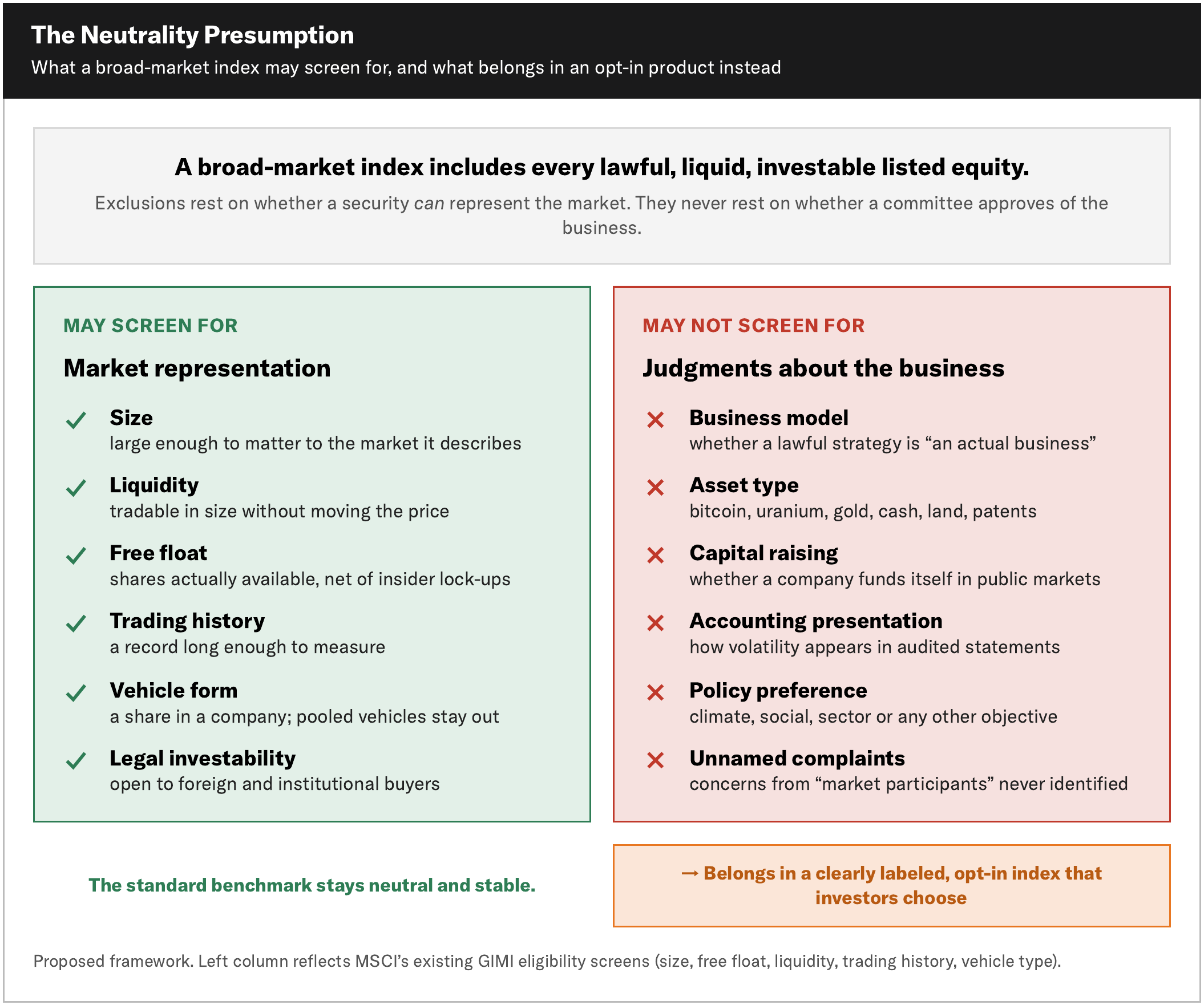
Congress and regulators should demand a clear principle from index providers. A broad-market index should include every lawful, liquid, investable listed equity. Any exclusion from such an index should rest solely on market-feasibility grounds. Those grounds concern whether a security is large enough, liquid enough and free enough of insider lock-ups to be bought in size, and whether it is a share in an actual company. Shares in pooled vehicles that simply hold other shares do not qualify, and they are already excluded today.68 A judgment about whether a lawful business model is the right kind of business model does not qualify as a market-feasibility ground. An index provider that wants to act on such a judgment should do so in a clearly labeled product that investors choose for themselves, and it should leave the broad-market benchmark alone.
That is the whole principle. It is consistent with how MSCI already describes its own flagship indexes, which exist, in MSCI's words, to "represent and measure global equity markets."69 The principle asks index providers to follow their prior public representations.
Three actions that follow from the principle
1. MSCI should withdraw the test or offer it as a choice. The consultation closes on September 30, and MSCI has said it will decide by October 16.70 The cleanest outcome is withdrawal. The next best outcome is the one Strive proposed in December 2025.71 MSCI could publish a variant of its Global Investable Market Indexes that excludes non-operating companies and let any client who shares MSCI's concern adopt it. That approach preserves investor choice, removes no company from the standard benchmark, and gives MSCI a product for the demand it says exists.
2. The SEC should finish the inquiry it opened in 2022. In June 2022, the Commission asked whether index providers had grown large and discretionary enough to be regulated as investment advisers. It noted at the time that inclusion or exclusion from an index "drives advisers with clients tracking that index to purchase or sell securities."72 Four years later, the docket is open and the question is unanswered.73 The Commission does not need to resolve the adviser question in order to act. It can require truthful labeling of every index licensed to a registered fund, so that investors know whether they own a broad-market product or a thematic, factor, climate or custom one. It can also require a published process, with notice, comment and stated reasons, for any categorical change to the eligibility rules of a broad-market index used by registered funds.74 The Commission has just shown, in its pursuit of ISS, that it regards the neutrality of financial gatekeepers as worth enforcing.75 The same standard belongs on the larger gatekeeper.
3. Congress should hold a hearing to bring light to this topic. The House Select Committee's 2024 report established that Congress already understands index rules move capital.76 A hearing before the House Financial Services Committee or the Senate Banking Committee should now ask the obvious follow-up questions. Those questions are what governs the rules, what recourse exists when they change, and whether a private firm that has told regulators it makes no judgments about companies should be permitted to make one.
Closing
Investors who select a broad-market fund reasonably expect exposure to the investable market under stable and transparent rules. They do not ordinarily expect a private committee to remove lawful companies because it has adopted an unpublished view of which assets or financing methods constitute a proper business.
Index providers should remain free to innovate, and investors should remain free to choose among competing products. The safeguard is accurate labeling and a clear separation between measuring a market and screening it according to policy or business-model preferences. Strategy makes the issue visible because it is large and controversial. The longer-term consequence will be determined by how the same discretion applies to the next capital-intensive technology or strategic industry.
The central question is who decides what a broad-market index represents. Private providers will continue to write methodologies, but their discretion should be bounded by transparent, sector-neutral rules and procedures that permit scrutiny and correction. That framework preserves competition among index providers while preventing a small, closed committee from becoming an unreviewable allocator of American and global capital.
Notes
1. Investment Company Institute, 2026 Investment Company Fact Book, ch. 2, pp. 18–19, figs. 2.5–2.6; ch. 6, pp. 75–76, fig. 6.5. Investment Company Institute, Active and Index Investing, July 2026 (Aug. 31, 2026), tables and notes.
2. Securities and Exchange Commission, Request for Comment on Certain Information Providers Acting as Investment Advisers, Release Nos. IA-6050 & IC-34618, File No. S7-18-22 (June 15, 2022), pp. 3–6, 22–25, 28–30.
3. MSCI, MSCI Indexes, headline metrics and nn. 1–2 (AUM as of Dec. 31, 2025; equity-index and ETF figures as of June 30, 2026; accessed Sept. 18, 2026).
4. Securities and Exchange Commission, Request for Comment on Certain Information Providers Acting as Investment Advisers, Release Nos. IA-6050 & IC-34618, File No. S7-18-22 (June 15, 2022), pp. 3–6, 22–25, 28–30.
5. MSCI Inc., Letter to the SEC Regarding File No. S7-18-22 (Aug. 15, 2022), pp. 4–6, 11–12.
6. Reuters, US Firms Facilitated Investments into Blacklisted Chinese Companies, Says House Probe (Apr. 18, 2024). Eric Revell, Billions in US Investment Goes to Chinese Firms Linked to CCP Military, Human Rights Abuses (Fox Business, Apr. 28, 2024).
7. MSCI, Public Offering of Metaplanet and Index Consultation on Digital Asset Treasury Companies (Sept. 12, 2025). MSCI, Extension of the Consultation on Digital Asset Treasury Companies (Oct. 10, 2025). MSCI, Consultation on Digital Asset Treasury Companies (Oct. 2025), pp. 2–3.
8. MSCI, Consultation on Eligibility of Non-Operating Companies for the MSCI Global Investable Market Indexes (Aug. 2026), pp. 2–10.
9. Id.
10. Id.
11. Securities and Exchange Commission, Request for Comment on Certain Information Providers Acting as Investment Advisers, Release Nos. IA-6050 & IC-34618, File No. S7-18-22 (June 15, 2022), pp. 3–6, 22–25, 28–30.
12. Id.
13. Securities and Exchange Commission, Investor Bulletin: Index Funds (Aug. 6, 2018); Securities and Exchange Commission, Request for Comment on Certain Information Providers Acting as Investment Advisers, Release Nos. IA-6050 & IC-34618, File No. S7-18-22 (June 15, 2022), pp. 3–6, 22–25, 28–30.
14. Investment Company Institute, 2026 Investment Company Fact Book, ch. 2, pp. 18–19, figs. 2.5–2.6; ch. 6, pp. 75–76, fig. 6.5.
15. S&P Dow Jones Indices, SPIVA U.S. Scorecard Year-End 2025, report 1a, pp. 12–13.
16. Investment Company Institute, 2026 Investment Company Fact Book, ch. 2, pp. 18–19, figs. 2.5–2.6; ch. 6, pp. 75–76, fig. 6.5.
17. Securities and Exchange Commission, Request for Comment on Certain Information Providers Acting as Investment Advisers, Release Nos. IA-6050 & IC-34618, File No. S7-18-22 (June 15, 2022), pp. 3–6, 22–25, 28–30.
18. MSCI, Consultation on Digital Asset Treasury Companies (Oct. 2025), pp. 2–3. MSCI, Consultation on Eligibility of Non-Operating Companies for the MSCI Global Investable Market Indexes (Aug. 2026), pp. 2–10.
19. Id.
20. MSCI, Consultation on Digital Asset Treasury Companies (Oct. 2025), pp. 2–3.
21. Id.
22. Andrew Bary, Strategy Isnʼt in S&P 500. Now It Could Get Kicked Out of Other Indexes (Barronʼs, Nov. 20, 2025); Reuters, Saylorʼs Strategy Engaging with MSCI on Potential Index Exclusion (Dec. 3, 2025).
23. Strive, Inc., Letter to Henry A. Fernandez Regarding Digital Asset Treasury Companies (Dec. 4, 2025), pp. 5–7.
24. Strategy Inc., Letter to the MSCI Equity Index Committee (Dec. 10, 2025), p. 2.
25. MSCI, Results of the Consultation on the Treatment of Digital Asset Treasury Companies (Jan. 6, 2026).
26. MSCI, Public Offering of Metaplanet and Index Consultation on Digital Asset Treasury Companies (Sept. 12, 2025). MSCI, Extension of the Consultation on Digital Asset Treasury Companies (Oct. 10, 2025).
27. S&P Dow Jones Indices, S&P U.S. Indices Methodology (July 2026), pp. 8–12.
28. S&P Dow Jones Indices, id., p. 22; Reuters, Robinhood to Join S&P 500 (Sept. 5, 2025); S&P Global, December 2025 Quarterly Changes (Dec. 5, 2025).
29. MSCI, August 3 Consultation Announcement; MSCI, Consultation on Eligibility of Non-Operating Companies for the MSCI Global Investable Market Indexes (Aug. 2026), pp. 2–10.
30. Id.
31. MSCI, Consultation on Eligibility of Non-Operating Companies for the MSCI Global Investable Market Indexes (Aug. 2026), pp. 2–10. Strategy Inc., Response to MSCIʼs Consultation (Aug. 31, 2026), pp. 1–5, 8.
32. Strategy Inc., Form 10-Q for the Quarter Ended June 30, 2026, pp. 2, 8, 27. Strategy Inc., Q2 2026 Results, Form 8-K Exhibit 99.1 (July 30, 2026).
33. MSCI, Consultation on Eligibility of Non-Operating Companies for the MSCI Global Investable Market Indexes (Aug. 2026), pp. 2–10. Strategy Inc., Response to MSCIʼs Consultation (Aug. 31, 2026), pp. 1–5, 8.
34. MSCI, Consultation on Eligibility of Non-Operating Companies for the MSCI Global Investable Market Indexes (Aug. 2026), public PDF Info.
35. Strategy Inc., Response to MSCIʼs Consultation (Aug. 31, 2026), pp. 1–5, 8. Strategy Inc., Form 10-Q for the Quarter Ended June 30, 2026, pp. 2, 8, 27.
36. Strategy Inc., Response to MSCIʼs Consultation (Aug. 31, 2026), pp. 1–5, 8.
37. MSCI, Consultation on Eligibility of Non-Operating Companies for the MSCI Global Investable Market Indexes (Aug. 2026), pp. 2–10.
38. Id.
39. Id.
40. AST SpaceMobile, Inc., Form 10-Q for the Quarter Ended June 30, 2026, business description and government-services discussion.
41. AST SpaceMobile, Inc., June 2026 Form 10-Q, balance sheet and PP&E note.
42. AST SpaceMobile, Inc., June 2026 Form 10-Q, cash-flow statement; 2025 Form 10-K, cash-flow statement.
43. Id.
44. Lithium Americas Corp., Form 10-Q for the Quarter Ended June 30, 2026, pp. 10, 23–24.
45. Lithium Americas Corp., June 2026 Form 10-Q, balance sheets and cash-flow reconciliation.
46. Lithium Americas Corp., June 2026 Form 10-Q; 2025 Form 10-K.
47. MSCI, Is Fossil-Fuel Divestment the Answer to Climate Change? (published Oct. 14, 2021), official transcript, segments beginning 09:06 and 14:46.
48. MSCI, 2017 Annual Report and Form 10-K (filed Feb. 26, 2018), printed p. 15, Remy Briand biography.
49. MSCI, How Much Goes into a Net-Zero Commitment? (Apr. 22, 2021), official transcript, segments beginning 16:40, 17:26 and 18:11.
50. MSCI, MSCI Announces Senior Leadership Changes (Jan. 13, 2022).
51. MSCI, 2025 CDP Corporate Questionnaire reporting year 2024, sections 4.5 and 4.5.1, PDF pp. 47–49.
52. MSCI, 2026 Proxy Statement Compensation Matters, printed pp. 72–74, annual incentive plan changes.
53. Securities and Exchange Commission, Request for Comment on Certain Information Providers Acting as Investment Advisers, Release Nos. IA-6050 & IC-34618, File No. S7-18-22 (June 15, 2022), pp. 3–6, 22–25, 28–30. MSCI Inc., Letter to the SEC Regarding File No. S7-18-22 (Aug. 15, 2022), pp. 4–6, 11–12.
54. U.S. House Select Committee on the Strategic Competition Between the United States and the Chinese Communist Party, Investigative Report (Apr. 2024), pp. 1–2. Reuters, US Firms Facilitated Investments into Blacklisted Chinese Companies, Says House Probe (Apr. 18, 2024).
55. MSCI Inc., Letter to the SEC Regarding File No. S7-18-22 (Aug. 15, 2022), pp. 4–6, 11–12.
56. Reuters, US Firms Facilitated Investments into Blacklisted Chinese Companies, Says House Probe (Apr. 18, 2024).
57. MSCI, Consultation on Digital Asset Treasury Companies (Oct. 2025), pp. 2–3. MSCI, Consultation on Eligibility of Non-Operating Companies for the MSCI Global Investable Market Indexes (Aug. 2026), pp. 2–10.
58. MSCI, Formal Index Complaint Handling Policy and Procedure, pp. 2–3 (Dec. 2018).
59. S&P Dow Jones Indices, S&P U.S. Indices Methodology (July 2026), p. 22.
60. Financial Conduct Authority, Wholesale Data Market Study—Report, MS23/1.5 (Feb. 2024), paras. 1.20, 1.24; Annex 2: Benchmarks, paras. 3.62, 5.65, 6.14.
61. MSCI, Comments on Vanguardʼs Planned Transition (Oct. 2, 2012); Reuters, Vanguard Dumps MSCI Indexes from 22 Funds (Oct. 2, 2012).
62. Securities and Exchange Commission, Request for Comment on Certain Information Providers Acting as Investment Advisers, Release Nos. IA-6050 & IC-34618, File No. S7-18-22 (June 15, 2022), pp. 3–6, 22–25, 28–30.
63. Securities and Exchange Commission, SEC v. Institutional Shareholder Services, Inc., Litigation Release No. 26632 (Sept. 4, 2026).
64. Executive Order 14366, Protecting American Investors from Foreign-Owned and Politically-Motivated Proxy Advisors, 90 Fed. Reg. 58503 (Dec. 11, 2025), secs. 1, 2(c).
65. Securities and Exchange Commission, Litigation Release No. 26632 (Sept. 4, 2026); Memorandum of Law, pp. 1–10, 21–23.
66. Securities and Exchange Commission, Memorandum of Law in SEC v. ISS, pp. 1–10 (Sept. 4, 2026).
67. MSCI Inc., Letter to the SEC Regarding File No. S7-18-22 (Aug. 15, 2022), pp. 4–6, 11–12.
68. MSCI, Global Investable Market Indexes Methodology (May 2026), eligible-security rules, pp. 14–15.
69. MSCI, MSCI Indexes, headline metrics and nn. 1–2 (AUM as of Dec. 31, 2025; equity-index and ETF figures as of June 30, 2026; accessed Sept. 18, 2026).
70. MSCI, Consultation on Eligibility of Non-Operating Companies for the MSCI Global Investable Market Indexes (Aug. 2026), pp. 2–10.
71. Strive, Inc., Letter to Henry A. Fernandez Regarding Digital Asset Treasury Companies (Dec. 4, 2025), pp. 5–7.
72. Securities and Exchange Commission, Request for Comment on Certain Information Providers Acting as Investment Advisers, Release Nos. IA-6050 & IC-34618, File No. S7-18-22 (June 15, 2022), pp. 3–6, 22–25, 28–30.
73. Securities and Exchange Commission, Docket S7-18-22; public comment file.
74. Securities and Exchange Commission, Investment Company Names, Release Nos. 33-11238 & IC-35000 (Sept. 20, 2023), pp. 8–13, 71–79. This authority concerns fund names and disclosures and does not by itself establish direct authority over index-provider governance.
75. Securities and Exchange Commission, Litigation Release No. 26632 (Sept. 4, 2026).
76. U.S. House Select Committee on the Strategic Competition Between the United States and the Chinese Communist Party, Investigative Report (Apr. 2024), pp. 1–2.