


Executive Summary
Historically, limited access to energy and hardware has been the most significant constraint on America's AI buildout. But in 2026, a new and arguably more severe bottleneck has emerged: state and local politics. According to Gallup, more Americans today would favor a nuclear power plant being built in their area than a data center. Meanwhile, the number of local data center moratoria has skyrocketed, from 6 in 2024 to 294 in 2026.
Industry and state economic development offices have responded to rising opposition by highlighting job creation and tax receipts. But many residents remain unconvinced. Today, 73% of Americans believe the costs of the buildout outweigh its benefits. And when asked who will gain the most from AI at work, they name business owners and executives over workers by roughly eight to one.
The concern shared by many in America's heartland is that the AI revolution is either leaving them behind or does not stand to benefit them or their families. Beyond the blue-collar job creation that is already taking place, additional policy is therefore needed to ensure the economic empowerment of rural Americans in the age of AI. To that end, this paper proposes data center dividends.
A data center dividend is a payment or credit made every year to every household in a county that hosts a data center. The payment or credit would be funded by a fixed share of the property tax revenue the county already collects from that data center while still leaving ample funds to finance schools, police departments, and public works projects. Because that revenue is already being collected under rates already on the books, a dividend would require no new tax and would add no cost for the company that builds the facility.
The tax revenues being generated by data centers are large enough to reset the economic trajectory of an entire county. For example, in West Feliciana Parish, Louisiana, a jurisdiction of roughly 4,000 households, a data center developer has agreed to pay the local government about $90 million a year in revenue. This would more than triple the parish's current annual budget. By our estimates, this influx of revenue would allow the parish to double current funding for schools, roads, and public safety. And with the money left over, it could remit a data center dividend to each household in the parish worth between $5,600 and $11,200 every year.
After highlighting the potential benefits of data center dividends in West Feliciana, this paper then examines published tax documents to project the potential value of a data center dividend in other rural counties. By our estimates, a single 1-gigawatt AI data center could generate enough tax revenue to provide every household in a rural county with a data center dividend ranging between $4,500 and $8,900 every year.
The data center dividend model borrows from the logic of sovereign wealth funds (in countries like Norway and Saudi Arabia) and permanent funds (in states like Alaska). Every government that has built a successful permanent fund has two essential properties: a small population relative to its landmass and a highly scarce resource, usually in the form of energy. America's rural counties share those exact same properties: they have a small population relative to their landmass and a highly scarce resource in the form of pristine real estate for AI development. But they have yet to monetize these properties in a way that maximizes economic benefits for their residents. Data center dividends is their opportunity to do so.
Consider how the dividend model has already transformed the Alaskan economy. The Alaska Permanent Fund is a state-owned investment account that captures at least a quarter of the royalties Alaska earns from oil produced on state land, invests them in global markets, and pays out a share of the returns to every resident as an annual dividend. It has done so for 44 consecutive years, across governors of both parties. As a result, the typical Alaskan household has collected about $3,900 each year in dividends over the past decade. In the average US rural county that builds a data center and remits a data center dividend, the average household stands to collect even more.
The final form a data center dividend could take is ultimately up to the locals, and this paper offers a range of policy ideas. A county could offer a data center dividend as a check or a direct deposit. It could offer a dividend as a credit against property tax bills, or against electricity bills to address power-cost complaints. A county could use data center dividends to build an endowment that provides scholarships to every child who graduates from the county high school. Or a county concerned about the durability of the AI boom could invest the receipts and pay out only the earnings, keeping the endowment whether or not the data center is still running in 2050. This paper outlines a general concept for data center dividends rather than a one-size-fits-all policy prescription. And it encourages local leaders to tailor these policies according to their communities' needs.
The counties now being surveyed for data center campuses hold what the AI economy cannot manufacture anywhere else: open land and abundant power. In short, they are sitting on a digital goldmine, and they deserve to share in the rising fortunes of a country that is building primarily where they live. Data center dividends make this possible.

Figure 1. The dividend is the last claim on the money, not the first: the county funds its operating budget, reserves, and capital needs, then remits a fixed share of what remains to every household.
Introduction
Gallup asked Americans in early 2026 whether they would favor or oppose the construction of an artificial intelligence data center in their area: 71% said they would oppose it, with 48% saying they would oppose it strongly.1
By comparison, 53% of Americans said they would oppose a nuclear power plant being built in their area.2 In short, Americans are now more willing to live beside a nuclear power plant than a building full of computers.
This is the political backdrop of the data center buildout, the largest US infrastructure project of the decade. The bulk of this buildout is taking place in rural America. Of the more than 1,500 American data centers under construction, planned, or land-banked, 67% are headed to rural areas, and 39% to counties that host no data centers today.3 While the first generation of data centers clustered near fiber hubs outside major cities, the second generation is clustering around inexpensive land and power.
These jurisdictions are often poorer than the country as a whole. Roughly 46 million Americans live in the 1,958 counties the federal government classifies as nonmetropolitan, where poverty runs about three points above the urban rate and labor force participation about seven points below.4 The AI buildout is the largest capital investment those counties have seen in a generation. And yet, the political backlash to the buildout in many of these counties is growing. There were only 6 local data center moratoria in 2024. But that number climbed to 59 in 2025, and then to 294 by August 2026.5
Industry and state economic development offices have responded to the backlash by making the case for job creation and publishing rising tax revenues generated by data centers. And they are not wrong to do so. Data center construction reached an annualized $75.2 billion in July 2026, up 57% in a single year, and now accounts for 61% of all private office construction in the United States.6 Virginia's legislative audit commission credits the industry with 28,000 construction workers and more than 8,000 direct operations jobs in that state alone.7 Prince William County, Virginia, meanwhile, collected $293.7 million in data center taxes in tax year 2024, an increase of 77% over the prior year.8

Figure 2. Opposition to data centers has hardened as the buildout has accelerated. Sources: Gallup (March 2026), Marquette Law School Poll (July 2026), and the Bommarito moratorium dataset.
Nevertheless, opposition remains strong. At issue is the perception that large technology companies are reaping the benefits of the AI boom while the average American is getting left behind. In a survey conducted in July 2026, Americans were given two characterizations of data centers and asked which they agreed with more: 62% of registered voters chose the characterization that data centers are "mostly large technology facilities that use too much energy and water and provide too few benefits to local communities," against 38% who considered data centers critical infrastructure needed for the country's economy and security.9
A separate national survey found 73% of Americans believe the costs of the buildout outweigh its benefits, with majorities of both political parties agreeing.10 Asked who will benefit from the spread of AI at work, Americans named business owners and executives over workers by roughly eight to one.11
Beyond the blue-collar job creation that is already taking place, additional policy is needed to ensure the economic empowerment of rural Americans in the age of AI. To that end, this paper proposes data center dividends.
What Is a Data Center Dividend?
A data center dividend is a payment or credit made every year to every household in a county that hosts a data center. The payment or credit would be funded by a fixed share of the property tax revenue the county already collects from that data center. A data center dividend would not need to be funded by a new tax, because the money would come from revenue the county already collects from existing property taxes.
This paper first outlines a model for dividends offered as a check or direct deposit to households because it is the simplest form to understand. But a data center dividend could also be offered as a credit county citizens receive against a property tax or a utility bill. Or it could be invested as part of an endowment or permanent fund designed to serve the community over the long term. This paper outlines multiple options, all built around maximizing economic opportunities for county residents. But no matter the form the dividend takes, the basic structure remains the same: the county collects taxes from data centers, keeps what it needs, and remits the rest to the people living in the same county as the data center.
The logic for data center dividends is based on successful tax models found in other governments, at both the state and national levels. Countries and states with small populations and a rich energy resource funnel revenue raised from that resource into a permanent fund that compounds over the long term. The success of the Alaska Permanent Fund and several sovereign wealth funds demonstrates the prosperity America's local leaders can unlock at the county level.
A Brief History of Permanent Funds

Figure 3. Balances as reported mid-2026; figures for funds that do not publish audited holdings are estimates. Sources: Norges Bank Investment Management, Global SWF, and the Alaska Permanent Fund Corporation.
Every government that has built a successful permanent fund shares two characteristics: it has a small population relative to its landmass and valuable energy resources. Alaska offers the best American example.
The Alaska Permanent Fund is a state-owned investment account that captures a share of the money Alaska earns from oil produced on state land, invests it in stocks, bonds, and real estate, and pays part of the returns to residents as an annual dividend. The fund was created by constitutional amendment in November 1976, which requires that at least 25% of the state's mineral royalties be deposited into it and that the principal never be spent. The fund held $91.3 billion at the end of June 2026.12 It has paid a dividend to every eligible resident for 44 consecutive years, averaging $1,491 over the past decade.13 It paid 618,863 of Alaska's 738,737 residents in 2025 alone, with children receiving the same amount as adults.14
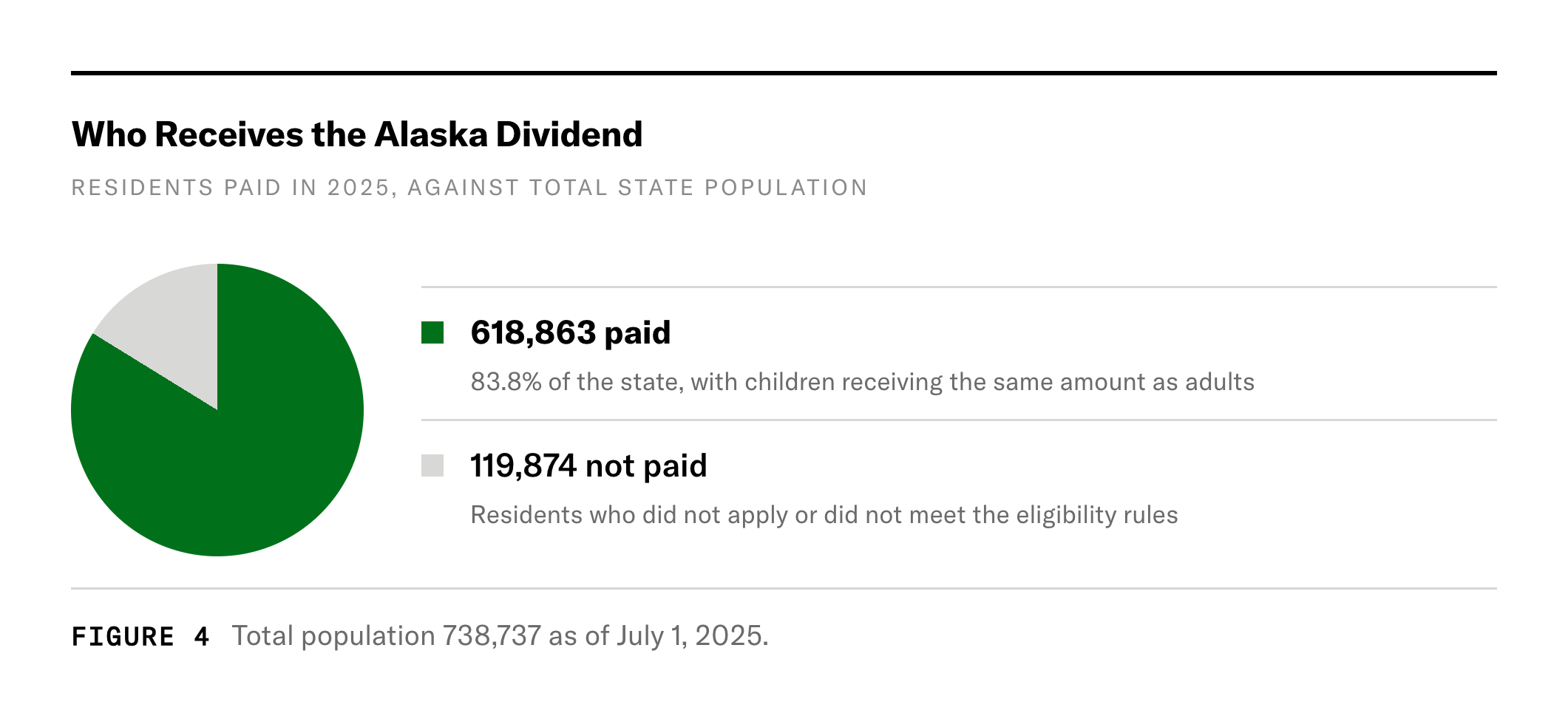
Figure 4. Total population: 738,737 as of July 1, 2025.
Governor Jay Hammond, the fund's principal architect, designed the dividend to ensure that all Alaskans benefited from oil production in the state. As his legislative ally, Clem Tillion, stated: "The dividend was designed to make the people aware that it's their money. This is a share of what their money earns. Not a fixed amount, that's a welfare check."15 Governor Hammond's fear was that oil money routed through appropriations would go to special interests when it should be returned to the people.
Policymakers designed the Alaska Permanent Fund to outlive the boom that created it. Alaska's petroleum production has fallen roughly 77% from its 1988 peak, and oil's share of the state's unrestricted general fund revenue has fallen to a forecasted 23% in fiscal year 2027.16 Yet the fund keeps compounding anyway. Over the past decade, from a resource producing a fraction of what it once did, the typical Alaskan household of 2.61 people received about $3,900 per year.
Alaska's permanent fund is unusual in America, but it is not unusual in the rest of the world.
Consider Kuwait, the first country to establish a sovereign wealth fund. In February 1953, the Kuwait Investment Board began putting oil receipts into overseas assets. The country's sovereign wealth fund now manages roughly $1.07 trillion.17
Abu Dhabi followed Kuwait's example in 1976, the same year Alaska amended its constitution to establish the Alaska Permanent Fund, and now holds approximately $993 billion in assets.18
Norway's Government Pension Fund Global, the largest in the world, stood at 22.7 trillion kroner at the end of June 2026, or roughly $2.3 trillion, an amount worth four million kroner, or about $405,000, for every Norwegian alive.19
Saudi Arabia's Public Investment Fund, meanwhile, reported $904 billion at the end of 2025, and Qatar's fund holds approximately $526 billion.20
Like Alaska, these countries monetize their national assets to expand their national wealth. But Alaska's dividend model sets it apart from the sovereign wealth funds. Writing in 2011, Angela Cummine observed that although more than 50 countries had established sovereign wealth funds, Alaska's was the only one distributing profits directly to its citizens. That remains true today.21 By returning the money to the people who make the oil industry possible, Alaska built a distinctly American model that answers to households rather than to a finance ministry. That is the model our country's rural counties should consider adopting.
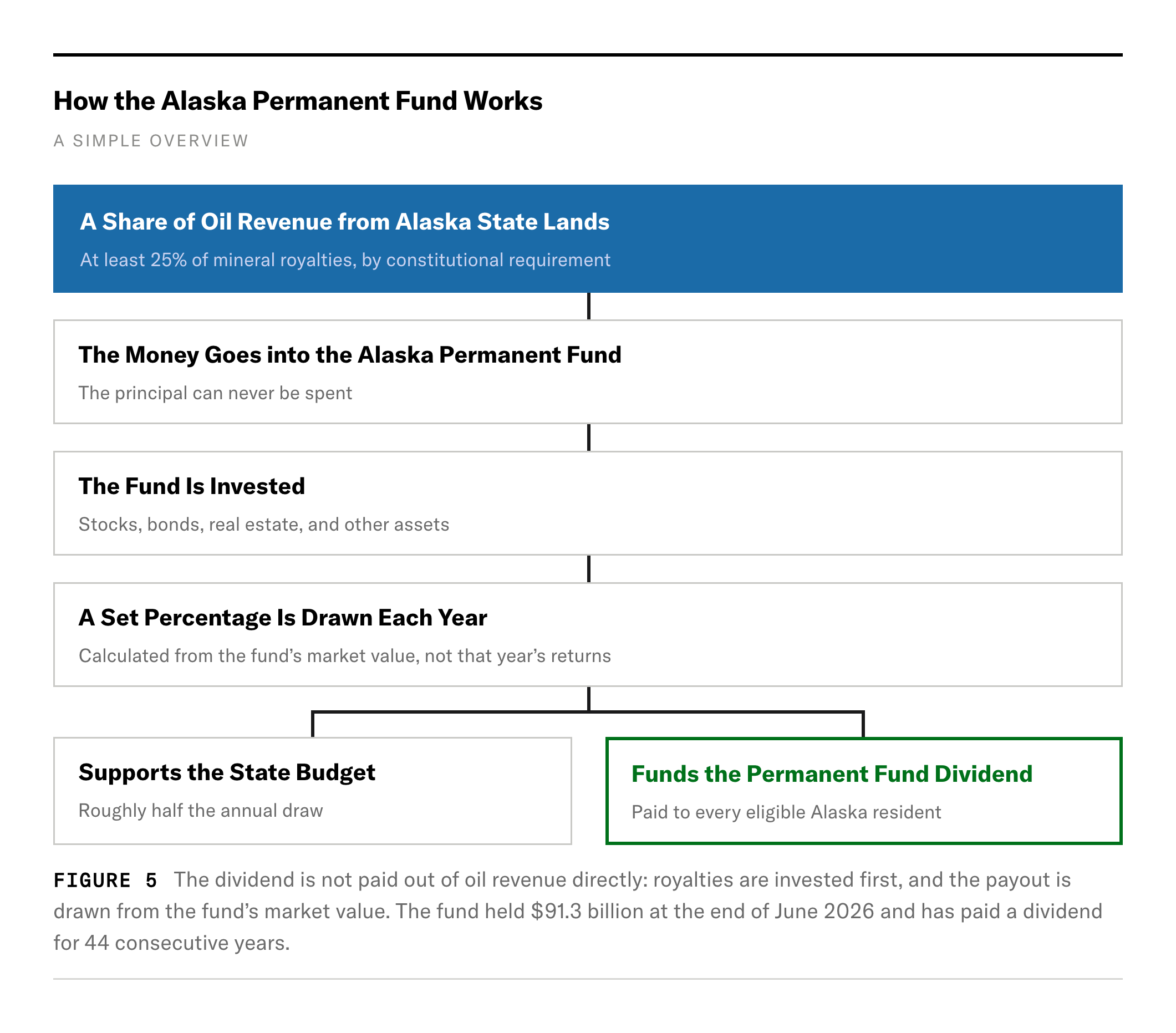
Figure 5. The dividend is not paid out of oil revenue directly: royalties are invested first, and the payout is drawn from the fund’s market value. The fund held $91.3 billion at the end of June 2026 and has paid a dividend for 44 consecutive years.
Applying the Permanent Fund Model to America's Rural Counties
Alaska, Norway, and the Gulf countries illustrate the two conditions necessary for establishing a successful permanent fund: a government must have a small population relative to its landmass and a valuable energy resource. America's rural counties have both.
What America's rural counties do not have is a fund, a formula, or any mechanism at all for turning tax revenue from the AI boom into something that can materially benefit county residents beyond new facilities and funding for essential services. This paper seeks to change that by outlining a basic structure for data center dividends.
Case Study: West Feliciana, Louisiana
Before turning to the potential value of a data center dividend in the average rural county, it is worth looking at a jurisdiction that almost implemented a similar policy. One Louisiana parish has come closer to a data center dividend than any other local government in the country, and its revenue figures are not projections.
In October 2025, a parish of about 4,000 households on the east bank of the Mississippi signed the most consequential data center agreement in the country, but it drew almost no national attention.
Hut 8 is building River Bend in West Feliciana Parish, which is located about 35 miles north of Baton Rouge. This AI campus represents up to $10 billion of investment in its first phase. Fluidstack has leased 245 megawatts on a 15-year agreement worth $7.0 billion, with Google backstopping the lease payments. In addition, Entergy Louisiana has committed 330 megawatts of initial capacity with room for 1,000 more. The first buildings are scheduled to start running in 2027.22
Once the first phase is complete, the parish expects the campus to pay it roughly $90 million a year. Parish President Kenny Havard has put the parish's current annual tax collections at about $41 million, which means that these payments will more than triple the parish budget.23 A second phase, expected three to five years out, would add another $30 million to $40 million a year.24
A quirk in Louisiana tax law made the $90 million annual payment possible. The state's Industrial Tax Exemption Program grants manufacturers up to 80% property tax relief for as long as a decade, allowing large industrial projects there to pay a small fraction of their property taxes for ten years. But this exemption does not apply to data centers, so Hut 8 was ineligible. Facing a facility with $7.5 to $8 billion of graphics processing units (GPUs) and no exemption to fall back on, the parish and the company built a payment in lieu of taxes through the parish Industrial Development Board.25 This payment in lieu of taxes allowed West Feliciana to capture a large share of a large tax base.
Then the parish did something no local government in the United States has done. In the spring of 2026, Representative Jeremy LaCombe carried a bill authorizing West Feliciana's three principal taxing bodies to hand data center revenue back to the people who pay taxes there. It passed the House 96 to 0 and the Senate 36 to 0, with no opposition testimony in the record. Governor Landry signed it as Act 434 on May 29, 2026, effective January 1, 2027.26
Act 434 authorizes a credit against next year's property tax bill, not a payment. The bill as originally filed permitted a fixed cash sum per property, but a House committee amendment later removed the cash option. The law requires the parish president, the school board president, and the sheriff to meet by June 30 each year and agree unanimously on a property tax credit or to agree unanimously on sending the funds elsewhere. The earliest meeting between the parish's three taxing authorities is set for June 2027.27
In summary, West Feliciana has not created a data center dividend, but it has created something remarkably close to it. Consider, however, what a data center dividend would look like in West Feliciana if the cash option had not been removed from Act 434. Dividing the parish's expected $90 million annual payment by its 4,026 households, the gross figure is about $22,400 per household.28
Now suppose 75% of that gross figure were used to fund schools, teacher salaries, the police department, roads, and infrastructure projects. That would still leave 25% of the gross revenue to fund data center dividends worth about $5,600 per household every year. And if 50% were used to fund a data center dividend, it would be worth about $11,200 per household every year.29
The average Alaska household has received about $3,900 a year over the past decade from a fund holding $91.3 billion that is fed by an entire state's oil revenue. By comparison, a West Feliciana household could receive $5,600 from tax revenue generated by one data center campus alone.30
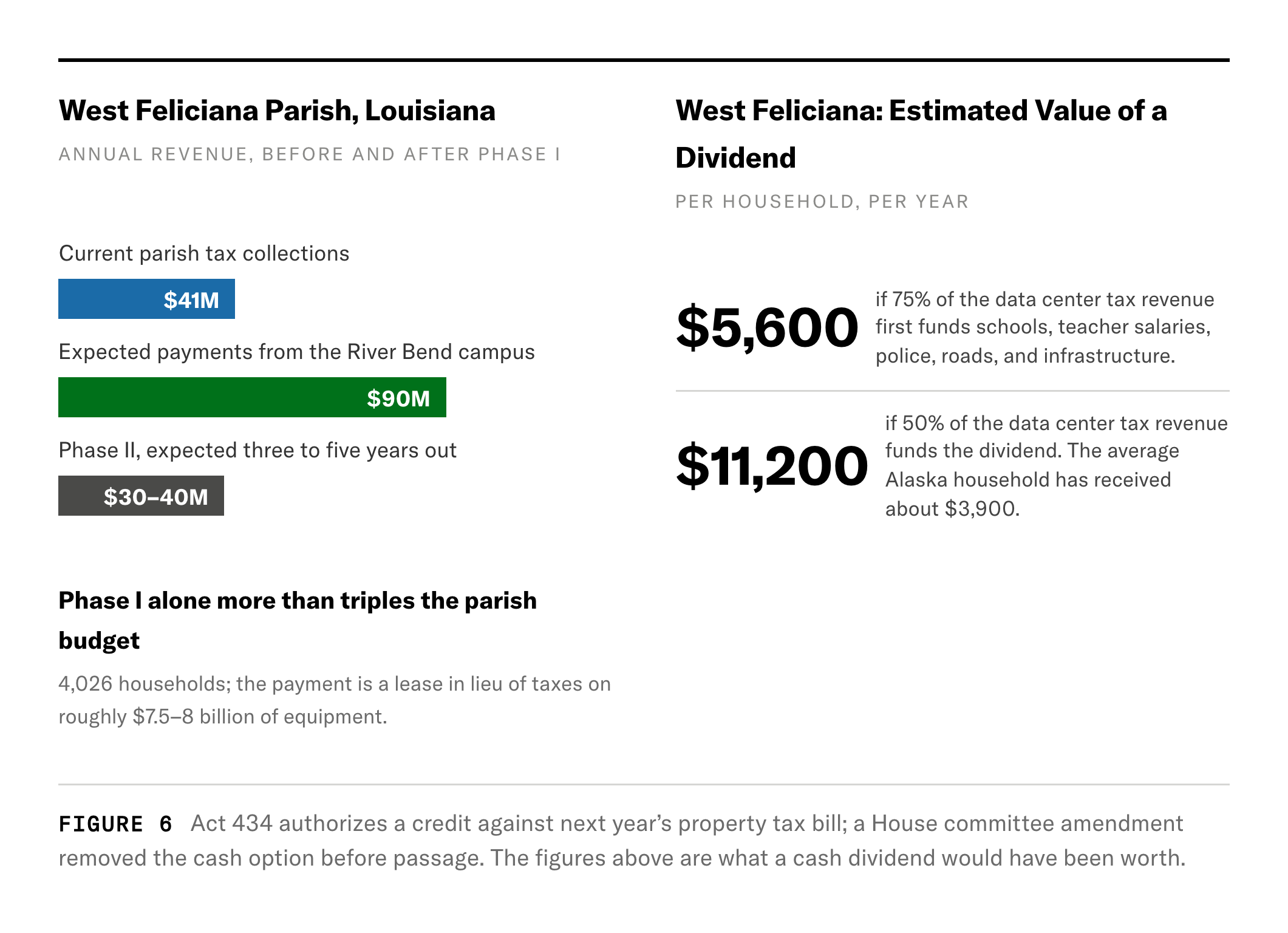
Figure 6. Act 434 authorizes a credit against next year’s property tax bill; a House committee amendment removed the cash option before passage. The figures above are what a cash dividend would have been worth.
What a Gigawatt Is Worth
West Feliciana is one parish with one unusually favorable position in its state's tax code. The question for every other rural county considering a data center is whether it could replicate the same success and model data center dividends in a similar fashion.
Answering that question requires building an estimate. And here, it must be emphasized that the figures that follow are just that, estimates. Every jurisdiction has different population sizes, and every jurisdiction has different tax structures. Rates vary, assessment ratios vary, and many counties give away a large share of the tax base in abatements before the first server is ever installed. A county that exempts data center equipment outright, for example, will likely collect much less than what West Feliciana negotiated.
To build a reasonable estimate, Loudoun County, Virginia, offers a helpful data set. Loudoun County is the best-documented data center jurisdiction in the country. It holds roughly half of Virginia's data center industry by site count, building square footage, and energy use, it taxes computer equipment at full rate with no abatement, and it reports what that equipment pays in its own budget documents.31 Almost no other county publishes this level of information about its data center industry.
In fiscal year 2024, Loudoun collected $684,787,341 in personal property tax on the computer equipment inside its data centers, a single line in the county's adopted budget.32 That is the tax on the servers alone, which sits at $4.15 per $100 of assessed value.33 This revenue total excludes the land and the buildings, and it excludes sales tax, because Virginia exempts data center equipment entirely. Data centers occupy about 4% of Loudoun's commercial parcels and supply roughly 38% of its general fund revenue.34
What separates data centers from other industrial facilities is how quickly they cycle out their equipment, providing a self-replenishing source of tax revenue for the county. Consider that a factory installs the majority of its equipment once and watches it depreciate over decades. A data center, by contrast, replaces its servers every three to five years, and each new generation enters the rolls near full value.35
As a case in point, Loudoun's tax on business computer equipment grew from $150.5 million in fiscal 2017 to roughly $879 million budgeted for data center equipment alone in fiscal 2027.36 That growth comes from new data centers being built, but it also comes from existing data centers buying new servers to replace old ones.
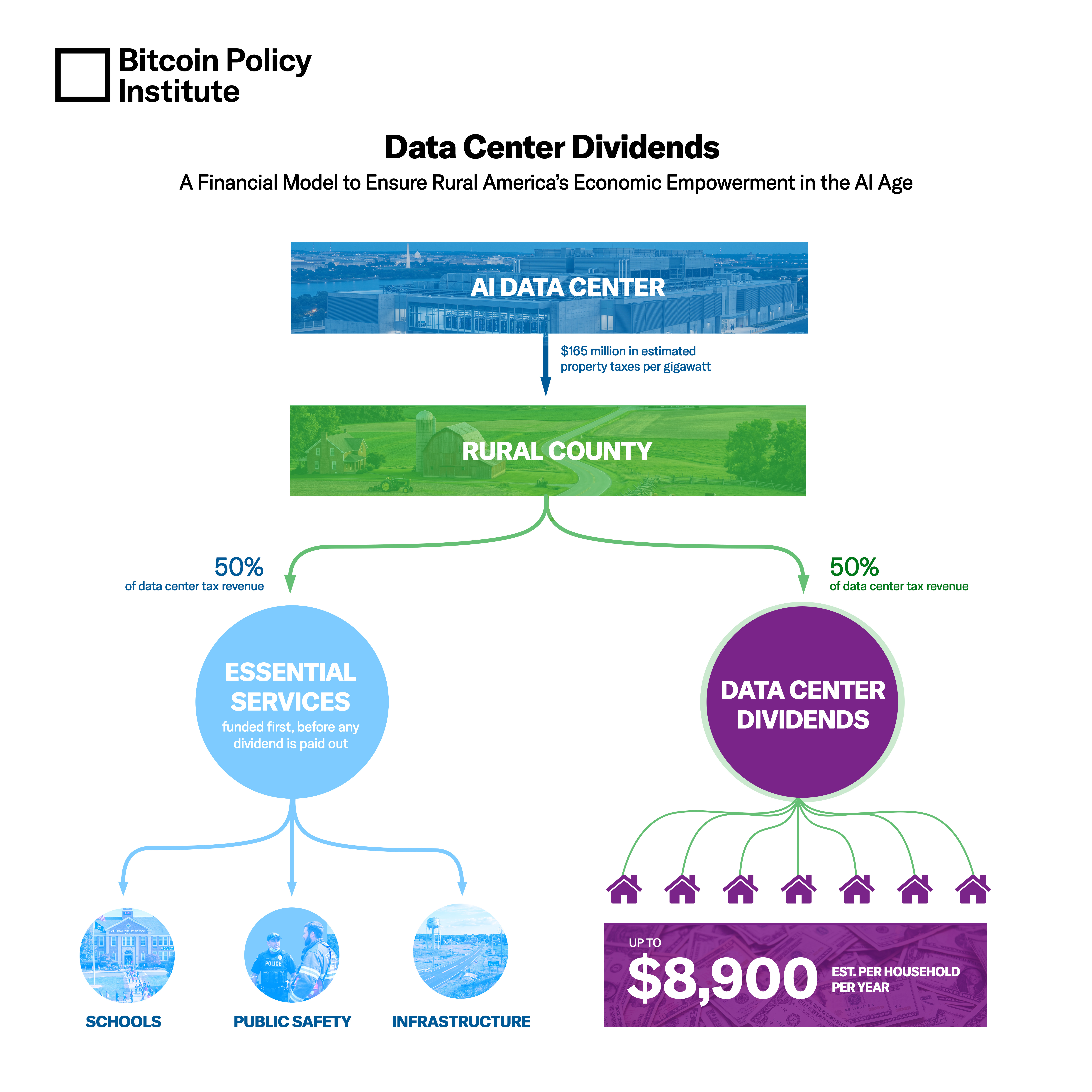
Loudoun's disclosures make possible a calculation no other county's numbers allow. Data centers are sized in gigawatts of electrical load, which is how every project in the country is announced and how every utility contract is written. Because Loudoun reports both what it collected and how much load its data centers were drawing, those figures can be used to convert a project's size directly into a tax figure. Divide what Loudoun collected in fiscal year 2024 by the data center load it was carrying, about 4.14 gigawatts, and the result comes to roughly $165 million in personal property tax revenue per gigawatt per year.37
Now place a gigawatt of that load in a rural county. The mean nonmetropolitan county holds about 23,400 people, or roughly 9,300 households based on the national average household size (note that the median county is smaller, which would push every figure below higher).38 At $165 million a year, that is about $17,800 of gross annual revenue per household for every gigawatt of power.39
That figure is built to run low. The $165 million counts only what Loudoun collects in business personal property tax on computer equipment. It excludes the real property tax those same campuses pay on their land and buildings, and it excludes sales tax.
Of course, no county would remit the full estimated tax amount of $17,800 per household. It would need to prioritize education and public works first. But a county that remitted just 25% of that tax revenue as a data center dividend would pay each household about $4,500 a year. And a county that remitted 50% of that tax revenue as a data center dividend would pay each household about $8,900 a year. In other words, according to this estimate, a single 1-gigawatt AI data center could pay every household in a rural county between $4,500 and $8,900 every year, without raising anyone's taxes and at no added cost to the company that built it.

Figure 7. These figures are estimates, not projections. The estimate counts business personal property tax on computer equipment, excluding real property and sales taxes. Using the mean rather than the median county also lowers every figure.
Note that the estimated range for this data center dividend is similar to the estimated range in the West Feliciana case study. West Feliciana, working from a signed agreement in a real jurisdiction, produces about $22,400 per household in gross revenue. The general estimate, built from a different state's tax rolls and the average household count for rural counties, produces about $17,800 per household in gross revenue. The general estimate is the lower of the two, which is the safer direction to be wrong in.
To put the general estimate in perspective, consider the economic premium a dividend of this size would provide for American families. A single annual dividend could cover a family's electricity bills for more than two years in a row. The average American household paid $142.26 a month for electricity in 2024, or about $1,707 for the year.40 The smaller of the two general dividend estimates above ($4,500) would erase that bill entirely and still leave more than half the payment for families to spend in whatever way best serves their wellbeing and financial health.
The Case for Dividends over Credits
Residents often feel the positive material impact of dividends more than they do tax cuts or tax credits. Take Loudoun County as an example.
Between fiscal year 2021 and fiscal year 2026, as data center revenue climbed, Loudoun County's general fund operating budget grew from $648.6 million to roughly $1.06 billion, about 10% a year. Its population, meanwhile, grew about 1.6% a year.41
This sudden surge in tax revenue allowed Loudoun to cut its real property tax rate every year for a decade to reach the lowest rate in Northern Virginia. But this did not prevent a political backlash to data centers in the county. In July 2026, in the most data center-dependent county in the country, the Board of Supervisors voted 6 to 1 to have county staff research the legality of pausing all new data center and substation applications, with a formal proposal to follow that fall.42
Tax cuts are seldom noticed by taxpayers, so credit is seldom given where it is due. No resident gets a notice explaining that their bill would have been higher, were it not for data centers. Pennsylvania has run a similar experiment at state scale since 2008. The state sends gaming tax revenue to school districts, which use it to knock a fixed amount off the school property tax bill of every owner-occupied home in the district. In fiscal year 2025, that came to $800 million spread across 2.64 million households, an average of about $303 each. But few Pennsylvanians know the casinos are paying part of their school taxes.43
By contrast, when residents receive a dividend, political support for what made the dividend possible persists over time. Alaska again provides a useful example. The dividend from the Alaska Permanent Fund has been paid for 44 consecutive years, across governors of both parties. And it survived a 2017 Alaska Supreme Court ruling holding that it enjoys no constitutional protection and "must compete for annual legislative funding just as other state programs."44 A 2021 statewide survey found 65% of Alaskans supported amending the constitution to guarantee the dividend against just 30% opposed.45 No Alaska legislature has been willing to end the dividend because a majority of residents support the program, including large numbers on both sides of the aisle.
There is a second reason to prefer dividends over tax credits or cuts or even additional local government spending. Local governments are not known for being effective capital allocators. Counties often route windfall tax revenue to projects based on whichever special interest pushes hardest, even when rural families could use the money more. Dividends are, therefore, a more efficient form of capital allocation, with much of the money being recycled directly into the local economy.
Designing the Dividend
This paper describes the cash payment version of data center dividends because it is most illustrative. But there is no single correct design. A parish of 4,000 households and a county of 40,000 households face different challenges, and a community with a failing water system has different priorities than one with a shrinking school. What follows is a menu of policy options local leaders can choose from, tailoring data center dividends to the needs of their citizens.
The two principles below can help local leaders maximize the efficacy and impact of data center dividends.
First, the dividend should be the last claim on the money, never the first. Fund the county's operating budget, then a reserve against volatility, then capital needs, and then pay the dividend out of what remains.
Second, shares should be equal, with no credit for seniority. Alaska's original statute granted one share for every year of residency since statehood, so a resident of 23 years would have received $1,050 and a resident of one year just $50. In Zobel v. Williams, the Supreme Court struck down this specific proposal 8-1, holding that rewarding citizens for past contributions is not a legitimate state purpose because it "would permit the states to divide citizens into expanding numbers of permanent classes."46 As a result Alaska's first dividend was a flat $1,000 to everyone, and all dividends since have been flat payments to individual residents.
Building on these principles, the final form a data center dividend takes is up to locals.
The Dividend Model
A county could write checks, as Alaska does, and as Macau has done for every permanent resident every year since 2008. Macau's payment is an annual appropriation from the general budget rather than a dedicated earmark, but gaming taxes supplied 82.7% of the government's total tax revenue in 2025, so in practice the casinos fund it.47 But a county could also deliver the dividend as a credit on property tax bills, which is the route West Feliciana is most likely to take and the route Pennsylvania has already taken based on earnings from gaming revenue. The benefit of a tax credit is that it is administratively simple compared to a cash dividend.
The Credit Model
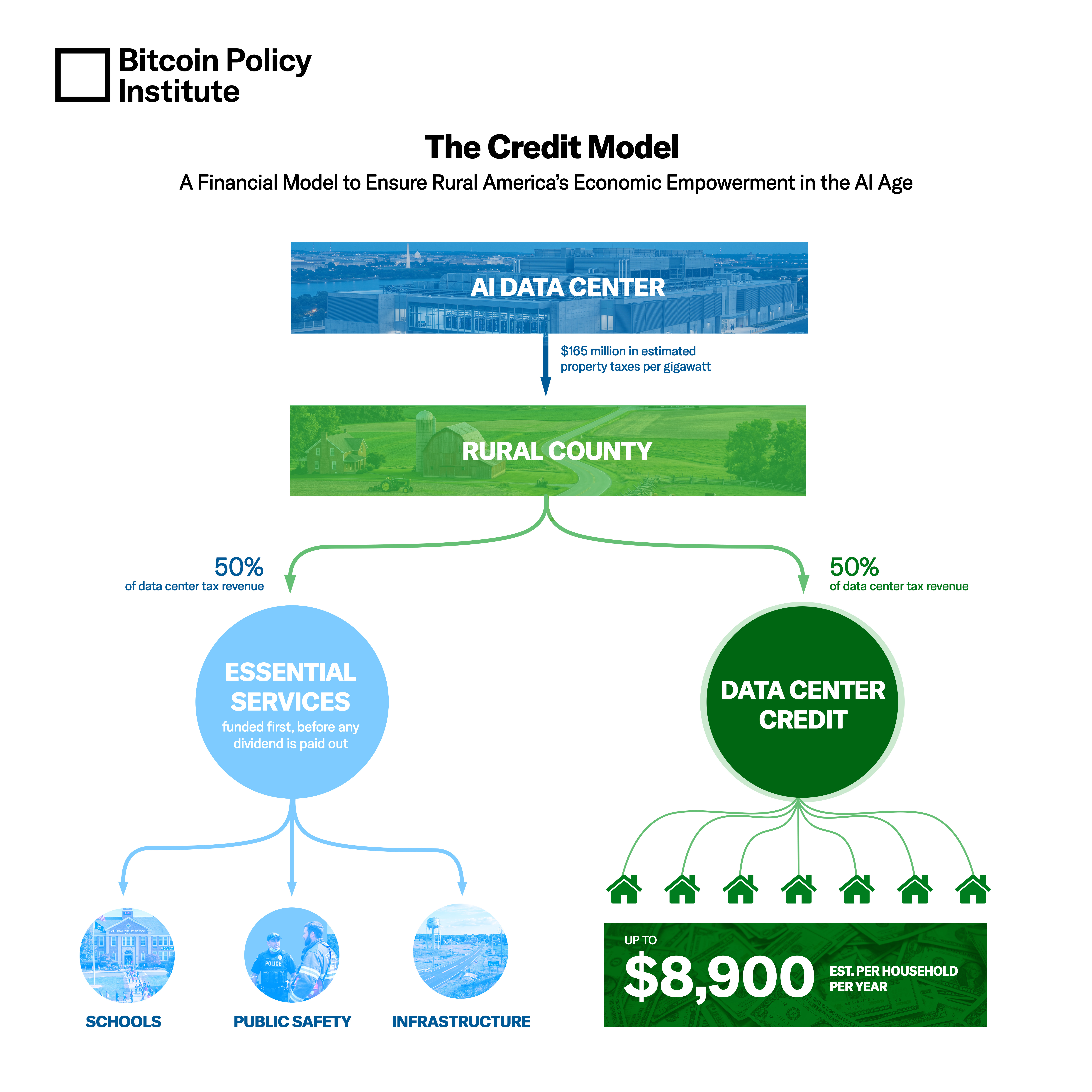
Alternatively, the credit made possible by data center revenues could apply directly to residents' electricity bills. Unlike a property tax credit, a credit for electricity payments would benefit homeowners and renters alike. And it would obviate any concerns about data centers hiking power prices. At the levels estimated above, the effect would be more than symbolic. As mentioned previously, a $4,500 dividend set against an average annual household electricity bill of $1,707 would cover a family's power costs for more than two years running.
The Endowment Model
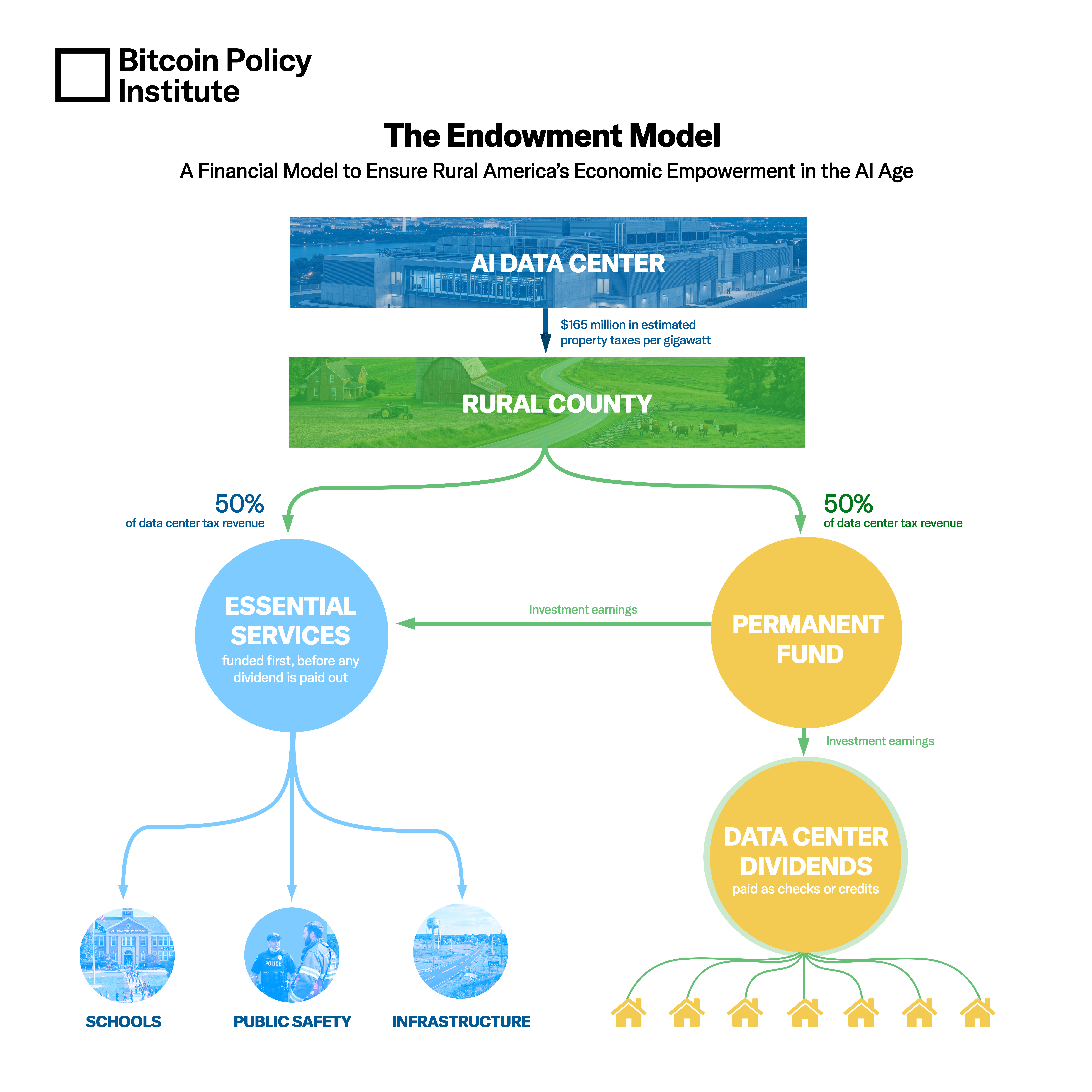
The revenue could also fund a service rather than a payment or a credit. New Mexico currently does exactly this. The state removed income eligibility from its child care program in November 2025 with a 1.25% annual draw on its Land Grant Permanent Fund.48
A school district could endow its share as a scholarship fund large enough to guarantee tuition for every graduating senior in the county, making "graduate here and college is paid for" a standing promise. As a proof of concept, Western Alaska's Community Development Quota groups have funded training and scholarships out of fishery royalties for three decades on this model.49
Likewise, a county could invest the receipts from data centers and distribute only the earnings, which answers the question every rural official asks first: what happens if this industry leaves the way the factories left? A county that saves the receipts owns a permanent endowment whether or not the campus is still operating in 2050. Alaska's dividend, for example, is not paid out of oil; it is paid out of a $91.3 billion diversified portfolio financed by oil royalties.
The choice ultimately belongs to the community. A county that needs young families to stay might pick the scholarship, a county concerned about power bills might pick the utility credit, and a county skeptical of AI's staying power might pick the fund.
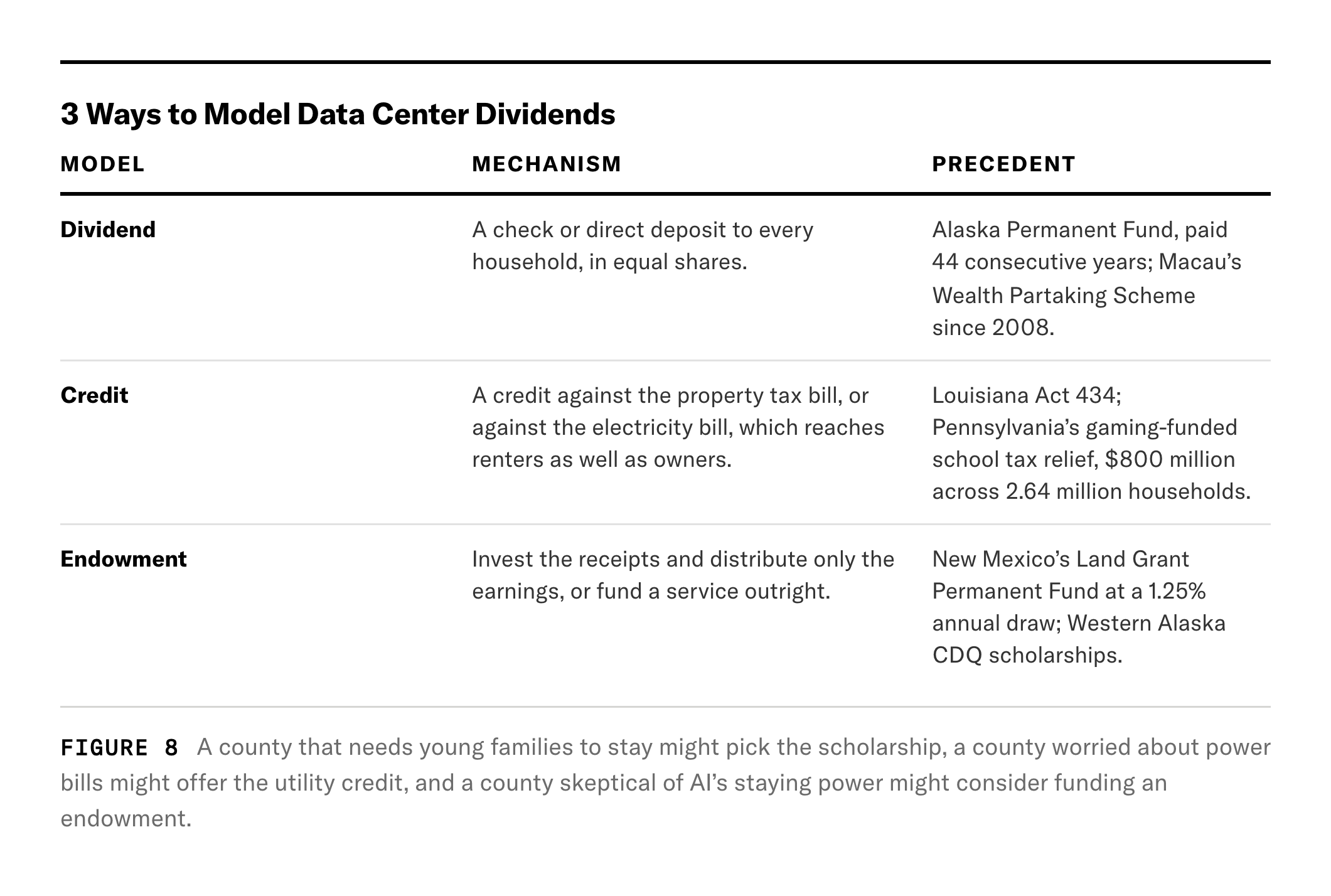
Figure 8. A county that needs young families to stay might pick the scholarship, a county worried about power bills might offer the utility credit, and a county skeptical of AI’s staying power might consider funding an endowment.
Pre-empting Critiques
One objection to data center dividends is that they will pay residents a significant amount of money, and will thus discourage work. But the Alaska example puts this concern to rest. Damon Jones and Ioana Marinescu, in the American Economic Journal: Economic Policy, found the dividend from the Alaska Permanent Fund had no effect on aggregate employment and actually increased part-time work by 1.8 percentage points.50 The comparison holds because the sums are similar. An Alaska household has averaged about $3,900 a year, while a rural county remitting a quarter of its data center revenue would pay roughly $4,500, according to our estimates above. A dividend of that size sits squarely in the range where the evidence finds no significant negative impact on employment.
The second concern is that the revenue from data centers will collapse. This underscores the need to establish a stabilization fund. Loudoun's tax year 2021 assessment of data center computer equipment came in at $10.0 billion against a forecast of $11.2 billion, a gap of $1.2 billion that cost the county roughly $50 million in the following year's budget. To guard against future shortfalls, the county has since built a revenue stabilization fund, into which it had contributed a cumulative $119.7 million through fiscal year 2026.51 A stabilization fund is essential to making a dividend viable over the long term. Because the dividend is paid out of what remains after the reserve is topped up, a bad assessment year shrinks the check rather than the school budget.
Then there is the question of why no counties have done this before. Outside of Alaska, several other states hold permanent funds fed by mineral royalties or severance taxes, and they route the earnings to schools, universities, or general revenue rather than to residents.52 While Alaska is the only government that has used the dividend model, it has worked for 44 years.
There are also legal concerns worth raising, which is why this paper is specifically addressed to state legislators as much as to county commissioners. Counties are subject to state law, and 39 states follow some version of Dillon's Rule, under which a local government holds only those powers the state has expressly granted it, with any ambiguity resolved against the county.53 Forty-five state constitutions go further, containing anti-donation or gift clauses that bar the use of public money to benefit private individuals.54
Those provisions exist for reasons worth taking seriously. Most were written in the 1800s, after cities and counties bankrupted themselves pledging public credit to railroad ventures that then failed. They are aimed at officials who direct public money to whoever has their ear, at treasuries converted into discretionary cash ahead of an election, and at dedicated school and fire millages raided for general purposes. Those risks are real, especially for a carelessly drafted dividend. In 2024 the Texas Supreme Court halted Harris County's guaranteed income program on precisely this ground, holding that the county had surrendered the "public control over the funds" its constitution requires.55
State enabling legislation should therefore be written narrowly, and Act 434 provides a good model. It delivers the benefit as a credit against taxes the recipient already owes rather than as a grant, which keeps it as a refund rather than a gift. It requires the unanimous consent of every affected taxing body, so a school board holds a veto over any rebate of its own millage. And it fixes the mechanism in statute rather than leaving it to annual discretion. Zobel does not foreclose the model. What the Court struck down was a scheme that rewarded length of residency, and Alaska has paid an equal dividend to every resident in the 44 years since.
Conclusion
The same ingredients that built the Kuwait Investment Authority in 1953 and the Alaska Permanent Fund in 1976 are sitting in a few hundred American counties today: a small population and the ability to generate industrial-scale levels of energy. What America's rural counties lack is a permanent fund to make the most of the opportunity presented by the AI buildout.
The AI buildout is the largest investment of private capital in rural America in a generation. Residents see the trucks, the substations, and the power bills. They are told the benefits will be lasting, and then they are asked to take it on faith. But 71% of Americans have said they would rather see the data centers built somewhere else.
Data center dividends have the potential to reshape the contours of this debate by converting a facility residents tolerate into an economic asset they benefit from on an annual basis. This proposal gives a county something no abatement fight has ever produced: a constituency with reasons to say yes that go beyond job creation and tax revenue. And it does so at no added cost to the companies building the campuses.
Data center dividends can ensure that rural Americans rise in the age of AI alongside the engineers developing this technology.
Footnotes
1 Gallup, "Americans Oppose AI Data Centers in Their Area," released May 13, 2026. Telephone survey of 1,000 US adults, fielded March 2–18, 2026, margin of error ±4 percentage points. Gallup notes these results "represent the first time Gallup has asked about data center construction." https://news.gallup.com/poll/709772/americans-oppose-data-centers-area.aspx
2 Gallup, "Less Support for Solar, Wind Energy; More for Nuclear," released April 22, 2026, reporting results from the same March 2–18, 2026 survey. Since Gallup began asking in 2001, the highest opposition it has recorded to a nearby nuclear plant is 63%. https://news.gallup.com/poll/708620/less-support-solar-wind-energy-nuclear.aspx
3 Pew Research Center, "Most new data centers in the U.S. are coming to rural areas," April 13, 2026. Pew's analysis of Data Center Map records, accessed February 19, 2026. https://www.pewresearch.org/short-reads/2026/04/13/most-new-data-centers-in-the-us-are-coming-to-rural-areas/
4 US Department of Agriculture, Economic Research Service, "What is Rural?" 45,893,412 people in 1,958 nonmetropolitan counties, 13.8% of the US population. County classification follows OMB's 2023 delineation; population is from the 2020 Census. https://www.ers.usda.gov/topics/rural-economy-population/rural-classifications/what-is-rural
5 Michael J. Bommarito, "Moratorium Nation," dataset current through August 19, 2026, identifying 533 local moratorium and restriction instruments across 42 states, of which the dated annual series runs 7 adopted in 2023, 6 in 2024, 59 in 2025, and 294 between January 1 and August 19, 2026; the balance is pre-2023 instruments and records without an adoption date, so the annual figures do not sum to 533. Bommarito labels the pre-May 2026 totals lower bounds, since earlier moratoria were located by opportunistic search rather than systematic review; the direction is robust but the year-over-year multiples should not be read precisely. A separately compiled tally by Robert Bryce reached 49 rejections in 2025 and 275 bans, rejections, restrictions or moratoria in 2026 as of August 3, 2026. Bryce counts a wider category of actions than Bommarito, so the two are not measuring the same quantity. https://mjbommar.github.io/moratorium-data-2026/ and https://robertbryce.substack.com/p/2026-data-center-rejections-hit-275
6 US Census Bureau, Value of Private Construction Put in Place, seasonally adjusted annual rate, released September 1, 2026. Data center construction at $75.166 billion in July 2026 (preliminary) against $47.810 billion in July 2025, and 61% of the $123.318 billion private office total. The series measures construction of data center buildings and excludes servers and other IT equipment, which is the larger share of a hyperscale project's cost. https://www.census.gov/construction/c30/pdf/privsa.pdf
7 Virginia Joint Legislative Audit and Review Commission, Data Centers in Virginia, Report 598, December 9, 2024. JLARC estimates 35,000 direct construction-phase jobs, of which 28,000 are construction workers, and more than 8,000 full-time direct operations jobs in FY2023, plus a further 24,000 indirect and induced jobs. JLARC's own summary notes that "most of these economic benefits derive from the construction phase rather than data centers' ongoing operations." https://jlarc.virginia.gov/pdfs/reports/Rpt598.pdf
8 Prince William County Department of Finance, Data Center Industry Tax Revenue Report 2024. Tax year 2024 data center revenue of $293.7 million against $166.4 million in 2023, an increase of 77%; data centers accounted for 49% of all commercial assessments. Part of the increase reflects a rate change, the county having raised its computer and peripherals rate from $2.15 to $3.70 per $100 of assessed value. Figures are preliminary pending the FY2025 external audit. https://www.pwcva.gov/assets/2025-06/Prince%20William%20County%202024%20Data%20Center%20Revenue%20Report.pdf
9 Harvard CAPS/Harris Poll, fielded July 11–12, 2026, 1,776 registered voters, margin of error ±2.3 percentage points. Respondents chose between "Data centers are critical infrastructure needed for America's future economy, technology, and national security" (38%) and "Data centers are mostly large technology facilities that use too much energy and water and provide too few benefits to local communities" (62%). https://harvardharrispoll.com/assets/uploads/2026/07/HHP_Jul2026_KeyResults.pdf
10 Marquette Law School Poll national survey, fielded July 22–29, 2026, 1,076 adults, margin of error ±3.2 percentage points. Question: "Companies are investing billions of dollars around the country in construction of data centers to run artificial intelligence and other applications. Which comes closer to your opinion, even if neither is exactly right:" benefits outweigh costs 27%, costs outweigh benefits 73%. By party, costs outweigh benefits among Republicans 66%, independents 72%, Democrats 80%. Marquette's April 2026 wave found the same pattern. https://law.marquette.edu/poll/2026/08/05/new-marquette-law-school-poll-national-survey-finds-inflation-and-cost-of-living-the-most-important-issue-economy-next-most-important/
11 Ipsos, fielded June 11–16, 2026 on a probability-based panel, 1,533 US adults aged 18 to 75 who are employed or marginally attached to the workforce, margin of error ±2.7 percentage points, commissioned by Groundwork Collaborative, a progressive economic policy organization. Asked "In general, who will benefit from the widespread use of artificial intelligence (AI) at work?" respondents answered only business owners or executives 16% and mostly business owners or executives 35%, against mostly workers 5% and only workers 1%; 27% said both equally and 14% said the use of AI at work will not benefit anyone. The sponsor is disclosed because no non-advocacy pollster has fielded a directly comparable question. https://www.ipsos.com/sites/default/files/ct/news/documents/2026-07/Groundwork_June%202026%20Survey%20Topline%20AI%20Results.pdf
12 Alaska Constitution, art. IX, § 15, approved by voters November 1976, requiring that at least 25% of mineral lease rentals, royalties, royalty sale proceeds, federal mineral revenue sharing payments and bonuses be placed in a permanent fund whose principal may be used only for income-producing investments. Fund value of $91.3 billion as of June 30, 2026 is unaudited and preliminary. Alaska Permanent Fund Corporation. https://apfc.org/the-fund/ The 1976 amendment created the fund; the managing corporation (1980) and the dividend program (1980–82) were established by statute.
13 Alaska Department of Revenue, Permanent Fund Dividend Division, "Summary of Dividend Applications & Payments." The 2017–2026 average of $1,491 is computed on total payments received, which include separately appropriated energy relief amounts in 2022, 2024 and 2026; on a dividend-only basis the ten-year average is $1,375. All figures nominal. https://pfd.alaska.gov/Division-Info/summary-of-dividend-applications-payments
14 Ibid. 618,863 paid of 665,327 applications received, or 83.8% of the state population. Alaska population of 738,737 as of July 1, 2025, per Alaska Department of Labor and Workforce Development. https://labor.alaska.gov/news/2026/news26-2.htm
15 Alaska Public Media, "Alaska, Inc: The roots of the Permanent Fund dividend," January 19, 2016. https://alaskapublic.org/2016/01/19/alaska-inc-the-roots-of-the-permanent-fund-dividend/
16 Alaska Beacon, "Alaska revenue forecast predicts more oil, but its importance to the state budget is declining," December 15, 2025. https://alaskabeacon.com/2025/12/15/alaska-revenue-forecast-predicts-more-oil-but-its-importance-to-the-state-budget-is-declining/
17 Kuwait Investment Authority, approximately $1.072 trillion as of May 2026. KIA does not publish its assets under management; the figure is a third-party estimate. The Kuwait Investment Board, established February 23, 1953, is generally regarded as the world's first sovereign wealth fund; the KIA itself was constituted by law in 1982.
18 Abu Dhabi Investment Authority, inception 1976, approximately $993 billion. ADIA does not publish its assets under management; the figure is a third-party estimate from the Sovereign Wealth Fund Institute. https://dev.swfinstitute.org/profile/598cdaa50124e9fd2d05a79b
19 Norges Bank Investment Management, Half-Year Report 2026. NOK 22,683 billion as of June 30, 2026. https://www.nbim.no/en/news-and-insights/reports/2026/half-year-report-2026/
20 Public Investment Fund, 2025 Annual Report, $904 billion in assets under management at year-end 2025 (https://www.pif.gov.sa/en/investors/annual-reports/). Qatar Investment Authority figure of approximately $526 billion from the Sovereign Wealth Fund Institute; QIA does not disclose assets under management. https://dev.swfinstitute.org/profile/598cdaa60124e9fd2d05bc5a
21 Angela L. Cummine, "Overcoming Dividend Skepticism: Why the World's Sovereign Wealth Funds Are Not Paying Basic Income Dividends," Basic Income Studies 6, no. 1 (2011): 1–18. https://ideas.repec.org/a/bpj/bistud/v6y2011i1n4.html
22 Hut 8 Corp., "Hut 8 Signs 15-Year, 245 MW AI Data Center Lease at River Bend Campus with Total Contract Value of $7.0 Billion," December 17, 2025 (https://www.prnewswire.com/news-releases/hut-8-signs-15-year-245-mw-ai-data-center-lease-at-river-bend-campus-with-total-contract-value-of-7-0-billion-302644600.html); Entergy, "Hut 8 selects Entergy, Southeast Louisiana for $10 billion artificial intelligence data center." The $10 billion Phase I figure is Entergy's and is described as "up to," including Hut 8's investment in data center infrastructure. https://www.entergy.com/news/hut-8-selects-entergy-southeast-louisiana-for-10-billion-artificial-intelligence-data-center
23 WAFB, "Hut 8 facility expected to generate $90 million annually for local government," December 18, 2025. The $41 million figure is Parish President Kenny Havard's, reported as total tax revenue currently collected by the parish; no public document defines whether it covers all local taxing bodies or the parish government alone. https://www.wafb.com/2025/12/18/hut-8-facility-expected-generate-90-million-annually-local-government/
24 The $90 million is the parish's first-year estimate for Phase I rather than a fixed annual sum. Under the donate-and-lease-back structure, Hut 8 donates the 611-acre site to the parish Industrial Development Board, which leases it back, and the lease payments equal what property taxes on the graphics processing units would have been. The parish assessor values that equipment annually. Parish Attorney Dannie Garrett put the first-year GPU value at $7.5 to $8 billion, "translating into about $90 million in lease payments," and addressed the depreciation exposure directly: "If they depreciate, that number will drop, but that's just like any other property." That is the same dynamic documented in Loudoun, where the equipment base holds up because operators keep replacing servers. The Phase I agreement runs 30 years, with a further 30-year term contemplated for the second phase, which Garrett estimated would pay 50% of equivalent property tax value. The Advocate, "West Feliciana Parish set to receive $90 million a year." https://www.theadvocate.com/baton_rouge/news/west-feliciana-parish-90-million-data-center/article_39986728-040c-48f0-9ba3-c3102c6cb326.html
25 WBRZ, "W. Feliciana Parish unique deal with data center project to generate life-changing money," October 25, 2025. Data centers are classified under NAICS code 518210 (data processing, hosting and related services), which is not manufacturing; Louisiana Economic Development limits Industrial Tax Exemption Program eligibility to manufacturers under NAICS codes 31, 32 and 33. Parish Attorney Dannie Garrett described the purpose of the payment in lieu of taxes as being "so that we can then give them a discount." https://www.wbrz.com/news/w-feliciana-parish-unique-deal-with-data-center-project-to-generate-life-changing-money
26 Louisiana Act 434 of 2026 (House Bill 466, 2026 Regular Session), by Rep. Jeremy S. LaCombe, enacting La. R.S. 33:2759. House final passage April 22, 2026, 96 yeas and 0 nays; Senate final passage May 20, 2026, 36 yeas and 0 nays. Signed May 29, 2026; effective January 1, 2027. https://legis.la.gov/LEGIS/BillInfo.aspx?i=250291
27 La. R.S. 33:2759(B)–(C). The credit is expressed as a percentage of ad valorem tax liability and applied by the sheriff to the tax bill before issuance. Because the benefit reduces a taxpayer's own liability rather than transferring public money to a private person, it reaches property owners only: renters receive nothing, and neither do homeowners whose liability is already zeroed out by Louisiana's homestead exemption. The cash payment options appeared in the bill as filed and were removed by House committee amendment.
28 US Census Bureau, QuickFacts, West Feliciana Parish, Louisiana: 4,026 households, 2020–2024 American Community Survey five-year estimates. Median household income $77,452; homeownership rate 75.7%. https://www.census.gov/quickfacts/fact/table/westfelicianaparishlouisiana/PST045224
29 The per-household figures here divide the parish's full expected Phase I payment of $90 million among all 4,026 households. They exclude the second phase, which would raise the total, and they do not attempt to model year-to-year movement in the assessed value of the equipment (note 24).
30 Households rather than population is the correct denominator in West Feliciana for a reason specific to the parish. The Louisiana State Penitentiary at Angola sits within its boundaries and held 4,253 incarcerated people as of June 30, 2025, against a census population of 15,310. More than a quarter of the people counted in the parish are therefore in prison and would receive nothing under any version of this policy. Figure as reported in Louisiana Illuminator, September 3, 2025. The Louisiana Department of Public Safety and Corrections no longer publishes facility-level counts, so this figure rests on that reporting rather than on a department document. Parish population is the 2020 Census count. https://lailluminator.com/2025/09/03/ice-angola/
31 Virginia Joint Legislative Audit and Review Commission, Data Centers in Virginia, Report 598, December 9, 2024. JLARC finds Loudoun accounts for roughly half of Virginia's data center sites, building square footage and estimated energy use, with Loudoun, Prince William and Fairfax together accounting for about 80%. On global position, JLARC reports Northern Virginia as a whole holds about 13% of world operational data center capacity and roughly a quarter of all capacity in the Americas, citing Cushman & Wakefield's 2024 Global Data Center Market Comparison. https://jlarc.virginia.gov/pdfs/reports/Rpt598.pdf
32 Loudoun County, Virginia, FY2026 Adopted Budget, General Fund Revenue section, FY2024 Actual column, line item "Computer Equipment – Data Centers." The county reports this separately from generic "Computer Equipment" (FY2024 actual: $13,935,830). https://www.loudoun.gov/DocumentCenter/View/216022/General-Fund-Revenue
33 Loudoun County, FY2027 Adopted Budget, Fiscal Trends. The general personal property tax rate is $4.15 per $100 of assessed value for tax years 2026 and 2027, reduced from $4.20, the rate in effect through tax year 2022. https://www.loudoun.gov/DocumentCenter/View/221489/Fiscal-Trends-PDF
34 Loudoun County, "Data Centers – Tax Revenues and the County Budget," county FAQ. https://www.loudoun.gov/FAQ.aspx?QID=1790
35 Loudoun County, Business Personal Property Tax Assessment schedules, classification "Computer Equipment in Data Center (DE)," effective January 1, 2026. Equipment is assessed at 60% of original capitalized cost in the first year of acquisition, then 45%, 30%, 15%, 10% and 5% in subsequent years, so any individual server is nearly worthless to the assessor within six years. The broader point, that short hardware refresh cycles keep replenishing assessed value in a way most commercial land uses cannot, has also been made publicly by the industry group NetChoice and documented by the Tax Foundation, which reports typical refresh cycles of three to six years. https://www.loudoun.gov/6301/Business-Personal-Property-Tax-Assessmen
36 FY2017 actual from Loudoun County, FY2021 Proposed Budget, Revenue and Trends (https://www.loudoun.gov/DocumentCenter/View/159072/R---Revenue-and-Trends); FY2027 figure from Fiscal Trends, note 33. In FY2017 the county did not yet report data center equipment on a separate line, so the $150.5 million covers all business computer equipment; the separate data center line begins with tax year 2021. Loudoun describes the FY2027 figure as "~77 percent of personal property tax revenue (excluding the state reimbursement)."
37 Loudoun County Data Center Brief, prepared by Vice Chair Mike Turner (Ashburn District), July 1, 2026, power demand chart: "2024: 4.14 Gw (actual)," rising to 5.33 GW in 2025. Earlier years in the series are interpolated from Dominion Energy's Northern Virginia load forecasts. Turner's chart is labeled "Power Consumption in Loudoun County" but is denominated in gigawatts, a unit of power rather than of energy, so the series is read here as electrical load. That is also the unit in which data center projects are announced and utility capacity is contracted. Because fiscal 2024 collections are matched against calendar 2024 load, and calendar 2023 load was lower at 3.4 GW, the resulting per-gigawatt figure is conservative. https://www.loudoun.gov/DocumentCenter/View/217605/Loudoun-County-Data-Center-Brief---Turner
38 Derived from note 4: 45,893,412 ÷ 1,958 = 23,439 people per nonmetropolitan county. Household size of 2.53 persons is the US average from the 2020–2024 American Community Survey five-year estimates. Nonmetropolitan county population is strongly right-skewed, so the median county is smaller than the mean; because a smaller county yields a larger per-household figure, using the mean is the conservative choice.
39 An alternative approach would estimate the marginal effect of an additional gigawatt rather than an average rate per gigawatt. That would be the better method for projecting growth inside an established market like Loudoun's, where each new increment arrives alongside rate changes and a maturing equipment base, but it requires a jurisdiction-level time series of load against collections that almost no county publishes. The average is also the more appropriate figure for the question here, which concerns a single campus arriving in a county that hosts none today, and it is the more conservative one: Loudoun's average blends heavily depreciated older equipment with new installations, whereas a new AI campus carries a denser and less depreciated stock of taxable equipment per megawatt.
40 US Energy Information Administration, Electric Sales, Revenue, and Price, Table 5A, 2024 data, released October 2025. US average monthly residential bill $142.26, average consumption 863 kWh per month, average price 16.48 cents per kWh. Louisiana's average bill was $140.96 per month on the highest residential consumption in the nation, 1,202 kWh, at 11.73 cents per kWh; Virginia's was $148.77. https://www.eia.gov/electricity/sales_revenue_price/pdf/table_5A.pdf
41 Loudoun County, Fiscal Trends, note 33. General fund operating budget of $648.6 million in FY2021. Population growth of 1.7%, 1.6%, 1.4%, 1.6% and 1.6% for 2021 through 2025 respectively; county population of 455,193 in 2025.
42 On July 22, 2026 the Loudoun County Board of Supervisors voted 6 to 1 on a motion by Supervisor Juli Briskman directing county staff to research the legality of a pause on all new data center and substation applications and to return a formal item at the board's September 15, 2026 meeting. No moratorium was enacted by that vote. The dissenting supervisor said of a future pause, "I cannot imagine we would not be sued if this were passed in September." As of this writing the September meeting has not occurred, and the county attorney's published position is that the board "does not have the legal authority to implement a moratorium on new data center applications." https://www.datacenterdynamics.com/en/news/loudoun-county-considering-moratorium-on-new-data-center-applications-rejects-325-million-sq-ft-campus/
43 Special Session Act 1 of 2006 (the Taxpayer Relief Act) sends gaming revenue to Pennsylvania school districts, which apply it as a homestead and farmstead exclusion that reduces the school district property tax bill on owner-occupied homes. County and municipal levies are untouched, and the reduction must be itemized on the school district tax bill. Philadelphia's share is used to reduce the city wage tax instead. Pennsylvania Department of Education, Property Tax Relief (https://www.pa.gov/agencies/education/programs-and-services/schools/grants-and-funding/property-tax-relief); Pennsylvania Independent Fiscal Office, "iGaming Drives Property Tax Relief to New High," Research Brief, October 2024, reporting the $800 million FY2024-25 allocation to 2.64 million approved homesteads and farmsteads, averaging $303 each. https://www.ifo.state.pa.us/getfile.cfm?file=Resources/Documents/RB_2024_10_Act_1.pdf&view=true
44 Wielechowski v. State, 403 P.3d 1141 (Alaska 2017), decided August 25, 2017. Clem Tillion was among the plaintiffs. https://law.justia.com/cases/alaska/supreme-court/2017/s-16558.html
45 Dittman Research, statewide survey of 401 Alaska registered voters, fielded June 10–13, 2021, margin of error ±4.89 percentage points, conducted for the Alaska House Majority. Asked "Do you support or oppose a state constitutional amendment to guarantee payment of the Permanent Fund Dividend each year," 65% supported and 30% opposed. By registration, Republicans supported 71% to 23%, undeclared voters 68% to 27%, non-partisan voters 60% to 36%, and Democrats opposed 47% to 42%. Support falls to 48%–48% when the question specifies deeper cuts to state services as the tradeoff, and to 42%–53% when it specifies a new sales or income tax. https://alaskalandmine.com/wp-content/uploads/2021/07/FINAL-Survey-Results-June-10-13-2021.pdf
46 Zobel v. Williams, 457 U.S. 55 (1982), decided 8-1, Chief Justice Burger writing, Justice Rehnquist in dissent and Justice O'Connor concurring in the judgment. The Court reserved only the narrower question of whether the tiered program could have been applied prospectively, writing that it "need not consider whether the State could enact the dividend program prospectively only." It did not rule on an equal-shares dividend, which Alaska has paid since 1982. https://supreme.justia.com/cases/federal/us/457/55/
47 Macao Special Administrative Region, Wealth Partaking Scheme, paying MOP 10,000 to permanent residents and MOP 6,000 to non-permanent residents in 2026 (https://www.planocp.gov.mo/en/about/intro). The scheme is re-authorized each year by administrative regulation and paid from the general budget; it carries no statutory earmark of gaming taxes. Macau's Financial Services Bureau reported gaming tax revenue of MOP 94.85 billion in 2025, or 82.7% of the government's MOP 114.64 billion in total tax revenue.
48 KUNM, "New Mexico will offer free universal childcare," September 9, 2025; New Mexico Constitutional Amendment 1 (2022), authorizing a 1.25% annual distribution from the Land Grant Permanent Fund for early childhood education. Income eligibility was removed effective November 1, 2025. Long-run funding for the program has been described as uncertain. https://www.kunm.org/local-news/2025-09-09/new-mexico-will-offer-free-universal-childcare
49 NOAA Fisheries, "Western Alaska Community Development Quota Program Summary," October 2018. https://media.fisheries.noaa.gov/dam-migration/cdq-program-summary-1018.pdf
50 Damon Jones and Ioana Marinescu, "The Labor Market Impacts of Universal and Permanent Cash Transfers: Evidence from the Alaska Permanent Fund," American Economic Journal: Economic Policy 14, no. 2 (2022): 315–40. The 1.8 percentage point increase in part-time work is a 17% relative rise. A contrary finding exists and is worth knowing: an NBER working paper on the OpenResearch guaranteed income study found a 4.2 percentage point drop in labor force participation, but that program paid a targeted group $12,000 a year for three years, an order of magnitude different in both size and design from a universal permanent dividend. https://www.aeaweb.org/articles?id=10.1257%2Fpol.20190299
51 On the shortfall, Loudoun County, Revenue and Tax Policy Study, Final Report (PFM Group Consulting, October 27, 2021), which reports the tax year 2021 data center computer equipment assessment at $10,001 million against a $11,200 million forecast and notes that "for the first time, in FY2022, the County overestimated revenue from the BPPT." At the tax year 2021 rate of $4.20 per $100, the $1.199 billion gap is worth roughly $50 million. Contemporaneous press reported a $60 million figure, which no county document states and which does not follow from the assessment gap; it is not used here. See also Loudoun Now, August 9, 2021, as summarized in DataCenterDynamics (https://www.datacenterdynamics.com/en/news/loudoun-county-budget-hit-by-data-center-60m-tax-revenue-shortfall/). On the stabilization fund, created October 2023 and fully funded at $119.7 million as of FY2026, see Loudoun County FY2026 Budget Story. https://prcsinfo.loudoun.gov/view/599219896/12
52 Pew Charitable Trusts, "From Volatile Severance Taxes to Sustained Revenue," October 2016, identifies seven states with severance tax-based sovereign wealth funds: Alaska, Montana, New Mexico, North Dakota, Utah, West Virginia and Wyoming, and reports that "most funds direct interest accruals and investment earnings toward their states' general operating funds." The total is higher if permanent funds capitalized by mineral royalties on state land are counted, among them the Texas Permanent School Fund and Permanent University Fund and New Mexico's Land Grant Permanent Fund. No published tally settles the figure, which is why this paper says "several" rather than naming a number. None of these funds pays its earnings to individual residents. https://www.pew.org/en/research-and-analysis/issue-briefs/2016/10/from-volatile-severance-taxes-to-sustained-revenue
53 Jesse J. Richardson Jr., Meghan Zimmerman Gough and Robert Puentes, Is Home Rule the Answer? Clarifying the Influence of Dillon's Rule on Growth Management, Brookings Institution, January 2003. Thirty-one states apply Dillon's Rule to all municipalities and eight to some, for 39 in total; ten states reject it. https://www.brookings.edu/wp-content/uploads/2016/06/dillonsrule.pdf
54 Jeremy Farris, New Mexico State Ethics Commission, The Anti-Donation Clause: What It Does, What It Does Not Do, & The Risks of Living Without It, December 10, 2024, counting anti-donation or gift provisions in 45 state constitutions. On origins and purpose, see Timothy Sandefur, "The Arizona Gift Clause in the Twenty-First Century," 16 Drexel Law Review 299 (2024), tracing the clauses to municipal insolvencies following failed railroad subsidies and identifying rent-seeking, official inability to pick winners, and favoritism toward the politically connected as the framers' concerns. The doctrinal root is Citizens' Savings & Loan Ass'n v. City of Topeka, 87 U.S. 655 (1874). https://www.nmlegis.gov/handouts/ALFC%20120924%20Item%2011%202024-12-05%20Farris%20on%20Anti-Donation%20Clause.pdf
55 In re State of Texas, No. 24-0325 (Tex. 2024), opinion issued June 14, 2024, halting Harris County's Uplift Harris guaranteed income program, which would have paid $500 a month for 18 months to 1,928 low-income residents, under Tex. Const. art. III, § 52(a). The Court held the county had not retained the "public control over the funds" needed to ensure a public purpose was accomplished, distinguishing regulated in-kind programs such as food and housing assistance. The county ended the program. https://www.txcourts.gov/media/1458734/240325.pdf