
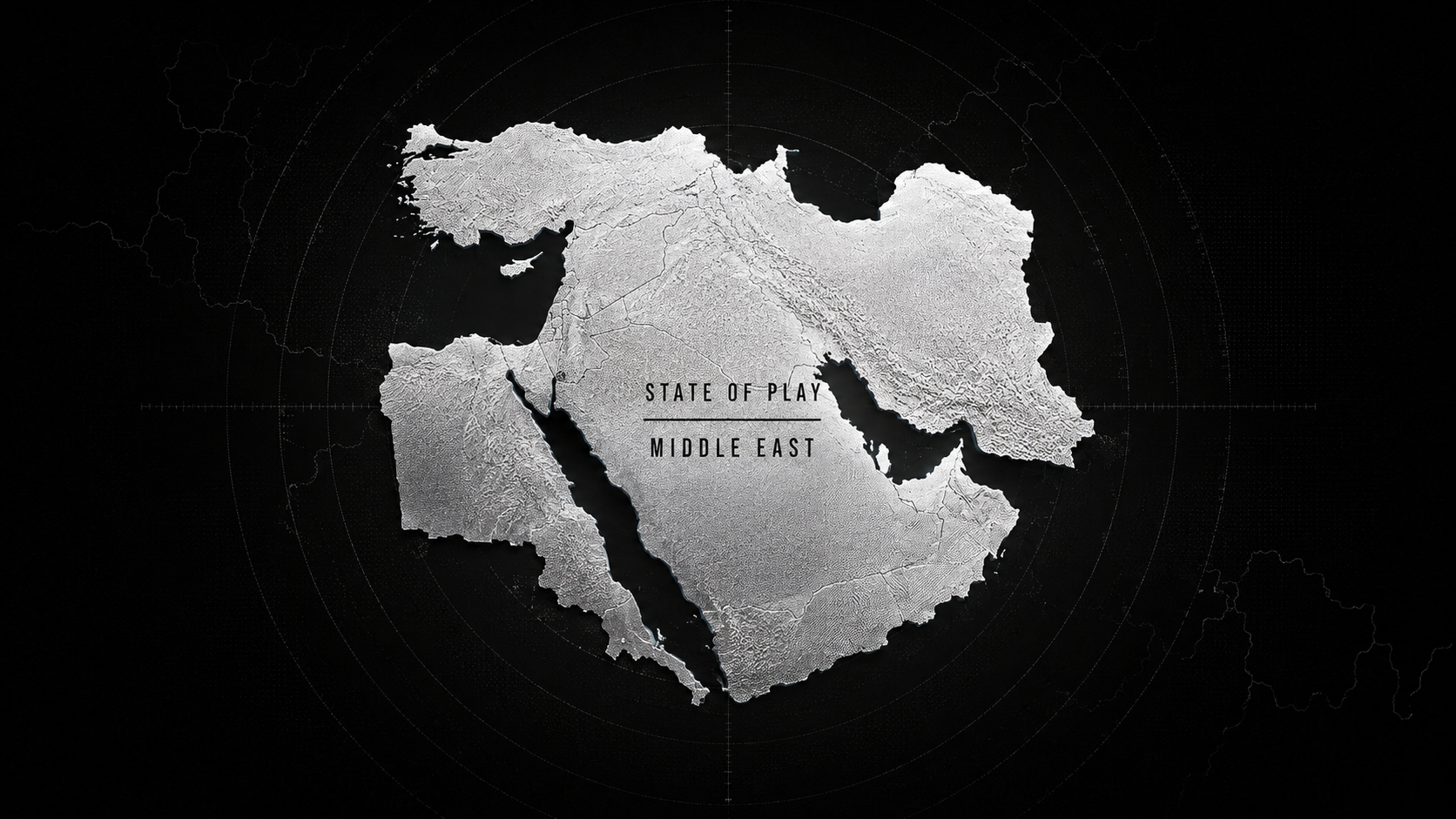
Regional conflicts tend to accelerate capital outflows. The Iran conflict displayed a different dynamic: instead of exiting the region, a growing share of capital shifted into digital assets, underscoring the increasing role of cryptocurrencies — and Bitcoin in particular — as a hedge against economic and geopolitical uncertainty.
The Middle East and North Africa (MENA) has emerged as one of the world's fastest-growing cryptocurrency regions, with annual on-chain transaction volumes increasing from approximately $100 billion in 2022 to an estimated $350 billion by 2025–2026. While global digital asset adoption has been shaped by institutional investment and regulatory developments, MENA's growth has been driven by a unique combination of macroeconomic pressures and government-led digital transformation strategies.
A Classic Risk-Off Posture
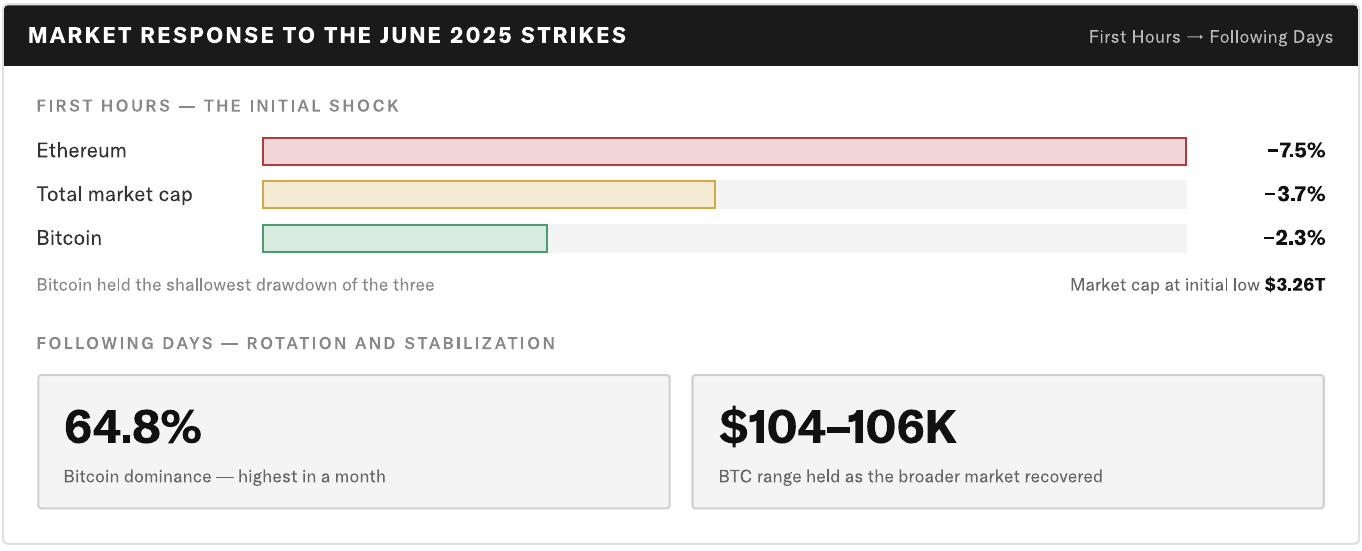
During the initial stages of the Israel–Iran conflict in June 2025, cryptocurrency markets reacted much like other global risk assets. Following the first Israeli strikes on Iran, the global digital asset market lost approximately 3.7% of its total market capitalization, falling to around $3.26 trillion in a matter of hours. Bitcoin declined by roughly 2.3% to around $105,200, while Ethereum experienced a much steeper correction of 7.5%, evincing investors' broad shift away from higher-risk assets amid escalating geopolitical uncertainty. Rather than behaving as an immediate safe-haven asset, Bitcoin initially traded in line with global equity markets as investors adopted a classic risk-off posture.
As the conflict evolved, so did market responses. Instead of exiting digital assets, investors rotated capital from higher-risk altcoins into Bitcoin, driving Bitcoin dominance to 64.8%, its highest level in a month. Bitcoin stabilized within the $104,000–106,000 range despite continued military exchanges between Israel and Iran, while broader markets gradually recovered. The episode demonstrated two important structural characteristics of the digital asset market. First, cryptocurrencies traded continuously throughout the conflict; investors responded instantly to geopolitical developments while traditional financial markets remained closed. Second, Bitcoin increasingly attracted defensive positioning as investors reassessed the conflict's macroeconomic implications, particularly the risk of higher oil prices, rising inflation, and prolonged monetary tightening stemming from instability around the Strait of Hormuz.
This resilience was also reflected in broader Gulf financial markets. By late June 2025, the iShares MSCI Saudi Arabia ETF had recorded US$108.5 million in net inflows year-to-date, while the iShares MSCI UAE ETF was up 11% for the year, suggesting that international investors continued to view Gulf markets as resilient despite heightened geopolitical tensions.
The Gulf's Regulated Ecosystem
Despite the geographical proximity to Iran, and strikes against GCC countries, the Gulf's regulated digital asset ecosystem continued operating without major disruption, reinforcing confidence in the region as a stable digital asset hub. According to executives from UAE-based digital asset firms, the country experienced minimal disruption to its digital asset ecosystem during the conflict, with exchanges, blockchain firms, and other market participants maintaining operations through cloud-based infrastructure.
Stephen Coltman, Vice President Head of Macro at 21shares, points to this operational continuity as proof of the market's growing maturity, noting that when Iranian missiles were landing in the UAE earlier this year, the stock exchanges were closed down, but the crypto exchanges continued operating as normal. The best-performing major assets in March after the war broke out were Oil and Bitcoin. The Middle East has been quick to recognize the operational benefits and superior resilience of a blockchain-based financial system and has put in place the regulatory framework that has allowed a digital asset ecosystem to flourish.
A Growing Divergence Within MENA
Rather than slowing regional adoption, the episode highlighted the growing divergence within MENA: in countries experiencing sanctions, conflict or currency instability, cryptocurrencies served as a means of preserving wealth and transferring value outside traditional financial systems, while regulated Gulf markets continued to attract institutional capital and strengthen their position as the region's leading centers for digital assets.
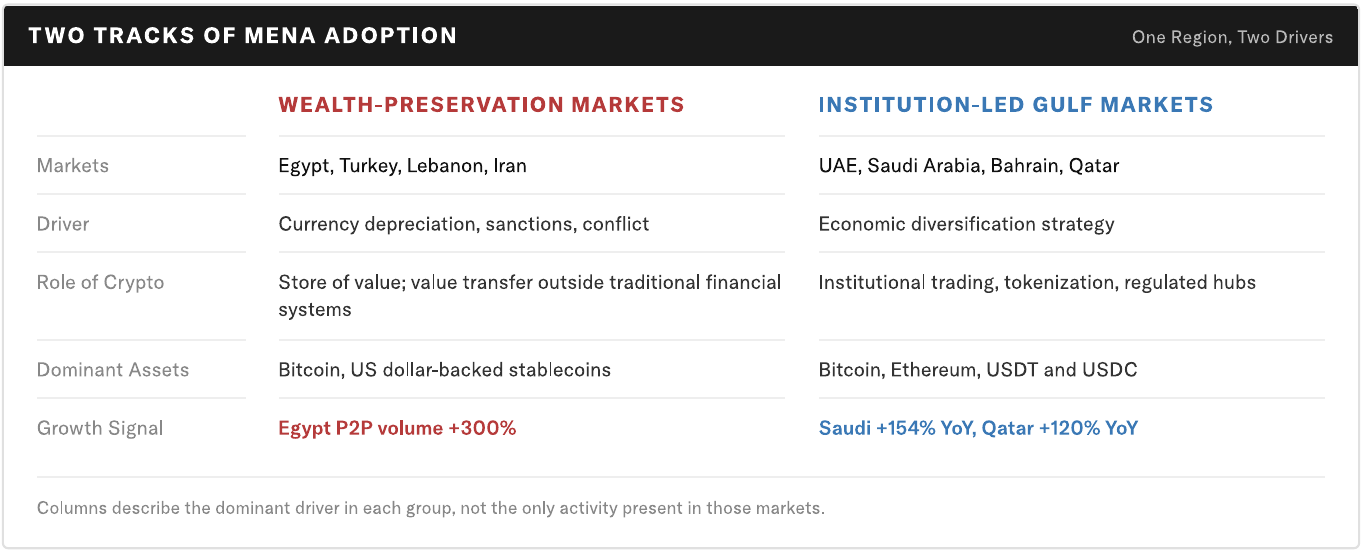
Egypt, Turkey, Lebanon, and Iran have experienced significant currency depreciation in recent years, prompting individuals to turn to Bitcoin and US dollar-backed stablecoins as alternative means of preserving purchasing power. In Egypt alone, peer-to-peer Bitcoin trading volumes increased by more than 300% following successive devaluations of the Egyptian pound.
The Gulf, by contrast, has witnessed digital asset growth for fundamentally different reasons. Digital assets are becoming a pillar of broader economic diversification strategies. The United Arab Emirates and Bahrain have deliberately developed comprehensive regulatory frameworks by introducing a new federal licensing regime for virtual asset service providers (VASPs) through the Capital Market Authority (CMA), while Dubai's Virtual Assets Regulatory Authority (VARA) updated its rules on tokenization and virtual asset activities. Bahrain further expanded its regulatory framework following the introduction of its Stablecoin Issuance and Offering (SIO) Module, reinforcing its position as one of the region's earliest regulated digital asset markets.
The Region's Primary Growth Engine
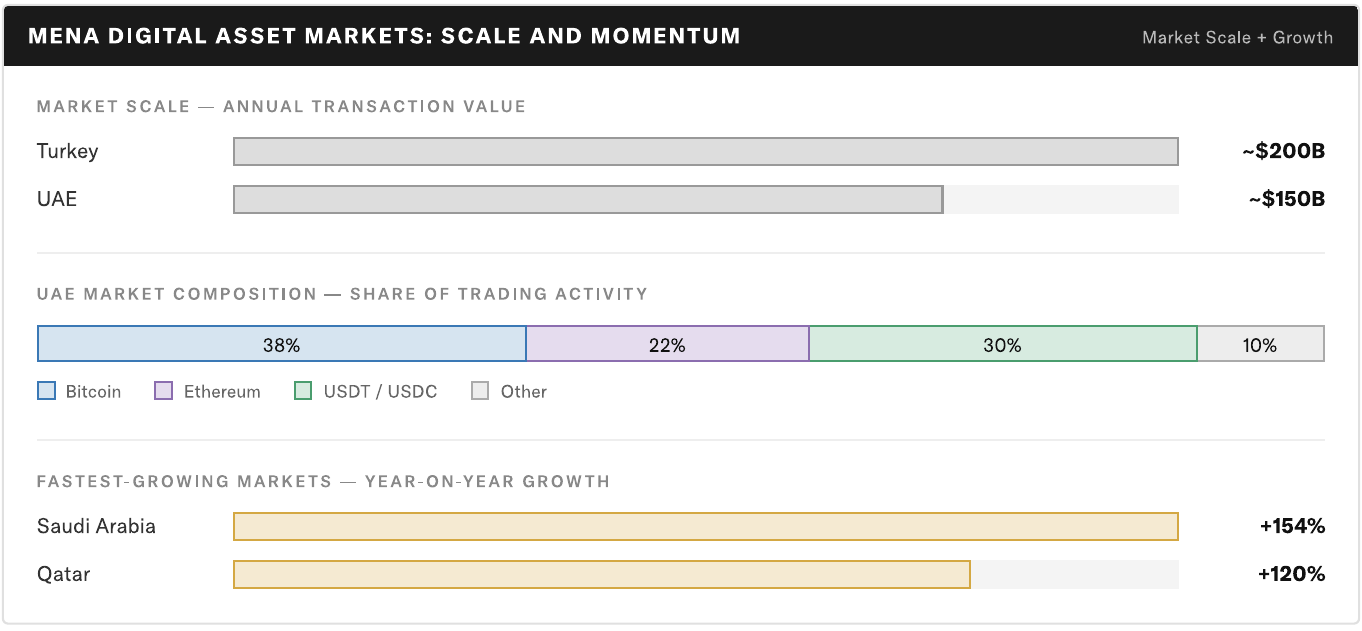
Turkey remains the largest cryptocurrency market across the wider MENA region by transaction value, receiving nearly $200 billion annually. But the Gulf has emerged as the region's primary growth engine. The United Arab Emirates has established itself as a leading digital asset hub, processing approximately $150 billion in cryptocurrency transactions in 2025. Its market is characterized by strong institutional participation, with Bitcoin accounting for 38% of trading activity, followed by Ethereum (22%) and US dollar-backed stablecoins, primarily USDT and USDC (30%).
The strongest momentum, however, is now coming from Saudi Arabia, the fastest-growing digital asset economy in MENA, where activity expanded by 154% year-on-year. This growth is supported by favorable demographics, with a population of 35 million, smartphone penetration of approximately 97%, and more than 60% of citizens under the age of 35, as well as sustained government investment in blockchain technologies, central bank digital currencies (CBDCs), gaming, and fintech.
Qatar follows as the region's second-fastest-growing crypto market, recording 120% year-on-year growth, underpinned by an increasingly supportive regulatory framework and continued investment in digital financial infrastructure. Together, these trends illustrate how the Gulf has evolved from a regional digital asset adopter into one of the world's fastest-growing digital asset ecosystems.
The Iran conflict demonstrated that the MENA digital asset ecosystem has reached a new level of maturity and resilience. The next geopolitical shock is therefore likely to reinforce MENA's digital asset landscape. As the Gulf continues to strengthen regulatory frameworks and attract institutional participants, the region is becoming an increasingly credible destination for global capital allocators seeking exposure to regulated digital asset markets, while cryptocurrencies are likely to remain an essential financial tool in more constrained economies.