
Executive Summary
Suppose an American think tank was funded almost entirely by foreign money. Suppose it was the most influential think tank in the country on issues related to AI safety. Suppose a foreign billionaire played a significant role in guiding its policy agenda. Suppose two of its founders had spent years praising Chinese AI governance while lobbying to slow American AI. And suppose its ideas directly shaped the AI Data Center Moratorium Act and the Ban Artificial Superintelligence Act, the strongest anti-AI legislation to come before Congress this year.
Should the American people know about it? We suppose they should.
The above description is not a hypothetical but the remarkable story behind the Future of Life Institute (or FLI), the most well-resourced AI safety think tank in the United States. This report examines the foreign funding stream and private actors who launched FLI to national prominence and empowered the organization to sow widespread fears of AI in the US and abroad.
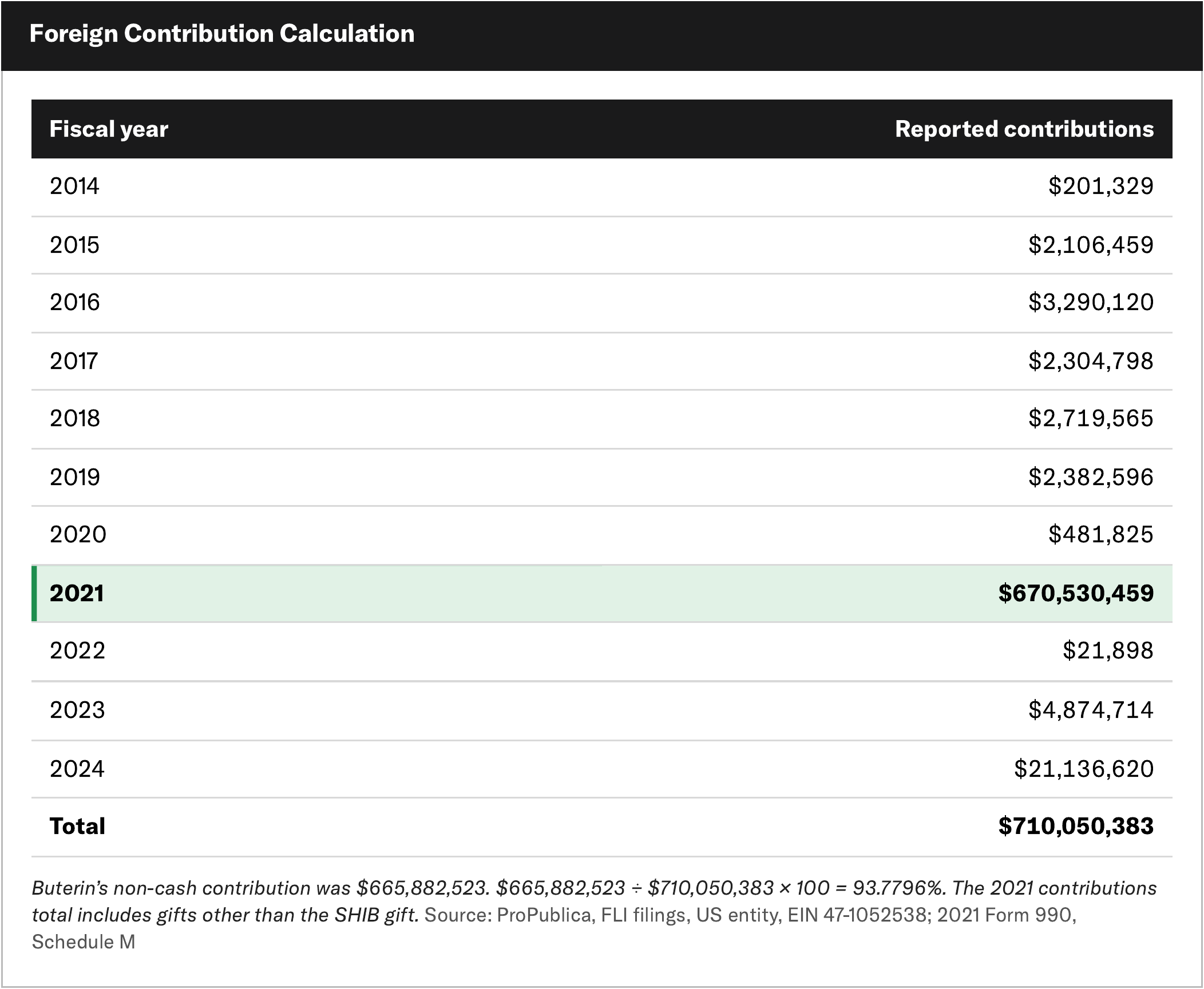
Our research shows that approximately 94% of FLI’s received funding over the last decade came from a single donation from a foreign national: Vitalik Buterin, the Russian-Canadian-Montenegrin developer of Ethereum.
In 2020, anonymous crypto developers gifted Buterin with 50% of the supply of a memecoin called Shiba Inu (or SHIB). SHIB soared in price during the digital asset boom of 2021, rising to a market cap of $13 billion. During the crypto bull run, FLI reached out to Buterin asking him to donate his SHIB directly to the organization. Buterin agreed, sending $665.9 million-worth of SHIB to FLI in May 2021 – a donation that, overnight, put the organization on par with the wealthiest think tanks in the country, surpassing even the Brookings Institution and RAND Corporation in net assets.
Just as notable as the donation itself were the organizations involved in monetizing it. After receiving Buterin’s donation, FLI worked with FTX and Alameda Research, the now-defunct crypto businesses of convicted fraudster Sam Bankman-Fried, to convert the memecoin gift to dollars and launch a new grant program. FLI’s co-founder and current board member, Estonian billionaire Jaan Tallinn, had a pre-existing business relationship with Bankman-Fried, and even loaned Alameda Research $110 million in 2018 to help get the hedge fund off the ground. Tallinn and Bankman-Fried were connected not only through their commercial interests but in their mutual commitment to a philosophy known as effective altruism.
In May 2021, the same month Buterin donated his SHIB to FLI, liquidity for the memecoin (i.e., the ability to match the number of sellers with the number of buyers) was exceptionally low. But Bankman-Fried helped engineer a significant liquidity event for SHIB by listing it for trading, withdrawals, and deposits on FTX, expanding access to the cryptocurrency to millions across the globe. In effect, this strengthened the ability to “cash out” on Buterin’s donation. By his own account, Buterin thought FLI would only be able to cash out $10 to $25 million of his SHIB donation because of low liquidity. But the organization was able to cash out, according to Buterin, “something like $500 million.”
The question is, how? How did FLI monetize the SHIB donation at a rate 20 times higher than even Buterin expected? This paper outlines the potential roles FTX and Alameda might have played in helping FLI take advantage of a crypto boom-and-bust to build a half-a-billion-dollar warchest. It also spotlights FLI’s efforts to minimize the involvement of Bankman-Fried’s companies in this transaction, which includes removing public praise of Alameda Research from its website after Bankman-Fried’s criminal conviction.
After receiving Buterin’s historic gift, FLI used the money to seed new AI safety organizations and donated millions of dollars to religious organizations and newsrooms. In 2023, the think tank launched itself to global prominence by organizing the “Pause Giant AI Experiments” open letter. The letter urged AI labs to pause the training of any AI models more powerful than GPT-4 and called on governments to step in and stop the labs themselves if they did not do so voluntarily. This letter and the work of FLI’s leaders later provided the intellectual foundation for the most stringent anti-AI legislation to come before Congress in 2026: Senator Bernie Sanders’ AI Data Center Moratorium Act and his Ban Superintelligence Act.
Buterin himself has raised concerns about how FLI used his gift. In March 2026, he wrote that FLI “had an internal pivot by which they started focusing on cultural and political action as a primary method, quite different from the original approach.” He warned that “large-scale coordinated political action with big money pools” can “solve problems in a way that is both authoritarian and fragile.” Those concerns come from the donor whose gift accounts for 94% of FLI’s received funding, a sign that even FLI’s largest financial backer is uneasy with the organization’s political turn.
In addition to advocating before US lawmakers, FLI co-founder Max Tegmark has also cultivated relationships with Chinese AI leaders and institutions. And he and fellow co-founder Jaan Tallinn have, on multiple occasions and over several years, expressed admiration for China’s “long-term” approach to AI governance, holding the country up as a global example.
Tallinn has previously said that China is “in a much better position to regulate” technological development when compared to Western governments that are more likely to respond slowly to existential risks, a shortcoming he attributes to the “weakness of capitalism.” Tegmark, for his part, has praised China as a “world-leading science and technology power,” as well as its “successful tradition of long-term planning.” Owing to these characteristics, Tegmark has expressed that China could play “a leading role in developing global AI governance.”
There is no evidence that FLI broke the law or engaged in unethical behavior by participating in any of the above activities. But this report highlights the outsized influence effective altruist institutions like FLI have in the AI safety movement, and questions whether that movement is truly focused on promoting safety or the philanthropic and commercial interests of a narrow tech elite.
AI indeed poses novel risks to human safety, and addressing them is of paramount importance. But to ensure these systems advance human flourishing, regulation must weigh those risks alongside threats to individual liberty and scientific progress – whether those threats arise from AI itself or from efforts to control it.
Introduction
The Future of Life Institute (FLI) has become a powerful force in the national debate over artificial intelligence. The think tank organized the 2023 Pause AI letter, which advanced key arguments against AI development that were directly cited in Senator Bernie Sanders’ bill to impose a national data center moratorium.1 FLI’s arguments also found their way into Senator Sanders’ Ban Artificial Superintelligence Act, which cites the organization’s co-founder and chairman, Max Tegmark.2 To raise attention for this legislation, FLI hosted Senator Sanders for a Washington event calling on US lawmakers to ban superintelligence.3 And FLI’s chairman joined Senator Sanders and two Chinese nationals at a Capitol Hill event on April 29, 2026, to warn members of Congress about “the existential threat of AI.”4
Behind FLI’s policy campaign lies an extraordinary funding story. This report examines who finances FLI and how the organization has leveraged a $665 million foreign crypto gift5 to shape the AI safety debate in the United States.
Section 1
How Effective Altruists Seeded FLI with Windfall Profits from a Dog-Themed Cryptocurrency
Vitalik Buterin and the Launch of Shiba Inu
The dog-themed cryptocurrency known as “Shiba Inu” launched in August 2020, led by the pseudonymous crypto developer “Ryoshi.”6 Shiba Inu is a knock-off of Dogecoin, a joke cryptocurrency started in 20137 that nevertheless climbed to a market cap of $92 billion in May 2021.8
Like Dogecoin, Shiba Inu (or SHIB) holds no underlying value beyond what members of the community are willing to pay for it. In a paper published by Yale Law School, computer security researcher Dr. Nicholas Weaver pointed to SHIB as an example of a speculative market in which “every dollar ‘earned’ is at the expense of some other participant.”9 Fortune Finance Editor Jeff John Roberts described such memecoins as “no better than Ponzi schemes.”10 And Vitalik Buterin, the co-founder of Ethereum on whose blockchain SHIB was built, recounted that some SHIB holders saw it as “a fun pyramid gambling thing.”11
The developers of SHIB allocated 50% of the cryptocurrency’s original one-quadrillion-token supply to Vitalik Buterin shortly after launch.12 Buterin had not asked for the tokens. The developers sent them unsolicited so they could market the Ethereum co-founder as the token’s largest holder.13
As speculation sent the price of Shiba Inu soaring in the spring of 2021, reaching a market cap of $13 billion, Buterin found himself holding a multibillion-dollar paper fortune he had never asked for.14 According to Buterin, “When I got the Shiba tokens in 2021, I fully identified as EA then.”15 In line with the EA philosophy of “earning to give,” Buterin was inclined to donate as much of this money as possible. That inclination to give was present as early as December 2020, when Buterin had joined FTX CEO Sam Bankman-Fried in an FTX podcast titled “Crypto and Effective Altruism: The Farmer’s Guide to Giving.” The podcast episode was later removed from public channels, but the anonymous writer Pledditor unearthed a recording from the internet archives using LLMs.16
The Liquidity Problem
Buterin’s most notable charitable crypto donations that year began on April 24, 2021, when he gave approximately $600,000 in Maker and Ether to the India Crypto Relief Fund.17 This large donation triggered widespread speculation that Buterin would also donate his SHIB.18 But there was one significant obstacle that made turning the SHIB into a cash donation almost impossible: a lack of liquidity.19
To explain this concept in layman’s terms, to sell a large portion of any token without crashing the price, there has to be a substantial number of willing buyers on the other end of the trade. Selling such a large share of a token’s supply in a short amount of time could sharply depress its price.20
To complicate matters further, SHIB was not available for trading on major crypto exchanges in its early months. Trading SHIB was mostly confined to decentralized exchanges, or “DEXes,” which required an intermediate level of crypto fluency to use.21 The average retail investor was not buying or selling SHIB, which kept liquidity thin and made trading the token impossible without accepting a high degree of slippage (i.e., selling tokens for much less than their quoted price).22
Buterin and Bankman-Fried Made the Case for Effective Altruism on FTX’s Official Podcast Channel

A major crypto exchange listing SHIB was the only viable way for Buterin to donate his tokens to an organization that could later sell them at scale. In the world of digital assets, large exchange listings are the functional equivalent of an IPO, acting as a major liquidity event for initial investors to “cash out” their tokens. One of the first to provide such a liquidity event for SHIB was Sam Bankman-Fried.23
How SBF Helped Engineer a Liquidity Event for SHIB
On the morning of May 10, 2021, Sam Bankman-Fried, founder and CEO of crypto exchange FTX, and a well-known effective altruist himself, posted on X, “AFAIK [As far as I know], @FTX_Official is the only major CEX [centralized exchange] with deposits and withdrawals open for SHIB!”24 And the official FTX account posted, “FTX is the first CEX [centralized exchange] to launch SHIB markets with deposits/withdrawals”.25 In addition to announcing spot trading, FTX announced perpetual futures for SHIB, allowing customers to buy the token or speculate on its price through contracts with no expiry date.26 Bankman-Fried promoted the listing himself, linking to the futures market and writing, “sorry we’re late!”27
Bankman-Fried Helped Trigger a Major Liquidity Event for SHIB

That same day, Bankman-Fried’s business rival, Binance Founder Changpeng Zhao, also listed SHIB. But he was more cautious in his announcement on X: “Some have voiced concerns about $SHIB listing. We follow users. There is a large number of users demanding it … Not endorsing it. Super high risk. NFA [Not financial advice].”28
After listings on major exchanges, SHIB trading volume spiked tenfold, rising from $4.25 billion the week prior to $44.8 billion the week of the listing.29 Functionally, these listings would provide exit liquidity for Buterin’s SHIB fortune, should he choose to give it away. And by the public record, that appears to be exactly what Bankman-Fried intended.
On May 10, 2021, just hours after listing SHIB on his own exchange and promoting perpetual-futures trading for the memecoin, Bankman-Fried reached out to Buterin on X directly: “@VitalikButerin want to pitch some of your $SHIB to the FTX Foundation (http://ftx.com/foundation)? I’d chuck in some tokens too!”30 Bankman-Fried, in other words, wanted to take advantage of the liquidity event he helped orchestrate himself to enrich his own foundation, which a later investigative report filed in FTX’s bankruptcy said had been financed from accounts commingling customer and company funds.31
Ultimately, Bankman-Fried’s request to Buterin went unanswered. But Bankman-Fried’s companies, FTX and hedge fund and market-maker Alameda Research, still played a significant role in the eventual liquidation of Buterin’s SHIB donation.32
As SHIB’s market cap soared to $13 billion, Buterin said that he would donate the remainder of his SHIB tokens to charity. On May 12, he announced he would give 50 trillion SHIB, or about $1.14 billion in paper value, to the India Crypto Relief Fund.33 And on May 16, he left a message on the Ethereum blockchain that he would donate the remainder of his SHIB to a “(not yet decided) charity with similar values to cryptorelief (preventing large-scale loss of life) but with a more long-term orientation.”34
Bankman-Fried Solicits Buterin for SHIB Donation

FLI Wins Buterin’s Tokens
That not-yet-decided charity ended up being the Future of Life Institute, or FLI. Like Bankman-Fried, FLI pitched Buterin directly on donating his SHIB tokens to the organization.35 By Buterin’s own account, the effective altruist organization presented him with “a comprehensive roadmap that focused on improving all major existential risks,” including risks related to biological engineering, nuclear weapons, and artificial intelligence.36 The pitch swayed Buterin, who transferred his remaining 46 trillion SHIB (valued at $665.9 million on FLI’s tax return) to FLI on May 17.37
In making this donation, Buterin underestimated the size of the liquidity event that Bankman-Fried and other crypto exchange CEOs had helped architect. By Buterin’s own telling, “I thought that surely [FLI] would cash out at most $10-25M, because there’s no way the SHIB market is deep enough to cash out more … Instead, they managed to cash out... something like $500M.”38 FTX and Alameda played an important role in facilitating FLI’s liquidation.39
The FLI-FTX-SBF Connection
Before Buterin’s historic donation, FLI co-founder and Estonian billionaire Jaan Tallinn had a pre-existing relationship with Sam Bankman-Fried that began in 2018.40 In 2018, Tallinn loaned Bankman-Fried’s Alameda Research $110 million worth of Ether, supplying capital that was key to helping the hedge fund find “a firm financial footing.”41 For lending this money, Alameda Research paid Tallinn $2.2 million up front.42 When Tallinn visited Alameda’s California office that same year, he recalled that the electricity went out. So he asked the Alameda team to make their operation “more resilient and more constrained.”43
Tallinn later recalled the loans but said he had not heard of mismanagement at the firm. In his own words: “The main reason I recalled the loans was that Sam seemed to have gotten other financing so he did not need my funds anymore.”44 Semafor described the relationship between Bankman-Fried and Tallinn as one of “philanthropic comrades.”45 The effective altruist movement was the common thread in the charitable and commercial worlds in which both Tallinn and Bankman-Fried operated.
Sometime after recouping his initial loans to Alameda in 2019, Tallinn recalled meeting with Bankman-Fried in the Bahamas and visiting FTX headquarters there while the Future of Life Institute was holding offsite meetings on the islands.46 According to court filings, FTX began migrating its senior leadership and business to the Bahamas in mid-2021, just a few weeks after FLI received the donation.47 So the meeting between Tallinn and Bankman-Fried likely took place sometime during or after Q3 2021.
Later in 2024, Tallinn played a significant role in funding the settlement of a large financial dispute after the FTX bankruptcy. The FTX bankruptcy estate, in an attempt to restore the billions of dollars the exchange stole from customers, sought to claw back $4.9 million it said that FTX had given or lent to Lightcone Infrastructure and related entities.48 (For background, Lightcone Infrastructure is the EA-affiliated nonprofit that runs the LessWrong online forum and the Lighthaven campus in Berkeley, a prominent meeting place for EA-aligned AI safetyists.)49 But Lightcone disputed the estate’s account of how Lightcone used FTX’s money.50 According to Lightcone, Tallinn and the Survival and Flourishing Corporation then provided $1.7 million to ultimately settle the estate’s claims, partly as an advance against future donations.51
The pre-existing relationship between FLI leadership and FTX may be why the think tank turned to FTX and Alameda to steward the liquidation of Buterin’s donation. After Buterin transferred his SHIB tokens to FLI on May 17, FLI began transferring those tokens to FTX in stages between May 19 and June 4, as first documented in a groundbreaking investigation by technology researcher Nirit Weiss-Blatt.52
Assessing FTX and Alameda’s Role in the SHIB Liquidation
It is unclear what specific role FTX and Alameda played in facilitating the sale of FLI’s SHIB, although it is clear from both blockchain evidence and open source intelligence that they played a role and even a role FLI deemed worthy of publicly acknowledging.53
On June 3, 2021, while FLI was transferring the remainder of its SHIB to FTX, the think tank announced that Buterin’s donation had allowed for the creation of “Shiba Inu Grants” as part of “a $25M multi-year grant program aimed at tipping the balance [of life] toward flourishing, away from extinction.”54 In the same press release, FLI expressly thanked the three parties that made this grant program possible: Vitalik Buterin, the Shiba Inu Community, and “the amazing team at Alameda Research.”55
FLI, however, later removed the public acknowledgment of Alameda Research from its website sometime between January 20, 2024 and March 24, 2024, just a few months after a federal jury in the Southern District of New York convicted Bankman-Fried. As first noted by Nirit Weiss-Blatt, the current version of the announcement thanks only Vitalik Buterin and the Shiba Inu community.56
What specific role Alameda may have played in making these grants possible is not public information. The firm could have simply donated some of its own money to finance the grants. Or, assuming that it played a brokerage role with the Buterin donation, Alameda could have purchased the tokens directly through an over-the-counter (OTC) transaction, a privately negotiated sale in which a buyer takes a large block at an agreed price. In that scenario, Alameda would have assumed the risk of holding or reselling the tokens. Alternatively, it could also have arranged buyers or executed sales for a holder who purchased the tokens OTC, earning a fee without taking the same ownership risk.57
June 2021 Screenshot of FLI Press Announcement on SHIB Donation

October 2026 Screenshot of Same FLI Press Announcement on SHIB Donation

Likewise, FLI or an intermediary could also have sold the tokens through an ordinary FTX account. FTX’s internal records would identify the credited customer, buyers, execution prices, and dollar settlements in this scenario.58
Again, the specific role Alameda played in this effort is not evident from the public record, nor is the nature of the coordination, if any, between FLI and FTX/Alameda in selling the tokens.59
Also unknown is exactly when FLI sold the tokens. FLI could have sold its tokens in May, the same month Buterin made the donation. Or FLI could have sold the tokens later that year as FTX and Bankman-Fried continued to encourage SHIB trading and the memecoin climbed even higher, to a market cap of $51 billion.60 But this is unlikely given FLI’s claim that it sold its SHIB at a “significantly lower average price than it held on the donation date.” As further evidence of that claim, FLI’s 2021 tax return reports a $123.6 million loss on asset sales, which suggests FLI likely sold its SHIB either into the market or OTC below the donation-day price rather than near the October peak.61
The $51 Billion Question: Did Alameda Manufacture the Pump before the Dump?
Regardless of when FLI sold the tokens, onchain evidence and open source intelligence both make clear that FTX, Alameda, and Bankman-Fried were keen on expanding SHIB trading liquidity for many months after Buterin had made the donation to FLI.62
One specific crypto wallet with multiple links to Alameda Research, for example, began providing liquidity and farming rewards on ShibaSwap (a SHIB-specific crypto project) on July 6, 2021, the same day the platform launched.63 The same wallet received 4.05 trillion SHIB (or about $35.4 million at the time) from an FTX wallet that same day.64
A few months later, on October 26, Bankman-Fried publicly promoted a new FTX trading product for SHIB, tweeting “because sometimes 999 SHIB just isn’t enough.”65 The following day, the same Alameda-linked farming wallet unstaked approximately 1.307 trillion SHIB (or $74 million at the time)66 and transferred roughly 936.8 billion of those tokens to addresses publicly attributed to Alameda Research.67
The transfers the wallet made were consistent with positioning the tokens for sale near SHIB’s peak price. The blockchain record does not establish whether Alameda executed the sale. But the firm’s broader role as a major FTX market maker, together with regulators’ allegations of undisclosed trading advantages, makes the timing worth examining.68
SHIB reached its all-time high the very next day on October 28,69 and its price plummeted 90% in the months that followed,70 leading to speculation in some crypto market circles that Alameda itself had engineered the blow-off top of SHIB.71
Bankman-Fried Pushes SHIB Trading Product to Retail the Same Week of the Blow-Off Top


What This Report Does Not Claim
The public record does not show that FLI or Vitalik Buterin coordinated with Sam Bankman-Fried, FTX, or Alameda Research to promote SHIB or to time its sale. Buterin received his tokens unsolicited and gave them away. FLI has said it “converted this asset to dollars at a significantly lower average price than it held on the donation date,” and its 2021 tax return reports a $123.6 million loss on asset sales, making it unlikely that the organization sold the tokens moving into the October peak.72
What the record does show is that FLI converted the largest gift in its history at a value 20 times higher than even Vitalik Buterin expected. It converted that gift through the exchange of a man later convicted of fraud and of conspiracy to commit money laundering. It publicly thanked that same man’s trading firm, and the acknowledgment no longer appears on its website.73 Who bought the tokens, at what prices, and on what terms remains undisclosed.
Section 2
How FLI Leveraged a $665-Million Dog-Coin Donation to Shape AI Safety Policy in the US
Buterin’s Donation Was Technically a Foreign Gift
Buterin’s SHIB donation transformed FLI’s financial prospects.
The US organization reported roughly $2.36 million in year-end net assets in 2020 and $537.1 million a year later, representing an approximately 22,655% increase in reported year-end net assets.74 The gift had changed, in a profound manner, what FLI could afford to do. A think tank with a large financial reserve can make multiyear commitments and sustain a policy campaign through multiple political cycles. The significance of Buterin’s donation, therefore, extends well beyond the year in which the tokens were sold.
The size of this donation becomes even more apparent when weighed against the other donations the organization has received. FLI’s tax return shows that the value of the non-cash SHIB contribution was $665,882,523.75 From 2014 to 2024, FLI received $710.05 million in total reported contributions, according to its IRS 990 filings.76 This means that Buterin’s single donation accounts for 93.8% of all donations FLI received over that period.77 This calculation covers contributions to FLI’s US entity, including non-cash gifts. It takes into account all publicly available data on FLI’s donations as of November 2026 (the organization’s 2025 Form 990 has not been released yet). It is not a consolidated measure of new outside money across every related foundation.78
What this means, in effect, is that 94% of FLI’s received funding over those 11 years came from a single foreign private donor.79 Vitalik Buterin, who made the gift, is not an American citizen.80 He is, according to recent reports, a Russian-Canadian-Montenegrin citizen.81 He was born in Russia but emigrated to Canada when he was 6 years old, where he acquired Canadian citizenship.82 He now also holds Montenegrin citizenship.83 And according to reports as recent as 2024, he still maintains his Russian passport.84
Buterin Later Criticized FLI’s Use of His Funds
Although Buterin was a central player in the SHIB donation, there is no evidence to suggest he is an agent acting in the interests of another country. To the contrary, Buterin is a strong defender of liberal democratic values and an outspoken critic of authoritarianism. Buterin is, for example, a vocal supporter of Ukraine.85 And of the leadership in his native Russia, Buterin has said, “I believe that Putin is the devil.”86 In fact, it was Buterin’s allergy to authoritarianism that led him to later critique FLI’s use of his donation.87
In a post on X in March 2026, he expressed concern over FLI’s decision to dedicate so much of his financial gift to AI safety advocacy. Buterin noted that “FLI had an internal pivot by which they started focusing on cultural and political action as a primary method, quite different from the original approach.”88
Buterin then voiced his reservations with this new approach: “My worry is that large-scale coordinated political action with big money pools is a thing that can easily lead to unintended outcomes, cause backlashes, and solve problems in a way that is both authoritarian and fragile, even if it was not originally intended that way.”89 In the same post, he also credited aspects of FLI’s more recent work, including its Pro-Human Declaration.
Buterin’s Gift Exposes a Glaring Vulnerability in Nonprofit Tax Law
Having established that Buterin is a staunch critic of authoritarianism, whether that authoritarianism is being pushed by nation-states or nonprofit organizations, why is his status as a foreign national relevant? For the simple reason that it exposes a glaring vulnerability in nonprofit tax law.
A 501(c)(3) public charity in the United States can receive 100% of its funding from foreign donors without being required by federal law to label its funding as foreign and disclose that information to the public.90 This is an unworkable state of affairs, especially in an era of great power competition.
As this report demonstrates, a single $500 million donation from a foreign citizen is more than enough to stand up one of the most powerful and influential think tanks in Washington. And under current law, the think tank would not have to tell Americans that it is funded by foreign actors. This lack of transparency creates an environment where wealthy foreigners can launder their political and policy goals through US nonprofits.
Congress should work to close this loophole by requiring nonprofits to report the total contributions they receive from foreign nationals, with separate totals for nationals from adversarial countries. In July 2026, the House Ways and Means Committee advanced a bill to do exactly that.91
How FLI Spent the SHIB Fortune
FLI is the perfect case study for how a single foreign gift can elevate an organization to global prominence.
Shortly after receiving Buterin’s gift, FLI focused on moving the money into new affiliated organizations and spreading the money across a wide array of AI-safety focused institutions. Weiss-Blatt’s comprehensive review of FLI’s 2022 filing identifies approximately $180.3 million transferred to FLI Europe,92 $162.6 million to establish the related Lightcone Foundation (one of FLI’s main grantmaking institutions, distinct from Lightcone Infrastructure),93 and $25 million to establish and fund the Future of Life Foundation,94 which aims to build “three to five new organizations per year” focused on curtailing extreme risks facing humanity, according to a 2024 Politico report from Brendan Bordelon.95
But FLI’s tax filings suggest these affiliates have served less as incubators than as a bank. By the end of 2024, the Lightcone Foundation still held $174.3 million in net assets.96 Its grants have gone mainly to FLI itself, which received $25.3 million in 2023 and 2024; to the Silicon Valley Community Foundation, which received $20.75 million and whose end recipients the filings do not identify; and to the Improve the News Foundation and the Beneficial AI Foundation, two nonprofits whose filings list Max Tegmark as president.97 The Future of Life Foundation, meanwhile, reported $26.4 million in net assets at the end of 2023 after spending roughly $560,000 that year, and its filing lists two incubated projects: CARMA and the Windfall Trust.98 The SHIB windfall now serves primarily as a long-term warchest that can sustain FLI’s advocacy for years to come.
Targeting Faith Groups and Newsrooms
FLI’s grants aim to shape the public conversation on AI safety, not only in research laboratories, but in highly influential spheres such as churches and newsrooms as well. A BPI review of eight published grant lists identifies 70 distinct organizations and projects that FLI has listed for funding,99 with listed grants ranging from $22,000 to $3.25 million.100
While effective altruism is a secular philosophy, its practitioners and affiliated organizations have made substantial outreach to faith organizations over the last several years. FLI’s activism in this arena has been particularly pronounced. Across several programs, FLI listed approximately $2.28 million for 19 grants involving 18 recipients,101 supporting efforts ranging from educating Christian pastors and Jewish rabbis to developing Islamic declarations on AI and engaging Hindu and Buddhist communities.102 Its grant solicitation for religious organizations explicitly sought to “grow and deepen the movement,” including through grassroots organizing and the recruitment of community organizers.103
FLI’s Work with the Vatican

FLI has also taken an active role in shaping the news Americans consume and how they view AI. The largest listed grant among the eight lists BPI reviewed was a $3.25 million donation in 2021 to the Improve the News Foundation, which runs the news site Verity. The foundation’s IRS filings list FLI Chairman Max Tegmark as its president and FLI board secretary Meia Chita-Tegmark as an officer.104
FLI’s published grants also include $350,000 for CalMatters and The Markup to investigate industry influence and track corporate campaign contributions and lobbying.105 And its grants include $150,000 for Tarbell to support reporting on AI’s harms, AI companies, and AI lobbying efforts.106 FLI co-founder Jaan Tallinn separately backs Tarbell through the Survival and Flourishing Fund, which lists him as the source behind $1.91 million in recommended grants from 2024 to 2026, plus a $200,000 conditional matching pledge.107
Tarbell’s fellowship and reporting programs have worked with outlets including Bloomberg, CBS News, CNBC, and Fortune.108 Now, drawing on its broader donor base, Tarbell has announced its own $10 million newsroom-funding initiative, naming NPR among its first recipients.109 In short, FLI and Tallinn have helped fund media projects focused on the same AI-policy debates they seek to influence. Tarbell says the newsrooms it funds retain full editorial control.110
The Pause AI Letter and the AI Data Center Moratorium Act
On a federal level, FLI has had a profound impact.
In March 2023, FLI launched itself to international renown when it organized an open letter calling for a pause of at least six months on training AI systems more powerful than GPT-4.111 If AI laboratories refused to stop developing their products voluntarily, the letter urged governments to impose a moratorium.112
Three years later, that same argument appeared in Sanders’ AI Data Center Moratorium Act, announced with Representative Alexandria Ocasio-Cortez.113 The bill’s findings quote the letter and also emphasize the demand in FLI’s later Statement on Superintelligence for a prohibition pending scientific agreement on safety and public support.114 FLI followed the letter with policy recommendations to slow AI development in April 2023.115
California’s SB 1047
FLI has also been deeply involved in influencing AI safety regulation on the state level, actively supporting California’s SB 1047 in 2024.116 California’s SB 1047 would have required developers of powerful AI models to test for catastrophic risks and implement safeguards. But critics argued that these requirements were overly broad and would burden innovation with costly compliance obligations and uncertain liability.117 FLI worked with multiple organizations in a failed attempt to get the bill across the finish line.118
FLI recommended strengthening SB 1047, including removing the $500 million damage threshold for certain covered harms119 and authorizing government audits or requiring independent third-party audits of developers’ compliance.120 FLI published an explainer defending the bill,121 promoted polling showing public support,122 and produced an advertisement urging Governor Gavin Newsom to “Sign SB1047 today,” bearing the disclaimer “Paid for by the Future of Life Institute.”123 Its 2024 grant disclosures also list $250,000 in general support for Encode, one of the bill’s organizational co-sponsors, although the disclosure does not earmark that funding for SB 1047.124 After Newsom vetoed the measure, FLI publicly condemned the decision and called for further legislation at the state and federal levels.125
The Ban Superintelligence Act
FLI was likewise successful in shaping Sanders’ proposal to ban superintelligence. At FLI’s September 2026 Pro-Human Assembly in Washington, which also featured former White House chief strategist Steve Bannon, Sanders promoted the forthcoming legislation.126 Introduced with Representative Greg Casar, the Ban Artificial Superintelligence Act would create a federal AI department, pause advanced development pending oversight, and prohibit superintelligence.127 The bill’s findings quote FLI Chairman Max Tegmark explicitly and his warning that an unregulated race toward AGI and superintelligence amounts to “civilizational suicide.”128

The Estonian Billionaire Shaping US AI Policy
FLI’s co-founder Jaan Tallinn, who is an Estonian billionaire, has helped guide FLI’s advocacy campaign, and his financial support includes another organization that consulted on the legislation. Tallinn donated approximately £2.5 million (or $3.16 million) in 2023–2024 to Secure Future Research, ControlAI’s legal entity.129 WIRED later reported that ControlAI’s US arm consulted on the Sanders-Casar legislation.130 Tallinn’s donations preceded the reporting, but the date ControlAI began consulting legislative staff remains unknown.
Tallinn has an explicit policy role at FLI. He is an active board member, and FLI identifies him as an exception to its statement that donors do not influence its policy positions.131 His donation history shows $1.54 million designated for FLI across 2015–2024, including support for policy advocacy before the SHIB gift.132
In 2024, Politico reported that “the Future of Life Institute is building a network to fixate governments on the AI apocalypse” and that the organization’s crypto windfall “virtually guarantees FLI will wield outsized clout in the fast-moving global debate over regulating AI.”133 The same report identified Tallinn as an FLI board member and noted Tallinn’s statement from a podcast in November 2023 about increasing his own advocacy efforts. As Tallinn said, “my focus for the foreseeable future will be on regulatory interventions and trying to educate lawmakers, and helping and perhaps hiring lobbyists to try to make the world safer.”134
Section 3
FLI’s China Outreach
Beyond their work in the United States, FLI’s leaders have been involved in international outreach, including many years before the SHIB donation.135
Tallinn’s Affinity for Chinese Governance
Tallinn, for example, has repeatedly spoken in praise of China’s long-term outlook and its capacity to regulate advanced technology. In a 2018 Effective Altruism Global conversation, he suggested that Beijing might be better equipped to lead on AI safety because of its ability to govern over long time frames. In his own words: “I think it might be an interesting idea to have China as the grown-up in the room, because they take real pride in saying that they’re an old civilization who thinks long-term as opposed to those silly democratic countries who just think four years at a time.”136 While Tallinn caveated this comment saying he meant it “half-jokingly,” his later statements on the same subject demonstrate sustained admiration for China’s approach to AI development.
In a 2019 interview with Palladium on AI safety, Tallinn said, “Almost nobody thinks long-term, perhaps with the exception of China.” In the same interview, he described Chinese AI researchers as more receptive than their Western counterparts to discussions of long-term risks.137
In 2021, Tallinn drew an explicit contrast with the United States on the question of technological development, arguing that “China is now in a much better position to regulate.” Beijing could stop a dangerous technological development, he suggested, while Washington might take decades to intervene even when the danger was widely recognized, a dynamic Tallinn described as “additional evidence of the weakness of capitalism.”138 And as recently as May 2026, Tallinn described the Chinese government’s statements on AI as “very reasonable and adult,” while acknowledging uncertainty about whether the country’s actions matched its rhetoric.139
Tegmark’s Praise of China
FLI Chairman Max Tegmark made a similar case at the China-Europe International Business School’s US forum in Boston on May 15, 2019.140 According to the school’s account, Tegmark described China as a “world-leading science and technology power” and praised its “successful tradition of long-term planning.”141 Citing those strengths and China’s growing international influence, he concluded: “It can therefore play a leading role in developing global AI governance.”142 His remarks framed Chinese leadership as part of an international effort to manage risks that no country could address alone.
In January 2020, Tegmark spoke about the future of AI development at Peking University, where he praised China’s “long-term vision” for technological development and highlighted the CCP’s central diplomatic doctrine143 of “building a community with a shared future for mankind.”144 During his presentation, the university reported that “Professor Tegmark believes that with the rapid development of science and technology and its significantly enhanced international influence, China, which cherishes peace, is very likely to become a leader in guiding human development and mastering artificial intelligence.” According to the university account, “[Tegmark] greatly anticipates that China’s wisdom and leadership will effectively promote the construction of globally shared principles for the development of artificial intelligence.”145

Tegmark repeated that argument at the Beijing Academy of Artificial Intelligence’s June 2023 conference. He portrayed China’s tradition of long-term thinking as an advantage over the West and welcomed its Global Security Initiative’s attention to AI risks, praising “Chinese wisdom and leadership.”146 Asked afterward to compare AI governance in China, Europe, and the United States, he put China first: “I think China at least has so far done the most in terms of regulating AI.” He ranked Europe second and the United States third.147
Tegmark was developing relationships with China’s AI community as early as 2018, when he traveled the country giving AI safety talks as part of a tour to market his book, Life 3.0.148 Concordia AI arranged Beijing meetings in 2023 for Tegmark and other Western researchers with Zhang Ya-Qin and his Tsinghua laboratory, Beijing Academy of AI leadership, and leaders of Tsinghua’s AI-governance institute.149
The Chinese researchers who later joined Sanders’ Capitol Hill forum on April 29, 2026, had already participated in international AI-governance initiatives along with Tegmark and other FLI leaders.150 The Capitol Hill forum, titled “The Existential Threat of AI,” featured FLI’s Max Tegmark, researcher David Krueger, Tsinghua AI-governance dean Xue Lan, and Beijing Institute of AI Safety and Governance leader Zeng Yi, with the Chinese participants joining remotely.151

FLI’s Involvement in the Capitol Hill Event with Chinese Academics
At the Capitol Hill event, Tegmark and the two Chinese researchers reinforced a shared argument: the United States and China should cooperate to manage AI risks rather than allow geopolitical competition to override safety concerns. Xue Lan relayed the official CCP line to American policymakers that the narrative of a US-China race was “inaccurate.”153 And to avoid a race scenario, he urged collaboration between the two superpowers on safety standards.154
Tegmark followed by comparing the countries’ shared interest in preventing uncontrolled superintelligence to US-Soviet efforts to avert nuclear war.155 Zeng Yi agreed with Tegmark’s call to stop superintelligence development until researchers could establish its safety.156 Tsinghua University, where Xue serves as Dean of the Institute for AI International Governance, later reported on the event in both Chinese and English on its website.157 While Tegmark’s viewpoint on the need for global cooperation in AI aligns with Zeng and Xue’s viewpoints, neither this Capitol Hill event nor past interactions FLI leaders have had with Chinese AI leaders establish that Chinese officials directed FLI’s advocacy in any manner.

FLI’s Double Standard on AI Policy
FLI says it wants AI governed by international agreement. Its policy materials even warn that “the risks of advanced AI won’t stay within borders” and call for “an international governance framework.”158 Yet the restrictions its advocacy has helped advance in the United States would bind only American developers. The AI Data Center Moratorium Act, whose findings quote FLI’s open letter, would halt the construction and upgrading of AI data centers in the United States until Congress passes a series of new laws. And it pushes this moratorium without making it contingent on China or any other country adopting similar limits.159
The Ban Artificial Superintelligence Act, meanwhile, directs the US government to “pursue international agreements.” But its pause on advanced AI and its prohibition on superintelligence take effect whether or not any other country follows.160 FLI’s 2023 open letter likewise asked governments to “step in and institute a moratorium” without explicitly conditioning that request on an international agreement.161

Taken together with Tallinn’s and Tegmark’s praise for Beijing’s ability to regulate and plan for the long term, the policies FLI has helped shape are built around a double standard. FLI’s leaders hold up China’s approach as a model while the legislation their organization’s work has inspired restricts only the United States.
Tallinn’s own remarks show how one-sided his advocacy has been. At ETHShanghai in 2023, he was asked whether he was in discussion with Chinese entrepreneurs, technologists, or AI professionals about AI risk. “Not really,” he answered. While Tallinn’s praise of Chinese AI governance has been consistent over the years, he admitted that he personally had not been back to the country since before the COVID-19 pandemic and that “I don’t actually know the current state of affairs in China.”162 That same year, Tallinn said his focus “for the foreseeable future” would be on “regulatory interventions and trying to educate lawmakers.”163 But by Tallinn’s own account, his lobbying efforts did not include China.
Conclusion
Effective altruism has a near monopoly on the AI safety movement, in large part because EA-aligned activists like Tallinn, Tegmark, and Bankman-Fried had the prescience to see AI’s rise years in advance. And so, they set aside millions of dollars to ensure that governments regulate AI according to their worldviews.
But should the EA worldview, in its extreme commitment to utilitarianism, be the foundation of AI safety regulation in the US?
Effective altruism is, after all, a worldview that often puts ends before means in headline-grabbing fashion.
It is the worldview that Sam Bankman-Fried used to justify his decision to funnel billions of dollars in customer funds toward his own political and philanthropic pet projects – because he thought he could use the money to “maximize the greatest benefit for the most people” and recoup losses later.164
It is the worldview that has led other EA thought leaders to equate human life with shrimp life165 and even argue that “insects matter more than people in the aggregate.”166
It is the worldview whose intellectual godfather, Peter Singer, argued for the infanticide of severely disabled infants.167
And it appears to have been the worldview that motivated FLI to become a $665 million juggernaut in US AI regulation on the back of a memecoin mania pushed by Sam Bankman-Fried.
The SHIB trade was a textbook case of the “greater fool” theory of investment: the idea that investing in a severely overpriced asset is rational, so long as the holder can find a greater fool to trade to. In the case of SHIB, the “greater fools” were the hundreds of thousands of retail investors who lost money after buying SHIB. By December 2022, 85% of all SHIB investors, or approximately 1 million wallet holders, were in the red on their investment.168 But FLI and its affiliate organizations came away with roughly half a billion dollars.
The dubious decisions of effective altruists documented in this paper raise a related question: Who is the greater fool in the AI safety trade?
FLI’s leaders have poured millions of dollars into championing extreme ideas to regulate AI, including banning the construction of data centers and the development of superintelligence. But who will be left holding the bag if Washington buys what they are selling?
The millions of families whose livelihoods depend on the data center buildout? The thousands of medical researchers working toward lifesaving cures whose work depends on AI advancements? The American people who, falling prey to the fear, watch their nation’s technological advantage slip to China?
Think tanks like FLI are proposing that American citizens trade their freedom to build and their ability to use critical technology in exchange for a version of AI “safety” monitored and defined almost exclusively by effective altruists. Artificial intelligence will soon become essential for participation in modern political, economic, and social life. Many effective altruists, however, believe the technology will become too powerful to be entrusted to the average citizen, and that only a select few should be allowed to use it.
In effect, this would create a technological overclass hardly distinguishable from an oligarchy or dictatorship. Not only would this surrender our individual rights as citizens; it would also harm American dynamism and slow down the scientific research that will drive the most palpable benefits of AI to everyday people. We cannot abandon our principles as a nation, nor our commitments to personal freedom, in pursuit of “safety” as defined by a techno-elite with authoritarian tendencies.
In short, US policymakers should reject the offer being made by effective altruists.
AI indeed poses novel risks to human safety, and addressing them is of paramount importance. But to ensure these systems advance human flourishing, regulation must weigh those risks alongside threats to individual liberty and scientific progress – whether those threats arise from AI itself or from efforts to control it.
Notes
1. Future of Life Institute, “Pause Giant AI Experiments: An Open Letter,” March 22, 2023, Source; AI Data Center Moratorium Act, S. 4214, 119th Cong. §§ 2(2)(E)–(F), 3 (2026), Source. Section 2(2)(E) quotes the 2023 letter; section 3 concerns covered data center construction and upgrades. ↩
2. Ban Artificial Superintelligence Act, S. 5493, 119th Cong. § 2(6) (2026), Source. The House companion is H.R. 10538. ↩
3. Maham Javaid and Huo Jingnan, “Bernie Sanders and Steve Bannon Call for Curbs on AI,” NPR (via KUOW), September 15, 2026 (updated September 16, 2026), Source. FLI organized the September 15, 2026, Pro-Human Assembly. ↩
4. Tsinghua University Institute for AI International Governance, “US and Chinese Scholars Warn of Existential AI Risks on Capitol Hill, Urge Global Cooperation,” May 6, 2026, Source; Jesse Ma and Yuxuan Jia, “Bernie Sanders Invited Two Chinese AI Researchers to Talk Safety Cooperation,” Pekingnology, May 9, 2026, Source; Morgan Chalfant, “Sanders Convenes US, Chinese Scientists on AI,” Semafor, April 29, 2026, Source. The event took place the evening of April 29, 2026, Washington time (April 30 in Beijing). Sanders hosted; Xue Lan and Zeng Yi joined remotely. ↩
5. Future of Life Institute, Form 990: Return of Organization Exempt from Income Tax, 2021, Schedule M, 46, Source. Reported noncash gift value, rounded. ↩
6. Coinbase, “What Is Shiba Inu (SHIB)?” accessed October 13, 2026, Source. ↩
7. Dogecoin, “The History of Dogecoin,” accessed October 13, 2026, Source. Dogecoin launched on December 6, 2013. ↩
8. “With a $92 Billion Market Cap, Dogecoin Cannot Be Taken Lightly,” The Coin Republic, May 8, 2021, Source. Contemporaneous market-cap estimate, not realizable sale proceeds. ↩
9. Nicholas Weaver, The Death of Cryptocurrency: The Case for Regulation, Digital Future Whitepaper Series (New Haven, CT: Information Society Project at Yale Law School, November 2022), sec. XI, Source. Weaver is describing the speculative cryptocurrency market generally and cites betting on “the value of things like the Shiba Inu token” as an example; he is a researcher at the International Computer Science Institute. ↩
10. Jeff John Roberts, “Memecoins Are Bad for Investors—and for the Crypto Industry,” Fortune, April 12, 2024, Source. Roberts names Shiba Inu among Dogecoin’s imitators. ↩
11. Vitalik Buterin, interview by Lex Fridman, “Vitalik Buterin: Ethereum 2.0,” Lex Fridman Podcast, episode 188, June 3, 2021, video, 12:34, Source. Buterin is recounting how some SHIB holders reacted to his donations: “I thought I was just in this because it’s a fun pyramid gambling thing.” ↩
12. Coinbase, “What Is Shiba Inu (SHIB)?,” Source. The original supply was one quadrillion tokens, 50 percent of which was allocated to Buterin. ↩
13. Vitalik Buterin (@VitalikButerin), post on X, March 13, 2026, Source. ↩
14. Andrew Asmakov, “Ethereum Co-Founder Vitalik Buterin Burns $6.74 Billion in Shiba Inu,” Decrypt, May 17, 2021, Source. Valuations reflect quoted prices, not realizable proceeds. ↩
15. Vitalik Buterin, interview by Rob Wiblin, The 80,000 Hours Podcast, episode 194, “Vitalik Buterin on Defensive Acceleration and How to Regulate AI When You Fear Government,” July 26, 2024, transcript, Source. ↩
16. FTX, “Crypto and Effective Altruism: Farmers Guide to Giving,” with Sam Bankman-Fried, Vitalik Buterin, and Haseeb Qureshi, December 22, 2020, video, FTX YouTube channel, archived in “FTX Official YouTube Channel,” Internet Archive, Source; FTX, “Effective Altruism: Giving in Crypto,” Medium, December 17, 2020, Source; Pledditor (@Pledditor), “SBF x Vitalik Buterin talking about Effective Altruism for an hour,” X, October 26, 2026, Source. The original YouTube video (ID sBYOqwE70PE) is now set to private. FTX’s Medium post announced the December 22 panel; Pledditor writes that the recording was “scrubbed” and that “thanks to LLMs” he located an archived copy. ↩
17. “Ethereum Transaction 0xc871…456d,” Etherscan, April 24, 2021, Source; “Ethereum Transaction 0xb973…c8f7,” Etherscan, April 24, 2021, Source; “Ethereum Co-Founder Donates Rs. 4.5 Crores for COVID-19 Relief in India,” Gadgets 360, April 26, 2021, Source; “Vitalik Buterin Donates over $600,000 to COVID-19 Relief Fund,” ForkLog, April 26, 2021, Source. The donation consisted of 100 ETH and 100 MKR, valued at approximately $606,110 at the time. ↩
18. Nina Bambysheva, “Ethereum’s Co-Founder Vitalik Buterin Donates over $1 Billion to India Covid Relief Fund and Other Charities,” Forbes, May 12, 2021, Source. Reports speculation that Buterin might sell his SHIB holdings. ↩
19. A donation can transfer tokens without selling them; the liquidity constraint concerns converting them to cash. ↩
20. Uniswap, “Understanding Swaps on Uniswap,” accessed October 13, 2026, Source. See the sections “Price Impact” and “Slippage,” which explain why a trade has greater price impact when less liquidity is available. ↩
21. Coinbase, “What Is Shiba Inu (SHIB)?,” Source; Uniswap, “What Is a Network Cost?” accessed October 13, 2026, Source. Coinbase describes the initial allocation of half the supply to Uniswap; Uniswap explains that onchain trades require network tokens to pay transaction fees. ↩
22. Uniswap, “Understanding Swaps on Uniswap,” Source; Uniswap Labs, “Price Impact vs Price Slippage,” accessed October 13, 2026, Source. Strictly, price impact is the price change caused by the trade itself; slippage is the difference between expected and executed prices. ↩
23. Sam Bankman-Fried (@SBF_FTX), “AFAIK, @FTX_Official is the only major CEX with deposits and withdrawals open for SHIB!” X, May 10, 2021, 13:20 UTC, Source; FTX (@FTX_Official), “FTX is the first CEX to launch SHIB markets with deposits/withdrawals,” X, May 10, 2021, 17:06 UTC, Source. Gate and BitMart had announced SHIB trading in April 2021. ↩
24. Bankman-Fried (@SBF_FTX), post on X, May 10, 2021, 13:20 UTC, Source. ↩
25. FTX (@FTX_Official), post on X, May 10, 2021, 17:06 UTC, Source. ↩
26. FTX (@FTX_Official), post on X, May 10, 2021, 13:08 UTC, Source. Announces SHIB/USD spot trading and SHIB perpetual futures. ↩
27. Sam Bankman-Fried (@SBF_FTX), “sorry we’re late!” X, May 10, 2021, 13:04 UTC, Source. The post linked to FTX’s SHIB perpetual futures market. ↩
28. Mat Di Salvo, “Binance Lists Dogecoin Rival SHIB, but CEO CZ Warns It Is ‘Super High Risk,’” Decrypt, May 10, 2021, Source. The ellipsis omits Zhao’s explanation about user demand for ETH deposit addresses. ↩
29. CoinCodex, “Shiba Inu (SHIB) Historical Data,” accessed October 13, 2026, Source. ↩
30. Sam Bankman-Fried (@SBF_FTX), “@VitalikButerin want to pitch some of your $SHIB to the FTX Foundation (Source)? I’d chuck in some tokens too!” X, May 11, 2021, 03:18 UTC, Source. Posted late May 10 in U.S. Eastern time. ↩
31. John J. Ray III, Second Interim Report to the Independent Directors on Control Failures at the FTX Exchanges (June 26, 2023), 26, Source. Page 26 discusses philanthropic funding from commingled accounts. ↩
32. Nirit Weiss-Blatt, “The $665M Shitcoin Donation to the Future of Life Institute,” AI Panic, March 30, 2024 (updated April 2025), Source; “Ethereum Transaction 0xc0a6…b009,” Source; “Ethereum Transaction 0x26da…9ce3,” Source. ↩
33. Manish Singh, “Ethereum Creator Donates Meme Coins Worth $1 Billion to Help India Fight COVID-19,” TechCrunch, May 12, 2021, Source. The $1.14 billion figure is a contemporary market valuation, not realized proceeds. ↩
34. Asmakov, “Vitalik Buterin Burns $6.74 Billion in Shiba Inu,” Source. The article reproduces Buterin’s May 16 onchain message. ↩
35. Buterin (@VitalikButerin), post on X, March 13, 2026, Source. ↩
36. Buterin (@VitalikButerin), post on X, March 13, 2026, Source. ↩
37. Weiss-Blatt, “$665M Shitcoin Donation,” Source; “Ethereum Transaction 0xc0a6…b009,” Source; Future of Life Institute, Form 990, 2021, Schedule M, 46, Source. $665,882,523 is the noncash contribution value reported to the IRS, not the May 17 sale price. ↩
38. Buterin (@VitalikButerin), post on X, March 13, 2026, Source. The $500 million figure is Buterin’s retrospective estimate, not an audited figure. ↩
39. Weiss-Blatt, “$665M Shitcoin Donation,” Source; “Ethereum Transaction 0xc0a6…b009,” Source; “Ethereum Transaction 0x26da…9ce3,” Source. The specific brokerage and sale terms have not been publicly disclosed. ↩
40. Reed Albergotti and Liz Hoffman, “Charity-Linked Money Launched Sam Bankman-Fried’s Empire,” Semafor, December 7, 2022, Source. The lender was Tallinn personally, not FLI. ↩
41. Albergotti and Hoffman, “Charity-Linked Money,” Source. ↩
42. Liz Hoffman and Reed Albergotti, “Sam Bankman-Fried’s Hedge Fund Was Always a Disaster,” Semafor, December 8, 2022, Source. Semafor’s report of the $2.2 million upfront fee is based on internal documents. ↩
43. Jaan Tallinn, interview by Logan Bartlett, “This Reclusive Billionaire Gave SBF $100M,” The Logan Bartlett Show, episode 72, July 7, 2023, video, 3:32–5:05, Source. Quotations are from the video’s automated transcript. Tallinn says he visited Alameda while “visiting California in … early 2018.” ↩
44. Albergotti and Hoffman, “Charity-Linked Money,” Source. ↩
45. Hoffman and Albergotti, “Hedge Fund Was Always a Disaster,” Source. The article applies the phrase to Tallinn and Luke Ding together. ↩
46. Tallinn, interview by Bartlett, “This Reclusive Billionaire Gave SBF $100M,” 5:42–6:14, Source. Tallinn says he was “completely out” of his Alameda loans by 2019 and that he met Bankman-Fried “only … once in Bahamas” during an FLI offsite, when he also paid FTX a brief visit. ↩
47. Joint Provisional Liquidators of FTX Digital Markets Ltd., First Interim Report and Accounts of the Joint Provisional Liquidators, Supreme Court of the Commonwealth of The Bahamas, Commercial Division, February 8, 2023, §§ 4.1.1, 5.3, Source. The report states that the migration of FTX’s business, senior management, and key employees to The Bahamas “commenced in mid-2021”; FTX Digital Markets was incorporated there on July 22, 2021. ↩
48. Complaint, FTX Trading Ltd. et al. v. Center for Applied Rationality et al., in In re FTX Trading Ltd. et al., No. 22-11068 (JTD), docket no. 14718 (Bankr. D. Del. May 13, 2024), paras. 5–6, 44–49, Source. ↩
49. Oliver Habryka, “(The) Lightcone Is Nothing without Its People: LW + Lighthaven’s Big Fundraiser,” LessWrong, November 30, 2024, introduction and “Lightcone and the Funding Ecosystem,” Source. ↩
50. Stephen Council, “A Berkeley Landmark Is Now Embroiled in Sam Bankman-Fried’s Crypto Drama,” SFGATE, June 18, 2024, Source. ↩
51. Habryka, “(The) Lightcone Is Nothing without Its People,” “Lightcone and the Funding Ecosystem,” notes 13– 17, Source. Habryka reports that Tallinn and SFC supplied $1.7 million for the settlement, with $1.29 million to be offset against future potential donations. ↩
52. Weiss-Blatt, “$665M Shitcoin Donation,” “Act 1: Getting the Money,” Source; “Ethereum Transaction 0xc0a6…b009,” Source; “Ethereum Transaction 0x26da…9ce3,” Source. Weiss-Blatt reports the movement of approximately 44.4 trillion SHIB to FTX between May 19 and June 4, 2021. ↩
53. Weiss-Blatt, “$665M Shitcoin Donation,” “Act 1: Getting the Money,” Source; “Ethereum Transaction 0xc0a6…b009,” Source; “Ethereum Transaction 0x26da…9ce3,” Source; Future of Life Institute, “The Future of Life Institute Announces Grants Program for Existential Risk Reduction,” June 3, 2021, archived June 7, 2021, Source. The archived acknowledgment is also reproduced in Weiss-Blatt’s investigation. ↩
54. Future of Life Institute, “Grants Program for Existential Risk Reduction,” Source. The announced $25 million program included Shiba Inu Grants and Vitalik Buterin Fellowships. ↩
55. Future of Life Institute, “Grants Program for Existential Risk Reduction,” Source; Weiss-Blatt, “$665M Shitcoin Donation,” Source. The acknowledgment is also reproduced in Weiss-Blatt’s investigation. ↩
56. Future of Life Institute, “The Future of Life Institute Announces Grants Program for Existential Risk Reduction,” accessed October 13, 2026, Source; Future of Life Institute, “Grants Program for Existential Risk Reduction,” archived June 7, 2021, Source; Weiss-Blatt, “$665M Shitcoin Donation,” Source. The current page omits the acknowledgment of Alameda Research that appears in the archived version and thanks only Vitalik Buterin and the Shiba Inu community; the date of the change has not been established. ↩
57. These are possible transaction structures, not documented findings about the arrangement Alameda used. FLI’s public acknowledgment does not distinguish among a donation, a principal purchase, brokerage, execution or another service. ↩
58. This describes a possible execution mechanism, not a finding about any particular FTX customer. Public blockchain records typically do not disclose an exchange’s internal customer ledger. ↩
59. Weiss-Blatt, “$665M Shitcoin Donation,” “Act 1: Getting the Money,” Source; “Ethereum Transaction 0xc0a6…b009,” Source; “Ethereum Transaction 0x26da…9ce3,” Source; Future of Life Institute, “Grants Program for Existential Risk Reduction,” Source. No contract, internal FTX ledger or complete sale reconciliation has been located in the public record. ↩
60. Grady McGregor, “All the Reasons Why Robinhood Might Be Holding Off on a Shiba Inu Coin Listing,” Fortune, October 28, 2021, Source. The $51 billion figure appears to reflect fully diluted supply; on circulating supply, SHIB’s market cap at the October 28 intraday high was roughly $48 billion. ↩
61. Future of Life Institute, Form 990, 2021, Part VIII, line 7, Source; ProPublica, “Future of Life Institute,” Nonprofit Explorer, EIN 47-1052538, accessed October 13, 2026, Source; Weiss-Blatt, “$665M Shitcoin Donation,” Source. Line 7 (other than securities) reports a cost or other basis of $124,782,860 and a net loss of $123,558,439; Schedule D, Part IX reports $14,502,739 in SHIB still held at December 31, 2021. ↩
62. Sam Bankman-Fried (@SBF_FTX), “because sometimes 999 SHIB just isn’t enough,” X, October 26, 2021, Source; Conor Grogan (@jconorgrogan), post on X, February 9, 2023, Source. Bankman-Fried’s post, published at 22:43 UTC, links to FTX’s KSHIB/USD market. ↩
63. “Ethereum Transaction 0x5b9f…a577,” Etherscan, July 6, 2021, Source; “Ethereum Transaction 0x6f58…f522,” Etherscan, July 6, 2021, Source; “Ethereum Address 0x4122…a2f7,” Etherscan, Source; Grogan (@jconorgrogan), post on X, February 9, 2023, Source. The transactions record ShibaSwap liquidity provision and a liquidity-token farming deposit. Etherscan records transfers between this wallet and an address it labels “Alameda Research 11” (0xBefE…8E60), based on a public list of Alameda wallets compiled by Larry Cermak. ↩
64. Binance, “SHIBUSDT Daily Klines, July 2021,” Binance Public Data, Source; “SHIBA INU (SHIB) Token Transfers, Filtered by Holder 0x4122…a2f7,” Etherscan, accessed October 23, 2026, Source. At the July 6 daily close of 0.00000874 USDT, 4,050,000,000,000 × 0.00000874 = 35,397,000 USDT, or about $35.4 million (USDT as a dollar proxy). Etherscan records eleven transfers on July 6, 2021, from the address it labels “FTX 1” to wallet 0x4122…a2f7, totaling 4,050,000,000,000 SHIB. ↩
65. Bankman-Fried (@SBF_FTX), post on X, October 26, 2021, Source. The post links to FTX’s KSHIB/USD spot market. ↩
66. “Ethereum Transaction 0x8576…1ab9,” Etherscan, October 27, 2021, Source; Binance, “SHIBUSDT Hourly Klines, October 2021,” Binance Public Data, Source; Grogan (@jconorgrogan), post on X, February 9, 2023, Source. Wallet 0x4122…a2f7 withdrew 1,306,834,851,953 SHIB from ShibaSwap at 07:48 UTC; at the 07:00 UTC hourly close of 0.00005652 USDT, that is 73,862,305.83 USDT, or about $74 million. This is an indicative value, not an execution price. ↩
67. “Ethereum Transaction 0x8576…1ab9,” Source; “SHIBA INU (SHIB) Token Transfers, Filtered by Holder 0x4122…a2f7,” Etherscan, accessed October 23, 2026, Source; Grogan (@jconorgrogan), “Here is the address of the mystery wallet,” X, February 9, 2023, Source. Between 08:10 and 15:15 UTC on October 27, 2021, the wallet sent 936.8 billion SHIB in eight transfers to addresses Etherscan labels “Alameda Research 22” (370 billion), “Alameda Research: Binance Deposit” (366.8 billion) and “Alameda Research 5” (200 billion). It sent most of the remainder, about 370 billion SHIB, to an OKX deposit address. ↩
68. U.S. Securities and Exchange Commission, Complaint, SEC v. Samuel Bankman-Fried, December 13, 2022, Source. The allegations concern Alameda’s general privileges on FTX, not SHIB trading specifically. ↩
69. Binance, “SHIBUSDT Daily Klines, October 2021,” Binance Public Data, Source. October 28, 2021 intraday high: 0.00008854 USDT. ↩
70. Binance, “SHIBUSDT Daily Klines, October 2021,” Binance Public Data, Source; Binance, “SHIBUSDT Daily Klines, June 2022,” Binance Public Data, Source. SHIB fell about 91 percent from its October 28, 2021 intraday high of $0.00008854 on Binance to about $0.0000078 by June 19, 2022. ↩
71. Grogan (@jconorgrogan), post on X, February 9, 2023, Source. ↩
72. Weiss-Blatt, “$665M Shitcoin Donation,” Source; Future of Life Institute, Form 990, 2021, Part VIII, line 7, Source. Weiss-Blatt reproduces FLI’s statement from its EU Transparency Register entry as reported May 15, 2023. Line 7 reports a net loss of $123,558,439 on sales of assets other than securities. ↩
73. Future of Life Institute, “Grants Program for Existential Risk Reduction,” current page, Source, and archived version of June 7, 2021, Source; U.S. Attorney’s Office, Southern District of New York, “Samuel Bankman-Fried Sentenced to 25 Years in Prison,” press release, March 28, 2024, Source. Bankman-Fried was convicted in November 2023 on seven fraud and conspiracy counts. ↩
74. Future of Life Institute, Form 990, 2021, Part I, line 22, and Part X, line 32, Source; ProPublica, “Future of Life Institute,” Source. Reported net assets rose from $2,360,211 to $537,063,467: ($537,063,467 ÷ $2,360,211 − 1) × 100 = 22,654.9 percent, rounded to 22,655 percent. Net assets are assets minus liabilities, not annual revenue. ↩
75. Future of Life Institute, Form 990, 2021, Schedule M, 46, Source. Schedule M reports a single noncash Shiba Inu contribution; this is contribution value, not cash proceeds. ↩
76. ProPublica, “Future of Life Institute,” filings for 2014–2024, Source. ↩
77. Future of Life Institute, Form 990, 2021, Schedule M, 46, Source; ProPublica, “Future of Life Institute,” Source. $665,882,523 ÷ $710,050,383 = 93.8 percent of total reported contributions, 2014–2024. ↩
78. The calculation covers FLI’s U.S. entity and includes noncash gifts and possible transfers from related entities. It is not a consolidated measure of new outside funding, annual revenue, or spending. ↩
79. ProPublica, “Future of Life Institute,” Source. The figure concerns reported contributions, including the noncash valuation of the gift, not all revenue or realized cash proceeds. ↩
80. Vitalik Buterin, “The End of My Childhood,” January 31, 2024, Source; Shraddha Sharma, “Vitalik Buterin Transfers 80 ETH to Railgun,” CCN, May 23, 2024, Source. Buterin recounts an earlier suggestion that he seek an O-1 visa; Sharma quotes adviser David Lesperance’s statement that Buterin is not American. ↩
81. Turner Wright, “Vitalik Buterin Warns of Politicians Claiming to Be ‘Pro-Crypto,’” Cointelegraph, July 17, 2024, Source. Reports Canadian and Russian passports alongside Montenegrin citizenship. ↩
82. Vitalik Buterin, interview by Venera Galeyeva, Fontanka, June 2, 2017, Source; Wright, “Vitalik Buterin Warns of Politicians,” Source. Buterin describes his birth in Russia and move to Canada at age six; Wright reports his Canadian passport. ↩
83. “MFSS: Buterin Granted Montenegrin Citizenship,” Vijesti, April 11, 2022, Source. Reports the ministry’s announcement of his naturalization and passport issuance. ↩
84. Vitalik Buterin, interview by Laura Shin, Unchained, January 9, 2018, transcript, 17:57–19:19, Source; Buterin, interview by Galeyeva, Fontanka, Source; Wright, “Vitalik Buterin Warns of Politicians,” Source. Buterin identifies himself as a Russian citizen in the 2018 interview and confirmed in 2017 that he retained Russian citizenship; Wright reports retained passports. ↩
85. Yvonne Lau, “‘Ethereum Is Neutral, but I Am Not’: Russian-Born Ethereum Cofounder Vitalik Buterin Blasts Putin for Ukraine Invasion as Crypto Nose-Dives,” Fortune, February 24, 2022, Source; Anna Tutova, “Vitalik Buterin on Eating Sushi in Ukraine, How Crypto Can Help in a Crisis, and What’s Next for Ethereum,” Fortune, January 12, 2023, Source. Tutova reports that Buterin visited Kyiv and donated $5 million in crypto to Ukraine. ↩
86. Vitalik Buterin (@VitalikButerin), post on X, February 12, 2026, Source. The post is in Russian; the quotation is a BPI translation of “Я считаю, что Путин — дьявол, а народ России — не ангелы и не дьяволы.” ↩
87. Buterin (@VitalikButerin), post on X, March 13, 2026, Source. ↩
88. Buterin (@VitalikButerin), post on X, March 13, 2026, Source. ↩
89. Buterin (@VitalikButerin), post on X, March 13, 2026, Source. The same post also praises aspects of FLI’s more recent work, including its Pro-Human Declaration and its work on concentration of power. ↩
90. 26 U.S.C. § 6104(b), (d)(3)(A), Source. Public inspection copies of a public charity’s return need not include contributors’ names and addresses. ↩
91. Foreign Funding Transparency Act, H.R. 9772, 119th Cong. (2026), Source; Joint Committee on Taxation, description of H.R. 9772, JCX-35-26, July 20, 2026, Source; House Committee on Ways and Means, “Markup of H.R. 9772, H.R. 9771, H.R. 9721, and H.R. 9722,” July 22, 2026, Source. The bill would require tax-exempt organizations with at least $200,000 in gross receipts or $500,000 in assets to report contributions from foreign nationals, with separate totals for nationals of countries of concern. ↩
92. Weiss-Blatt, “$665M Shitcoin Donation,” Source. April 2025 update, reviewing FLI’s 2022 filing. ↩
93. Weiss-Blatt, “$665M Shitcoin Donation,” Source. Reports $162,587,667 to establish the Lightcone Foundation, which is distinct from Lightcone Infrastructure. ↩
94. Weiss-Blatt, “$665M Shitcoin Donation,” Source. Reported initial transfer: $25,025,000. Transfers among affiliates are not additional outside donations. ↩
95. Brendan Bordelon, “The Little-Known AI Group That Got $660 Million,” Politico, March 25, 2024, Source. ↩
96. Lightcone Foundation, Form 990, 2024, Part I, line 22, ProPublica Nonprofit Explorer, EIN 92-0636259, Source. Reported year-end net assets were $174,320,788. The Lightcone Foundation is distinct from Lightcone Infrastructure. ↩
97. Lightcone Foundation, Form 990, 2022, Schedule I, Source; Lightcone Foundation, Form 990, 2023, Schedule I, Source; Lightcone Foundation, Form 990, 2024, Schedule I, Source; Beneficial AI Foundation, Form 990, 2024, Part VII, Source; Improve the News Foundation, Form 990, 2024, Part VII, Source; Future of Life Institute, Form 990, 2024, Schedule R, Source. Lightcone’s 2022 grant was $10,000,000 to the Silicon Valley Community Foundation. Its 2024 grants were $21,050,000 to FLI, $8,500,000 to the Silicon Valley Community Foundation, $4,158,000 to the Improve the News Foundation, and $125,000 to the Beneficial AI Foundation (the 2024 return reports these amounts in its noncash-assistance column); its 2023 grants were $4,250,000 to FLI, $3,845,000 to the Improve the News Foundation, $2,250,000 to the Silicon Valley Community Foundation, $1,765,000 to the Beneficial AI Foundation, and $40,000 to the Civil Liberties Foundation. Totals for 2022–2024: FLI, $25,300,000; Silicon Valley Community Foundation, $20,750,000; Improve the News Foundation, $8,003,000; Beneficial AI Foundation, $1,890,000. The Beneficial AI Foundation and Improve the News Foundation returns list Max Tegmark as president and treasurer. FLI’s Schedule R lists the Lightcone Foundation, the Improve the News Foundation, the Beneficial AI Foundation, and the Civil Liberties Foundation as related organizations. ↩
98. Future of Life Foundation, Form 990, 2023, Part I, lines 18 and 22, and Part III, line 4a, ProPublica Nonprofit Explorer, EIN 88-0926067, Source. The return reports total expenses of $561,595, year-end net assets of $26,438,677, and $278,232 in program service expenses, and states that the foundation “incubated CARMA, a nonprofit fiscally sponsored project, and started to incubate the Windfall Trust project.” ↩
99. Future of Life Institute, “2021 Grants,” accessed October 13, 2026, Source; Future of Life Institute, “2022 Grants,” accessed October 13, 2026, Source; Future of Life Institute, “2023 Grants,” accessed October 13, 2026, Source; Future of Life Institute, “2024 Grants,” accessed October 13, 2026, Source; Future of Life Institute, “2025 Grants,” accessed October 13, 2026, Source; Future of Life Institute, “RFP on Religious Projects,” accessed October 13, 2026, Source; Future of Life Institute, “Multistakeholder Engagement for Safe and Prosperous AI,” accessed October 13, 2026, Source; Future of Life Institute, “Mitigate AI-Driven Power Concentration,” accessed October 13, 2026, Source. ↩
100. Future of Life Institute, “2021 Grants,” Source; Future of Life Institute, “2023 Grants,” Source. Minimum: Center for AI Safety, $22,000 (2023); maximum: Improve the News Foundation, $3,250,000 (2021). ↩
101. Future of Life Institute, “RFP on Religious Projects,” Source; Future of Life Institute, “2025 Grants,” Source; Future of Life Institute, “Multistakeholder Engagement,” Source. Sixteen religious-program awards ($1,560,276) plus Faith Matters ($174,000), the Institute for Security and Technology’s AI & Faith project ($484,050), and Mindstream Project ($60,000) total $2,278,326 across 19 grants and 18 recipients. ↩
102. Future of Life Institute, “RFP on Religious Projects,” Source. ↩
103. Future of Life Institute, “RFP on Religious Projects,” Source. ↩
104. Future of Life Institute, “Improve the News Foundation,” grant page, accessed October 13, 2026, Source; Future of Life Institute, “2021 Grants,” Source; ProPublica, “Improve the News Foundation,” Nonprofit Explorer, EIN 85-3391849, accessed October 13, 2026, Source; Future of Life Institute, “Our People,” accessed October 13, 2026, Source; Improve the News Foundation, Verity, accessed October 13, 2026, Source. The foundation’s Forms 990 for 2020–2024 list Max Tegmark as president and Mihaela (Meia) Chita-Tegmark as secretary or treasurer; its reported revenue for 2021 was $3,250,200. FLI lists Tegmark as founder and chair and Chita-Tegmark as board secretary. FLI’s grant page describes the award as general support and does not mention either. ↩
105. Future of Life Institute, “Mitigate AI-Driven Power Concentration,” Source. CalMatters award: $350,000; the project includes The Markup and datasets tracking corporate influence. ↩
106. Future of Life Institute, “2024 Grants,” Source. Tarbell award: $150,000. ↩
107. Survival and Flourishing Fund, “Recommendations,” accessed October 13, 2026, Source. Tallinn-funded recommendations to Tarbell: $520,000 (2024), $583,000 (2025), and $807,000 (2026), totaling $1.91 million, plus a separate conditional $200,000 match. These are recommendations and pledges, not confirmed payments. ↩
108. Tarbell Center for AI Journalism, “Institutional Grants,” accessed October 13, 2026, Source. ↩
109. Tarbell Center for AI Journalism, “Tarbell Launches $10 Million Institutional Grants Program to Expand AI Journalism,” October 5, 2026, Source. The $10 million is a program commitment through 2027, not an FLI gift. ↩
110. Tarbell Center for AI Journalism, “Tarbell Launches $10 Million Institutional Grants Program,” Source. Describes Tarbell’s editorial-independence policy. ↩
111. Future of Life Institute, “Pause Giant AI Experiments,” Source. The page is dated March 22, 2023; the letter was released publicly on March 29. ↩
112. Future of Life Institute, “Pause Giant AI Experiments,” Source. ↩
113. Office of Senator Bernie Sanders, “Sanders, Ocasio-Cortez Announce AI Data Center Moratorium Act,” press release, March 25, 2026, Source. ↩
114. AI Data Center Moratorium Act, S. 4214, §§ 2(2)(E)–(F), 3, Source. Section 2(2)(E)–(F) quotes the pause letter and the Statement on Superintelligence; section 3 contains the operative data-center restriction. ↩
115. Future of Life Institute, “Policymaking in the Pause,” April 12, 2023, Source. ↩
116. Future of Life Institute, “SB 1047: What You Need to Know,” August 20, 2024, Source. ↩
117. California Senate Judiciary Committee, SB 1047 (Wiener) Bill Analysis, as amended March 20, 2024 (hearing April 2, 2024), Source. The analysis describes the bill’s requirements and opponents’ arguments. ↩
118. California Senate Judiciary Committee, SB 1047 Bill Analysis, Source; Future of Life Institute, “2024 Grants,” Source; Future of Life Institute, “Statement on the Veto of California Bill SB 1047,” September 30, 2024, Source. The 2024 grant list records general support for Encode. ↩
119. California Senate Judiciary Committee, SB 1047 Bill Analysis, 18–19, Source. Records FLI’s recommended threshold changes. ↩
120. California Senate Judiciary Committee, SB 1047 Bill Analysis, 25, Source. Records FLI’s recommendation concerning government or independent third-party audits. ↩
121. Future of Life Institute, “SB 1047: What You Need to Know,” Source. ↩
122. AI Policy Institute, California SB 1047 poll topline, July 2024, Source. ↩
123. Future of Life Institute, full-page SB 1047 advertisement, August 2024, Source. ↩
124. Future of Life Institute, “2024 Grants,” Source; California Senate Judiciary Committee, SB 1047 Bill Analysis, 2, Source. The grants page lists $250,000 in general support for Encode; the committee analysis lists Encode Justice as a co-sponsor. ↩
125. Future of Life Institute, “Statement on the Veto of California Bill SB 1047,” Source. ↩
126. Javaid and Huo, “Bernie Sanders and Steve Bannon Call for Curbs on AI,” Source. ↩
127. Office of Representative Greg Casar, “Casar, Sanders Introduce Legislation to Create New Federal Agency to Ban Artificial Superintelligence, Pause Advanced AI Development,” press release, September 23, 2026, Source; Ban Artificial Superintelligence Act, §§ 4, 8–9, Source. ↩
128. Ban Artificial Superintelligence Act, § 2(6), Source. ↩
129. Jaan Tallinn, “List of Donations,” accessed October 13, 2026, Source; Manifund Trace, “Secure Future Research,” recipient record, accessed October 13, 2026, Source; Companies House, company number 15088415, accessed October 13, 2026, Source. £500,000 = $615,850 and £2 million = $2,546,200, for a total of $3,162,050. Companies House records the September 10, 2026, name change to ControlAI; Secure Future Research is the entity’s former name. ↩
130. Isabella Ward, “UK Lawmakers Are Freaking Out Over AI’s Summer of Chaos,” WIRED, September 9, 2026, Source. ↩
131. Future of Life Institute, “Finances,” accessed October 13, 2026, Source; Future of Life Institute, “Our People,” Source. ↩
132. Tallinn, “List of Donations,” Source. Fifteen entries designated for FLI’s U.S. entity in 2015–2024 total $1.54 million, excluding FLI Europe. ↩
133. Bordelon, “Little-Known AI Group,” Source. ↩
134. Jaan Tallinn, interview by Peter Scott, AI and You, episode 179, “Jaan Tallinn, Part 2,” November 20, 2023, transcript, Source. The quotation appears near the end of the transcript. ↩
135. Jaan Tallinn, “Jaan Tallinn: Fireside Chat (2018),” transcript, Effective Altruism Global, Source; Future of Life Institute, “FLI September 2018 Newsletter,” September 2018, Source. ↩
136. Tallinn, “Fireside Chat (2018),” Source. Tallinn prefaces the passage with a half-joking qualification. ↩
137. “We Might Need to Regulate Concentrated Computing Power: An Interview on AI Risk with Jaan Tallinn,” Palladium, July 29, 2019, Source. ↩
138. Technology and Society, “Existential Risks: Jaan Tallinn,” interview, 2021, Source. The site also publishes the interview in Ukrainian; quotations are from its English version. ↩
139. Jaan Tallinn, “AI Billionaire on Existential Risk,” interview by Steve Hsu, Manifold, May 2026, transcript, Source. ↩
140. China Europe International Business School, “American, Chinese Execs and Scholars Discuss Digital Innovation at CEIBS US Forum,” May 2019, Source. ↩
141. China Europe International Business School, “Digital Innovation at CEIBS US Forum,” Source. ↩
142. China Europe International Business School, “Digital Innovation at CEIBS US Forum,” Source. ↩
143. Wang Yi, “Holding High the Banner of Building a Community with a Shared Future for Mankind and Striving for Greater Achievements in Major-Country Diplomacy with Chinese Characteristics,” Qiushi, no. 2 (2025), English translation, Ministry of Foreign Affairs of the People’s Republic of China, January 27, 2025, Source. Wang describes the concept as “a major original idea proposed by General Secretary Xi Jinping” and “the core concept of Xi Jinping Thought on Diplomacy.” ↩
144. National Engineering Research Center of Visual Technology, Peking University, “⿇省理⼯学院Max Tegmark教 授北京⼤学学术讲座” [MIT Professor Max Tegmark’s Academic Lecture at Peking University], January 2020, Source. The lecture took place January 10, 2020. A photograph accompanying the article shows Tegmark presenting a slide titled “China’s Long-Term Vision,” which quotes China’s aim to “build a community with a shared future for mankind” beneath a photo of Xi Jinping. ↩
145. National Engineering Research Center of Visual Technology, “Max Tegmark教授北京⼤学学术讲座,” Source. The quotations in this paragraph are BPI translations of the Chinese text. ↩
146. PingWest, “图灵奖得主杨⽴昆在北京智源⼤会上分享对⼈⼯智能未来的看法” [Turing Award winner Yann LeCun shares his views on the future of AI at the BAAI Conference], June 9, 2023, Source. The page includes an English transcript of the June 2023 Beijing Academy of Artificial Intelligence Conference, including Tegmark’s keynote. ↩
147. PingWest, BAAI Conference transcript, Tegmark question-and-answer session, Source. ↩
148. Future of Life Institute, “September 2018 Newsletter,” Source; PR Newswire Asia, “华尔街⻅闻:泰格⻢克引领未来AI《⻅⾯》之旅” [Wall Street Insights: Tegmark leads a future-of-AI meet-up], September 26, 2018, Source. ↩
149. Concordia AI, “Concordia AI: 2023 Annual Review,” AI Safety in China, January 18, 2024, Source. ↩
150. Concordia AI, “2023 Annual Review,” Source; Future of Life Institute, “Pause Giant AI Experiments: An Open Letter,” March 22, 2023, PDF dated May 5, 2023, 3–4, Source; Yoshua Bengio et al., “The Singapore Consensus on Global AI Safety Research Priorities,” 2025, Source. Yi Zeng appears among the open letter’s signatories; the Singapore Consensus lists Max Tegmark, Lan Xue, and Yi Zeng among its authors. ↩
151. Tsinghua University Institute for AI International Governance, “US and Chinese Scholars Warn of Existential AI Risks,” Source; Ma and Jia, “Bernie Sanders Invited Two Chinese AI Researchers,” Source. The event took place April 29, 2026 (April 30 Beijing time). ↩
152. Tsinghua University, “智能产业研究院邀请国际知名学者谈AI发展影响和⻛险” [Institute for AI Industry Research Invites International Scholars to Discuss the Impact and Risks of AI Development], Tsinghua News, June 14, 2023, Source. The dialogue took place June 8, 2023, in the university’s Turing Lecture Hall. ↩
153. Ma and Jia, “Bernie Sanders Invited Two Chinese AI Researchers,” Source. ↩
154. Ma and Jia, “Bernie Sanders Invited Two Chinese AI Researchers,” Source. ↩
155. Ma and Jia, “Bernie Sanders Invited Two Chinese AI Researchers,” Source. ↩
156. Ma and Jia, “Bernie Sanders Invited Two Chinese AI Researchers,” Source. ↩
157. Tsinghua University Institute for AI International Governance, “中美学者在美国国会⼭共同警告⼈⼯智能⽣存性⻛ 险,呼吁加强国际合作应对共同挑战” [Chinese and American Scholars Jointly Warn of Existential AI Risks on Capitol Hill, Call for Stronger International Cooperation], April 30, 2026, Source; Tsinghua University Institute for AI International Governance, “US and Chinese Scholars Warn of Existential AI Risks,” Source. Both pages identify Xue Lan as dean of the institute. ↩
158. Future of Life Institute, “Policy Work,” accessed October 23, 2026, Source. ↩
159. AI Data Center Moratorium Act, S. 4214, §§ 2(2)(E), 3–4, Source. Section 3(b) bars the construction or upgrading of covered AI data centers until Congress enacts specified laws. Section 4 restricts exports of AI computing hardware to countries without comparable laws but does not condition the moratorium on other countries’ actions. ↩
160. Ban Artificial Superintelligence Act, §§ 8–9, 15, Source. Section 15(a) directs the Secretary to “pursue international agreements and allied coordination”; sections 8 and 9 contain no condition tied to action by other countries. ↩
161. Future of Life Institute, “Pause Giant AI Experiments,” Source. ↩
162. Mask Network, “Fireside Chat with Jaan Tallinn — Confluence of Minds: Synergy on AI Research | ETHShanghai2023,” Medium, July 22, 2023, Source. ↩
163. Tallinn, interview by Scott, AI and You, episode 179, Source. ↩
164. Aaron Katersky, “FTX Founder Sam Bankman-Fried Didn’t Think Rules Applied to Him, Ex-Girlfriend Says,” ABC News, October 11, 2023, Source. The article reports Caroline Ellison’s trial testimony that Bankman-Fried was a utilitarian whose aim was to “maximize the greatest benefit for the most people.” ↩
165. Bentham’s Bulldog, “It’s Better to Save Infinite Shrimp from Torture than to Save One Person,” Effective Altruism Forum, August 5, 2025, Source. ↩
166. Bentham’s Bulldog, “Insects Matter More Than People: In the Aggregate,” Bentham’s Newsletter (Substack), September 18, 2026, Source. The essay concludes that “insects matter more in the aggregate than humans.” ↩
167. Peter Singer, “On Being Silenced in Germany,” New York Review of Books, August 15, 1991, Source. ↩
168. Lavina Daryanani, “Shiba Inu: Merely 12% of Investors Are Currently Making Money,” Watcher Guru, December 29, 2022, Source. Citing IntoTheBlock data, the article reports that 85.08 percent of SHIB addresses were underwater. ↩